





Even as the Election Commission’s SIR guidelines cap the number of applications during the claims and objections period that a booth-level agent (BLA) can submit at 10 per day after publication of the draft electoral roll, BLAs in Delhi can bypass the cap through the ECINET portal. The software doesn’t have a mechanism to impose the limit prescribed for the political party-appointed BLA, violating its own guidelines.
BJP BLA Chitresh Chandoliya, for instance, filed 35 objections in two days — 12 on September 21 and 23 on September 22 — all through the ECINET portal, an analysis of Form 10 statutory reports between September 21 and 26 shows. Three other people also filed more than 10 objections in a day last week.
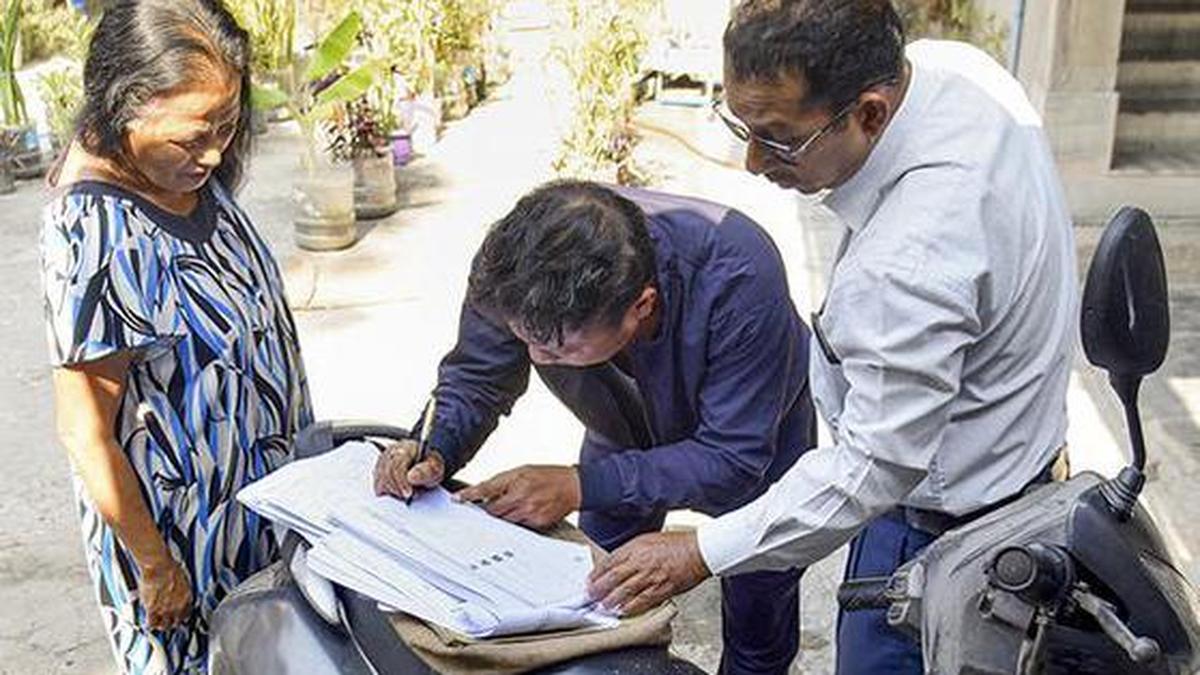
Chandoliya, son of BJP Delhi MP Yogender Chandoliya, said, “I filed all the form 7 for deletions online. If I were to submit to submit the forms to the election office, I wouldn’t be allowed more than 10.”
The Form 10 reports, which compile details of Form 7 applications for deletion, remain available on the Election Commission portal for seven days.
The EC guidelines state that BLAs of recognised political parties may file applications in bulk, subject to the condition that a BLA “shall not submit more than” 10 forms a day after publication of the draft roll. “You need to be party-appointed BLA to fill forms in bulk. For online there is no such condition. I log in like any ordinary citizen and use Aadhar authentication to fill forms. There is no section to specify that I am a BLA,” he said.
EC directions also require applications received through Forms 6 for inclusion, 7 for objection/deletion and 8 for modification to be computerised and uploaded on the Delhi CEO’s website daily, apart from the consolidated statutory reports in Forms 9, 10 and so forth. The application-level details have not been published on the Delhi CEO website nearly a month into the claims and objections period.

He said he had been involved in booth-level data management for over a decade.
All 35 objections cited “absent/permanently shifted” as the reason. Mr. Chandoliya said the people concerned either did not live at the addresses mentioned in the roll or had sold their houses. Fifteen were women who had married and moved out of the area or city. While nearly all were not found in the area during a visit by The Hindu, and locals said they had moved out, Karnail Singh stayed at the address mentioned on the roll, but Mr. Chandoliya claimed that the address itself should not fall under this booth citing the distance, for the reason for removal.

“They filled online enumeration forms and asked the BLO to verify, so the names appeared on the draft roll. Now we are getting the option to seek deletion, so we are objecting to their names because they don’t live here,” he said.
The Hindu also conducted a spot check in Patel Nagar’s Part 38, where one Raj Singh filed objections against 13 names on September 26.
The locality has multi-storey buildings in narrow lanes, with several houses sharing the same house number and a mixed religious population. Home-based factories also operate in the area.
Danish Khan and Toufiq Khan were living at the addresses mentioned in their enumeration forms and were running a home-based factory there. Their names had nevertheless been challenged on the grounds of being “absent/permanently shifted”.

“We have not filled any application for deletion, or shifting,” Mr. Khan said.
Locals said several of the other people whose names had been challenged had moved to different houses within the locality.
Arun Kumar Tanwar filed 12 objections on September 25 in Delhi Cantonment, while Sabo Devi filed 15 on September 27 in Tri Nagar.
Between the 21 and 26th of September, 1,095 Form 7 objections were filed. Data showed that around 80% were filed by individuals against their own names. In one case, 20-year-old Apoorv Dwivedy appeared to have filed an objection against his own name, citing “death”. An ERO said that while filing Form 7 offline, an objector can enter another person’s name in the objector field.

The disposal of Form 7 objections has also been faster than the disposal of Form 6 inclusion applications, despite the latter being higher in number. Between September 14 and 20, 519 Form 7 applications were disposed of, compared with 92 Form 6 applications, even though disposal of an objection requires notice, a hearing and a speaking order by the ERO.
AEROs and EROs have also filed objections against 24 names in Sadar Bazar, Malviya Nagar, Chhatarpur, Kirari and Vikaspuri. The electors were also flagged for noitces, but the reasons for the objections have not been specified in the form 7 applications, as per the stautory reports. The Hindu had reported on September 27 that over 350 voters have already been marked ‘ineligible’.
The deadline for filing claims and objections has been extended from September 30 to October 30. Since publication of the draft roll on August 31, 1.54 lakh applications for inclusion and 3,435 applications seeking deletion have been received.
Published – September 29, 2026 11:45 pm IST