

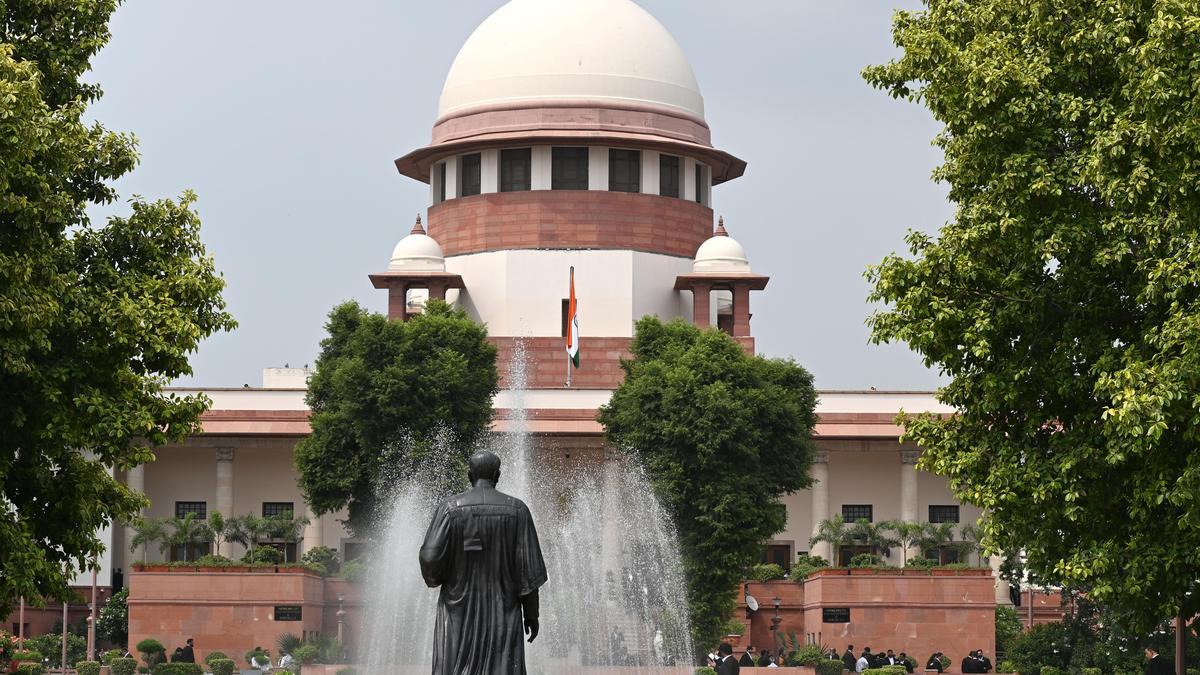


Case records show the long-pending clash over legislative privilege and speech was deemed academic after the Assembly withdrew the resolution years ago. File
| Photo Credit: Shashi Shekhar Kashyap
After a pendency of well over 20 years in the Supreme Court, a seven-judge Bench headed by Chief Justice of India (CJI) Surya Kant took less than half-an-hour on Tuesday (October 6, 2026) to dispose of as infructuous a reference related to questions linked to legislative privilege being used to choke free speech, arising out of a 2003 Tamil Nadu Assembly resolution to arrest editors of The Hindu for an editorial criticising then Chief Minister Jayalalithaa.
The Bench headed by Chief Justice of India Surya Kant found no point in going for lengthy hearings after learning from the Tamil Nadu Legislative Assembly counsel, senior advocate Raju Raachandran, that the resolution against the newspaper had been withdrawn in 2004.

The Constitution Bench said the withdrawal of the resolution escaped the notice of the Supreme Court.
On the petitioners’ suggestion, the Court left the larger and substantial questions of law open for a future occasion in an appropriate case.
Senior advocate A.M. Singhvi remarked light-heartedly that the Court had set two records, shortest hearing and the quickest one by a seven-judge Bench.
On Monday (October 5), the very eve of the Constitution Bench hearing, Mr. Ramachandran, backed by Attorney General of India R. Venkataramani and Solicitor General Tushar Mehta, had brought the fact of the withdrawal to the attention of Chief Justice of India.

Mr. Ramachandran had submitted that the fact of the withdrawal was not noticed by the Court nor recorded in its order referring the case to the seven-judge Bench a couple of months ago in August. He had said the reference would only be an academic exercise now.
Chief Justice Kant had said the Court did not want to get into a prolonged academic exercise, particularly when several other part-heard matters were pending.
The case travelled back to 2003 when The Hindu had published the editorial, prompting the Assembly Speaker at the time to pass a resolution in the House accusing the daily of having “distorted the proceedings of the Assembly, commented contrary to the events in the Assembly”.

The resolution had said the comments made in the editorial “amounts to breach of privilege of the entire House” under Article 194 of the Constitution, which guarantees freedom of speech and immunities to Members of State legislatures. The Tamil Nadu State Assembly had passed a resolution to arrest the editorial staff of The Hindu.
Shortly after the resolution, the police raided The Hindu’s Chennai office, attempting to arrest its senior editors. In November 2003, N. Ravi, the then Editor of The Hindu, approached the Supreme Court.

When the case came up for hearing, senior advocate Harish Salve, appearing for the newspaper, had argued against the invocation of Article 194(3) to choke Press freedom enshrined under Article 19(1)(a) of the Constitution. The Supreme Court had also examined the larger legal issue whether a critical speech or publication would constitute a breach of legislative privilege.
However, a Division Bench of Justices Y.K. Sabharwal and B.N. Krishna had, on December 8, 2003, referred the tussle between legislative privilege and free speech to a five-judge Constitution Bench. The Bench had noted that the petitions and intervening applications, by journalists and the Press Council of India, raised “substantial questions of law as to the interpretation of Articles 194(3), 19 and the interplay between these two Articles and Article 21 of the Constitution”.

A year later, on December 8, 2004, the five-judge Bench heard Mr. Salve’s submission that the apex Court had given contradictory opinions in a 1959 judgment in Pandit MSM Sharma versus Shri Krishna Sharma and a Presidential Reference of 1964 about the interplay between free speech and the scope of legislative privileges.
Published – October 06, 2026 02:54 pm IST