






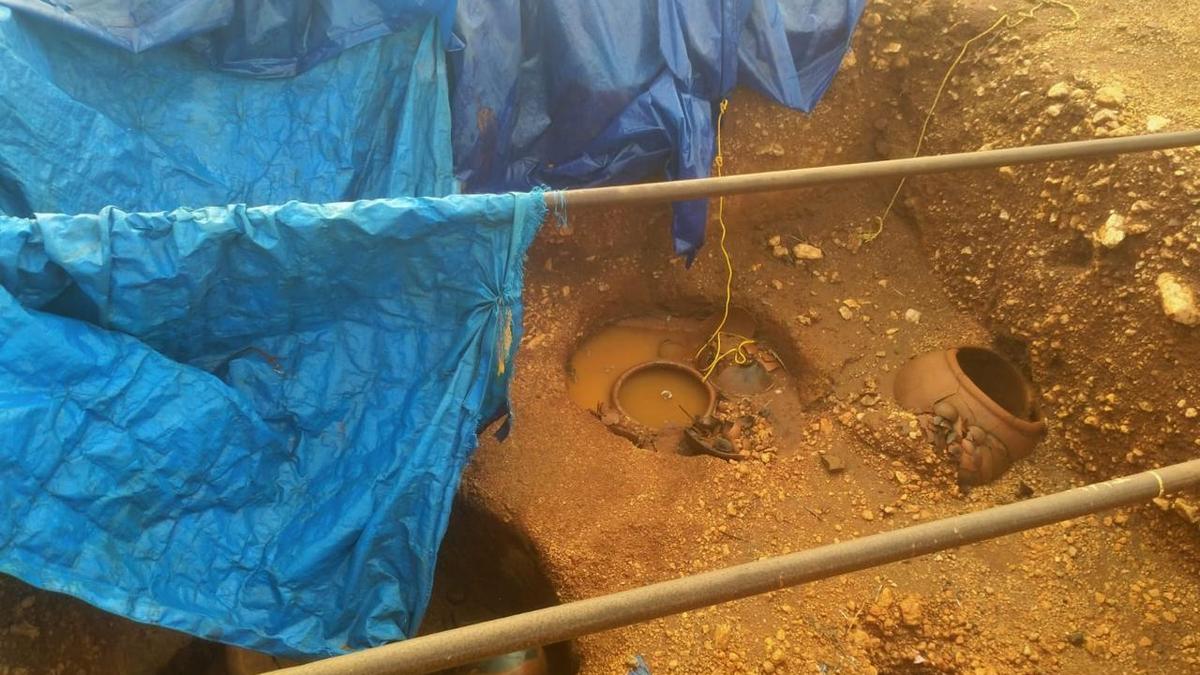


Rainwater seen in the trenches of the ASI’s ‘C’ site in Adichanallur after the recent showers.
| Photo Credit: SPECIAL ARRANGEMENT
Recent showers in the Srivaikuntam region resulted in rainwater entering excavated trenches and urns at the ‘C’ site of the Archaeological Survey of India (ASI) in Adichanallur.
Although an ASI official had said last year that measures would be taken to construct a protective shelter to cover the site, work on the project has only recently begun, with installation of iron pillars to support a roof made of galvanised sheets.
For nearly two years, archaeology enthusiasts from the region have been calling for the replacement of thatched roofs with a semi-permanent structure to protect the site, which is regarded as a ‘royal site’ owing to the numerous valuable artefacts unearthed there. The much-spoken-about golden diadem was also excavated from the ‘C’ site.
Located on a mound along the banks of the Thamirabarani, the site has repeatedly been exposed to the elements. In September 2025, The Hindu published a report stating that the damaged thatched roof structure and tarpaulins covering the ‘C’ site posed a threat to excavated trenches and urns.
At that time, an ASI official said steps had been initiated to construct an enhanced shelter to protect the site from natural calamities. However, a year has passed, and work has only recently begun.
Muthalankurichi Kamarasu, an archaeology enthusiast from the region, said no concrete measures had been taken to protect the trenches and urns at the ‘C’ site, apart from the installation of iron pillars, which commenced a few days ago.
He pointed out that the site was being regularly visited by numerous school and college students and members of the public to learn about its rich heritage and history. “After the rain, I immediately visited the site and found that water had entered into urns,” Mr. Kamarasu said, stressing that the project to protect the site should be expedited.
A senior ASI official from the Tiruchi circle told The Hindu that works for constructing the protective shelter were under way. He attributed the delay to procedural requirements, including obtaining approvals, preparing and approving estimates, and completing the tender process.
The shelter, featuring the galvanised-sheet roof, was expected to be completed within a week, making the site more visitor friendly, he added.
Published – October 10, 2026 11:24 pm IST