






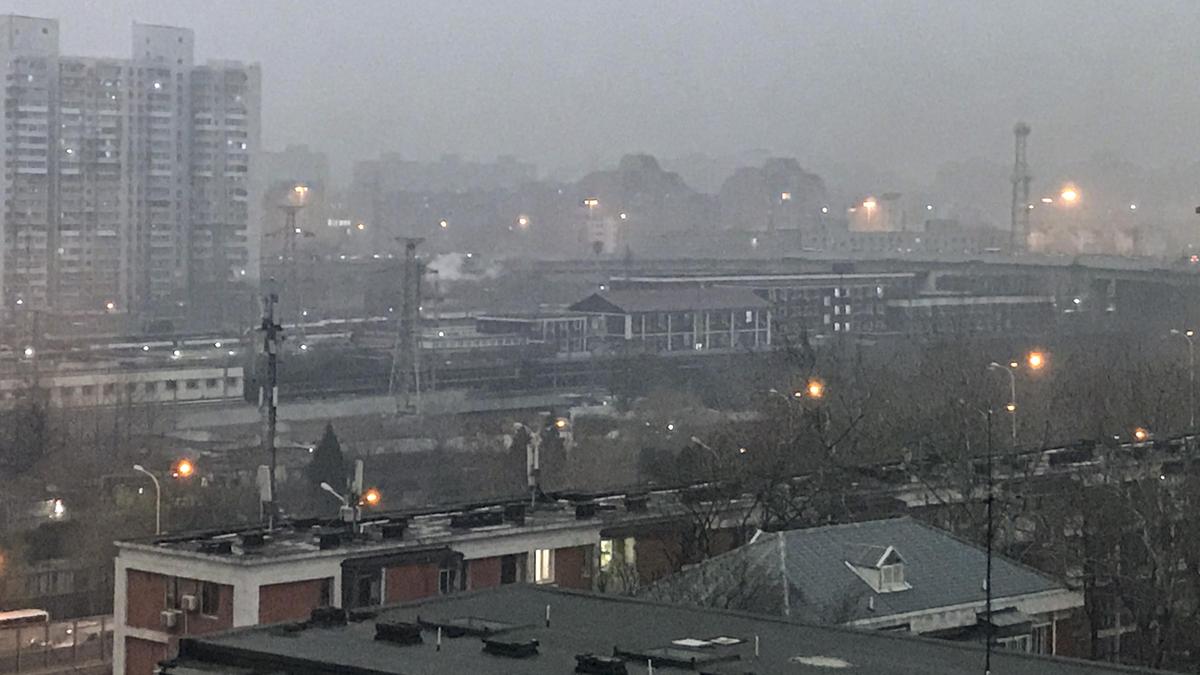

Beijing was shrouded in heavy smog on Thursday (December 18, 2025) with Air Quality Index (AQI) climbing to “very unhealthy” levels of 215, a rare spike in pollution in the Chinese capital after years of expensive cleaning up.
Also Read: Beijing’s war against air pollution | Explained
China’s national observatory on Wednesday (December 17, 2025) issued a yellow alert for heavy fog in some parts of the country, saying that thick fog is expected to shroud parts of Hebei, Beijing, Tianjin, Henan, Anhui, Jiangsu, Hubei, the Sichuan Basin and Chongqing on Thursday (December 18, 2025).
The smog with polluted air quality is rare these days in Beijing, which used to witness very heavy pollution before the government initiated a series of steps, including closure and relocation of heavy polluting industries in 2016, spending billions of dollars.
Officials say the city’s switch to natural gas or electric public heating in winters from the coal-fired ones, spending over $1 billion, has helped reduce pollution levels.

Beijing’s efforts to tackle heavy pollution were in the news in recent days in the backdrop of New Delhi witnessing a deepening pollution crisis. It sparked a debate over whether New Delhi should follow Beijing’s arduous and expensive journey to improve air quality.
The Chinese Embassy in New Delhi said in a post on X, highlighted some of the steps taken by the Chinese Government, including shutting down or removing over 3,000 heavy industries, and relocating Shougang, a major State-owned steel producer, out of the city to cut pollution levels.
Observers say the reasons for Beijing’s pollution in the past and that of New Delhi’s at present overlap in some areas but differ in terms of sources, geography, and seasonal drivers.
While historically, Beijing’s pollution was driven by coal-fired power plants, heavy industry and automobile emissions, New Delhi’s pollution is more structural and multi-sourced, with persistent emissions from agriculture — especially stubble burning — dust, transport, and informal industries.
Researchers at China’s Tsinghua University who studied the years of pollution experienced in Beijing say that stringent enforcement of industrial emissions standards significantly reduced Particulate Matter (PM) 2.5 concentrations in major Chinese cities.
Sceptics argue that such enforcement was possible under a one-party government headed by the ruling Communist Party and question whether it could be replicated in a multi-party democracy like India with judicial safeguards for industry and other stakeholders.
Before Thursday’s (December 18, 2025) smog, Beijing municipal environmental authorities reported that in the first 11 months of this year, the city’s average PM2.5 concentration dropped to 26.5 micrograms per cubic metre — a 16.7% year-on-year decrease.
During the period, the city experienced 282 days of good air quality, which was 23 days more than in the same timeframe in 2024, they said on Tuesday (December 16, 2025).
Under the “0.1 microgram initiative”, the city has promoted the broader adoption of new energy vehicles, implemented emissions reduction measures in construction projects, and supported the green transformation of businesses, among other moves, reported the State-run Xinhua news agency, quoting authorities.
During the past five years, Beijing has achieved significant improvements in its ecological environment, Chen Tian, head of the municipal ecology and environment bureau, said during a press conference held on Wednesday (December 17, 2025).
The reduction of pollution in the last four years also helped Beijing’s biodiversity, which includes 7,121 species.
The population of migratory bird Beijing swifts has exceeded 10,000, and rare birds such as red-crowned cranes and white-naped cranes, which are under first-class protection in China, have been spotted at the Miyun Reservoir, Mr. Tian said.
Published – December 18, 2025 05:03 pm IST