



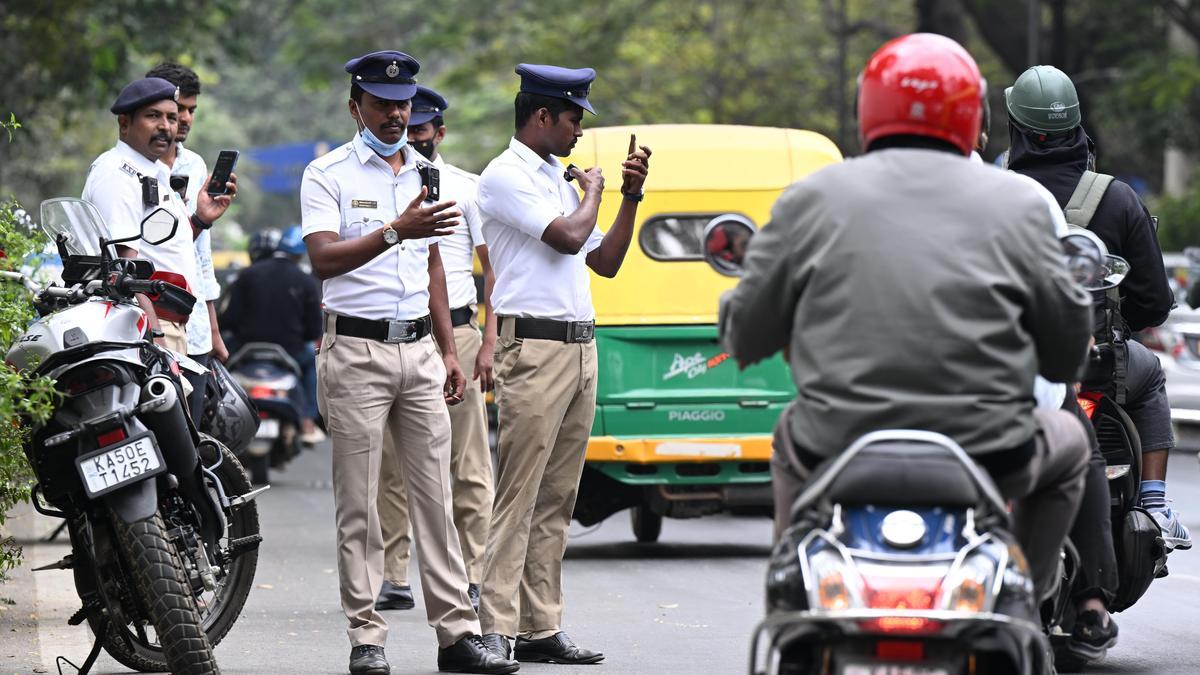


Image for the purpose of representation.
| Photo Credit: ALLEN EGENUSE J.
Seven years after the Motor Vehicles (Amendment) Act came into force, road-safety experts have called for tighter implementation of safety standards, stricter speed management, and safer infrastructure for pedestrians and other vulnerable road users.
The call comes against the backdrop of a high road-crash fatality burden. According to the publication Road Accidents in India 2024, the country recorded 4,87,707 road accidents in 2024, which claimed 1,77,175 lives and injured 4,71,441 people.
At a road-safety roundtable organised by the Road Safety Network (RSN) on Thursday (September 24, 2026), experts from IIT-Delhi, NIMHANS, Parisar and CrashFree India discussed the implementation of the amended law and identified priorities for the next phase of road-safety efforts.
Professor Geetam Tiwari of IIT-Delhi said road design needed to reflect the vulnerability of different road users, particularly on stretches where pedestrians, cyclists and two-wheelers interact closely with motorised traffic.
She identified 30 kmph as an important reference speed for such environments and highlighted measures including speed tables, rumble strips and other traffic-calming interventions, particularly near schools and areas with heavy pedestrian movement.
Mr. Ranjit Gadgil, programme director at Parisar, a civil society organisation, and a member of RSN, stressed the need to translate the recognition of the “right to walk” into safe and continuous pedestrian infrastructure.
He called for clearly demarcated pedestrian pathways and stronger implementation by state governments, development authorities and urban local bodies. The discussion also highlighted the need to improve technical capacity within municipalities and road-owning agencies so that existing road-design standards and guidelines are implemented consistently.
Mr. Shubham Kumar of CrashFree India said road safety needed to be viewed beyond individual road-user behaviour, with greater attention to road design, legislation and institutional responsibility.
He pointed to Section 198A of the Motor Vehicles Act, which deals with responsibility relating to compliance with standards for road design, construction and maintenance.
Participants stressed the need for monitoring mechanisms to ensure that statutory provisions and technical standards are implemented on the ground.
Dr. Gautham Melur Sukumar of NIMHANS focused on the post-crash response, calling for better coordination among emergency services, ambulances, hospitals and rehabilitation providers.
He highlighted the provisions relating to Good Samaritans, the Golden Hour, and accident-related treatment and compensation, and called for standardised training for emergency medical personnel, mapping of hospitals based on trauma-care capacity, stronger ambulance regulation and improved crash-data systems.
Published – September 24, 2026 05:56 pm IST