







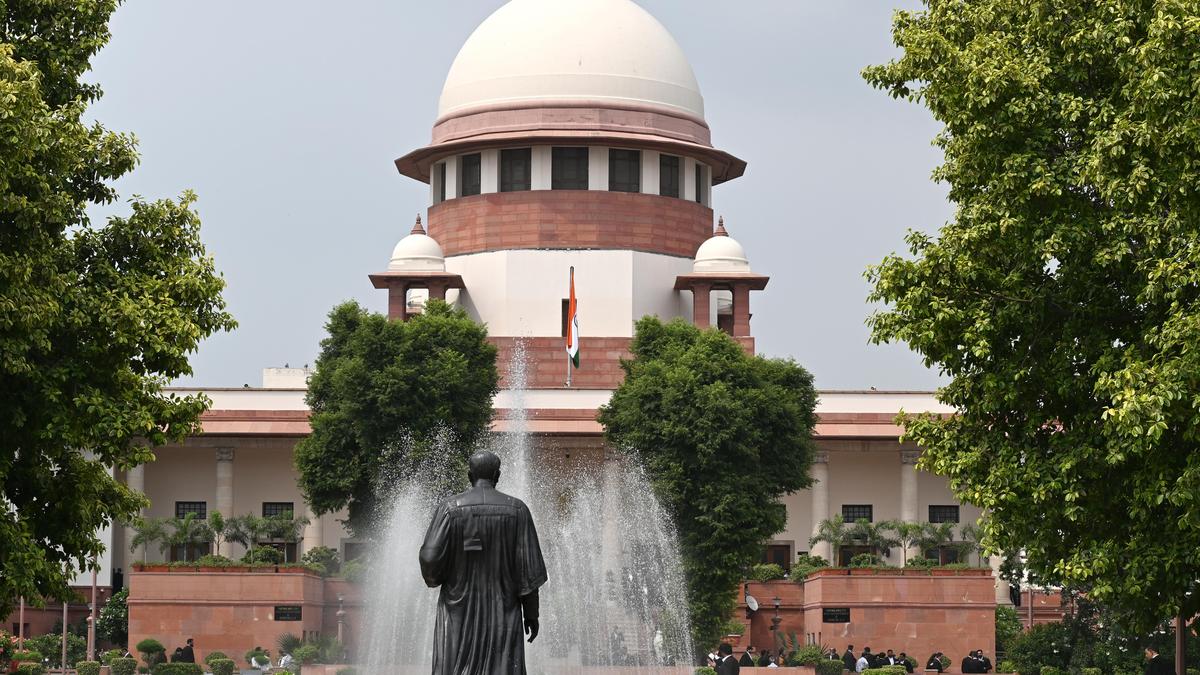


Chief Justice of India Surya Kant, heading a three-judge Bench, questioned how the BCI, a regulator of the legal profession, could be considered an expert on legal education when there were domain experts and legal academicians. File
| Photo Credit: Shashi Shekhar Kashyap
The Supreme Court on Wednesday (September 23, 2026) decided to examine the authority of the Bar Council of India (BCI) to control and regulate legal education imparted in law colleges and national universities.
Chief Justice of India Surya Kant, heading a three-judge Bench, questioned how the BCI, a regulator of the legal profession, could be considered an expert on legal education when there were domain experts and legal academicians.
The Bench said the BCI could formulate general guidelines like the duration of a law course, but had no authority to dictate the nuances of legal education.
The oral observations came while issuing notice in a writ petition filed by Girish Mittal, represented by advocates Prashant Bhushan, Cheryl D’Souza and Pranav Sachdeva, against the constitution of the Bar Council of India Trust for Promotion of Education (Legal & Professional) and Reforms in Law and For Improvement of Research and Social Training (PEARL FIRST) and the establishment of law institutions by the Trust.
Mr. Bhushan submitted the existence of a conflict of interest arising from the continuing institutional association of BCI and the State Bar Councils, with institutions operating in the field of legal education.
He questioned the BCI’s simultaneous exercise of regulatory and inspecting functions along with the establishment of the India International University of Legal Education and Research, Goa (IIULER) through the BCI-PEARL Trust.
Mr. Bhushan said 77% of the General Council of the university, which is the supreme supervisory body, were members nominated by the BCI or the BCI-PEARL Trust.
“Being the regulator having the power to lay down standards for legal education in the country as well as the power to inspect universities to ensure those standards are being met, the BCI cannot act as the owner/management of any law university as it is in complete conflict with its primary function of setting standards and conducting inspection in an unbiased manner,” the petition said.
Subsequent to setting up IIULER in Goa, the same model is proposed to be set up IIULER in Andhra Pradesh, Mr. Bhushan submitted.
The petition said the BCI’s interventions in the internal governance of educational institutions extended to several other universities across the country, including the National Law School of India University, Bengaluru, Gujarat National Law University, National Law University, Delhi, and the National Academy of Legal Studies and Research University in Hyderabad.
The plea has sought the apex court to step in and restrain the BCI from “establishing, owning, managing, governing, funding or promoting any law university, whether directly or through BCI-PEARL Trust or any entity under its aegis.”
It has also sought a direction to the BCI and the Trust to disassociate themselves from the ownership, management, governance, funding and promotion of IIULER, Goa. The petition has sought a declaration that the BCI’s establishment, governance or control of IIULER, Goa and Andhra Pradesh, or of any other University established on the same model, is illegal and impermissible in law.
Published – September 23, 2026 02:03 pm IST