







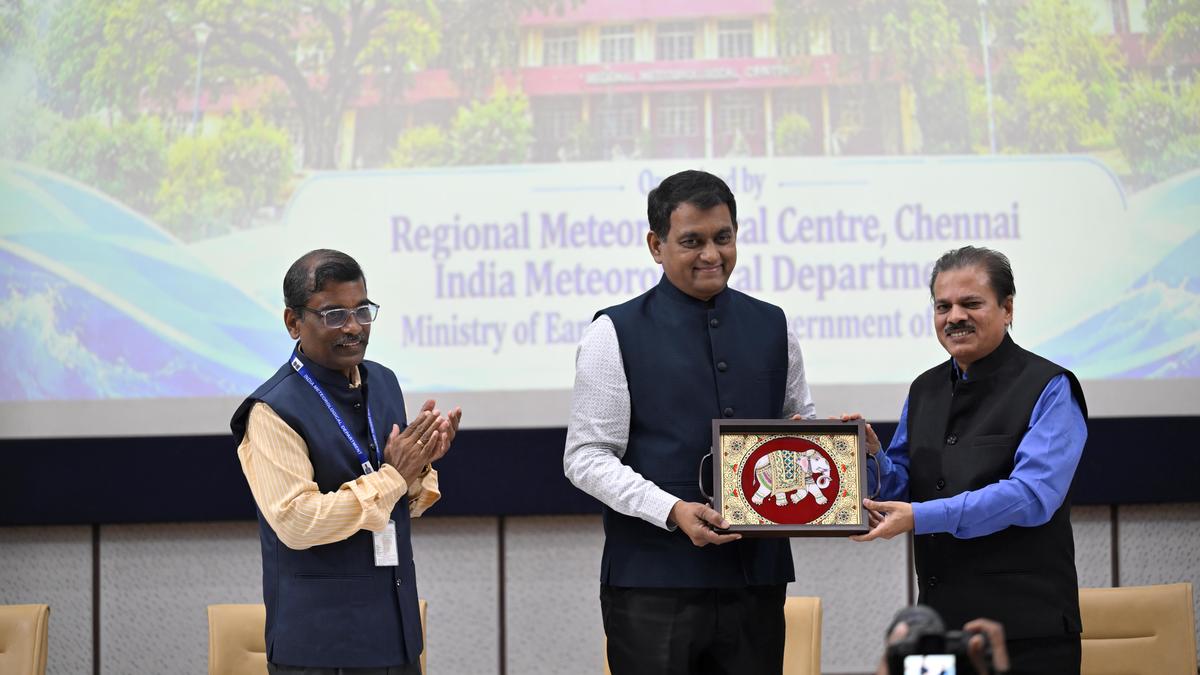


B. Chandramohan, Additional Chief Secretary and Commissioner of Revenue Administration and Disaster Management, and Mrutyunjay Mohapatra, Director General of Meteorology, IMD, during the North East Monsoon Seasonal Outlook Forum 2026 in Chennai on Thursday.
| Photo Credit: Johan Sathyadas J
The State government has proposed adding 1,000 more automatic rain gauges (ARGs) across Tamil Nadu this year.
The Tamil Nadu Disaster Risk Reduction Agency (TNDRRA) has identified about 2,000 flood vulnerable locations across the State and chalked out location specific plans for flood response during the ensuing Northeast (NE) monsoon, B. Chandramohan, Additional Chief Secretary and Commissioner of Revenue Administration and Disaster Management, said .
At the inauguration of the “Northeast Monsoon Seasonal Outlook Forum 2026” hosted jointly by India Meteorological Department (IMD) and TNDRRA for various stakeholders for the first time in the city on Thursday, he elaborated on the flood mitigation and response plans.
The granular forecast provided by IMD at village level has been useful for disaster management. This year, the State has identified 1,030 high and very high vulnerable locations and another 1,003 medium vulnerable locations where water stagnation is expected to range from 2 ft and 6 ft. Flood mitigation and response plans have been prepared for each location.
Moreover, street-level flooding forecast, that predicts three days prior, would also be done through integrated flood management centre for Chennai Metropolitan Area with data obtained about various agencies, including Water Resources Department (WRD).
While TNDRRA has a network of 1,400 ARGs and 100 automatic weather stations, it plans to add 1,000 more ARGs in the State to reach the goal of covering every village panchayat with an ARG, he said and called upon National Institute of Ocean Technology to work with TNDRRA to finetune their forecast models.
Sharing highlights about the NE monsoon forecast outlook, Mrutyunjay Mohapatra, Director General of Meteorology, IMD, said southern parts of Tamil Nadu and Kerala are likely to experience normal to above normal rainfall during the monsoon. Most areas of remaining districts may receive below normal rainfall.
In October, many areas of south T.N., some areas of north T.N., and hilly areas of Kerala may experience normal to above normal rainfall and most of the other areas are expected to get below normal rainfall. Most parts of south Peninsula, including T.N., are likely to experience above normal maximum and night temperatures during the monsoon. The prevailing El-Nino is likely to become stronger till November and lose strength later. However, El-Nino conditions would persist till March 2027. Such forums with various stakeholders would help identify gaps and bring out solutions, he said.
While D. Sivananda Pai, Deputy Director General of Meteorology, RMC, highlighted on networking through the forum would help States prepare for the monsoon and strengthen scientific collaboration, NIOT’s Director Balaji Ramakrishnan said organising such forums was crucial for disaster preparedness, particularly for densely populated cities.
O.P. Sreejith, Head, Climate Monitoring and Prediction, IMD, Pune, also spoke on monsoon forecast over south Peninsular India. Experts discussed NE monsoon outlook, impact of El-Nino on the monsoon, and the information needs of various user sectors at the forum.
Published – October 02, 2026 12:44 am IST