







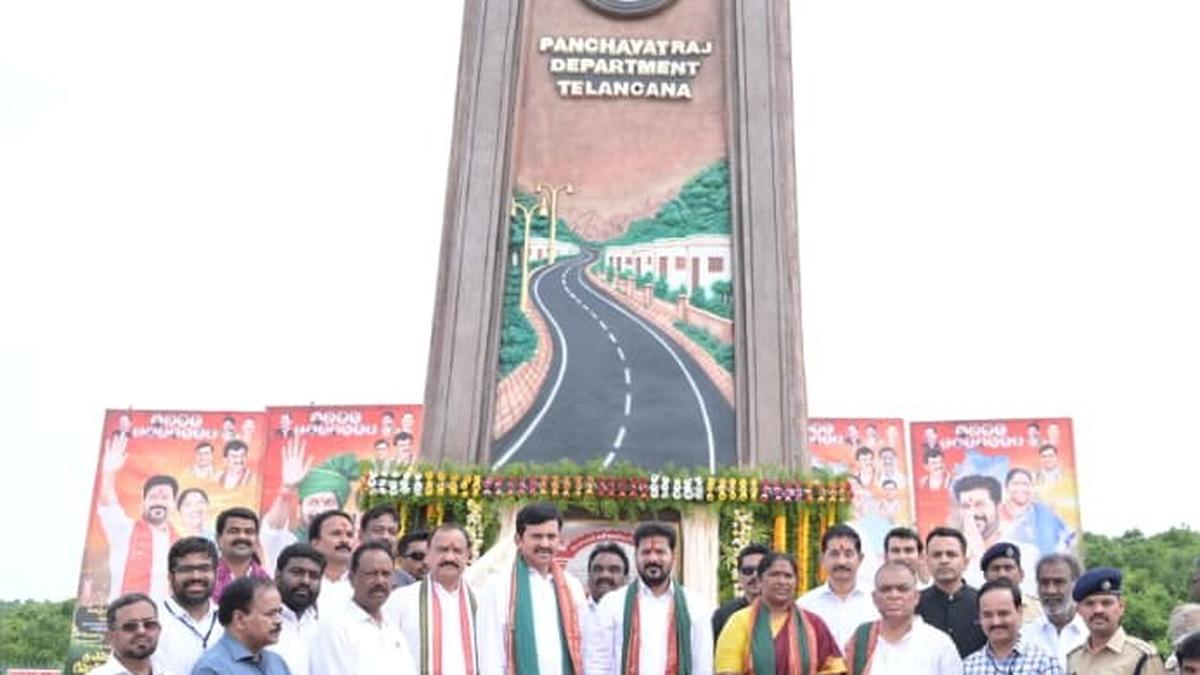


Chief Minister A. Revanth Reddy with Ministers Seethakka, Ponguleti Srinivasa Reddy, Laxman Kumar and others at the unveiling of the HAM road pylon near Gattamma Temple, Mulugu, on Sunday.
The State government has adopted the Hybrid Annuity Model (HAM) for the construction and maintenance of rural roads, with Telangana becoming the first State in the country to take up rural road development under the model, according to the Panchayat Raj Engineering Department (PRED). Chief Minister A. Revanth Reddy launched the initiative by unveiling a pylon near the Gattamma Temple in Mulugu district headquarters on Sunday.
Under Phase I of the HAM programme, 2,145 roads covering 7,448 km will be developed at an estimated cost of ₹6,294.81 crore. This includes 934 km of new BT roads to connect 176 Gram Panchayats (GP) that do not have road connectivity.
Another 5,490 km of existing BT roads will be strengthened and upgraded. A further 1,024 km of single-lane BT roads carrying heavy traffic will be widened to intermediate lane roads. The works under Phase I will benefit 3,036 Gram Panchayats. The phase covers all 96 rural Assembly constituencies in the State.
18,472 km to be developed in three phases
The government plans to develop 18,472 km of Panchayat Raj roads under HAM in three phases. The first phase will cover 7,448 km, the second 5,676 km and the third 5,348 km.
The roads have been selected based on their importance and to improve connectivity between gram panchayats and mandal and district headquarters, as well as the State capital. The programme aims to provide all-weather roads to unconnected GPs, upgrade earthen roads and strengthen the existing road network.
Under HAM, the government’s responsibility will not end with construction. The construction period is 30 months and the concessionaire will maintain the roads for 15 years. The State government will bear 40% of the construction cost, while the concessionaire will bear the remaining 60%. The State will repay the concessionaire’s share in 30 annuities over 15 years. The government has accorded administrative sanction of ₹16,007.56 crore for the programme, including maintenance costs for 15 years.
Focus on villages without road connectivity
Telangana has a Panchayat Raj road network of 69,318 km. Of this, 30,797 km, or 44.44%, comprises un-metalled roads. BT roads account for 25,916 km, or 37.38% of the network. Of the 12,760 GPs in the State, 12,426 already have road connectivity, while 334 are unconnected. The Phase I HAM works, however, are planned to be completed by March 2029.
Panchayat Raj and Rural Development Minister Danasari Anasuya Seethakka said, “Telangana is implementing the HAM system for rural road construction for the first time in the country. It is not merely about laying new roads but also about maintaining them with quality over the long term.”
Published – August 16, 2026 06:50 pm IST