






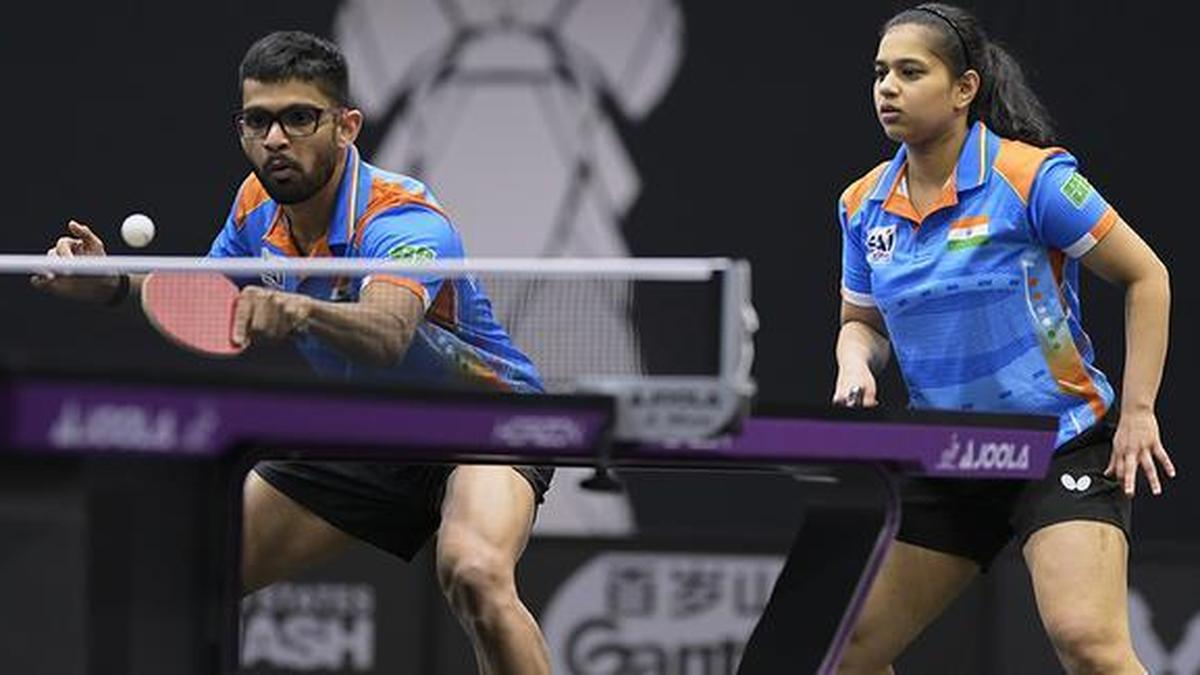

For four days in early September, Manush Shah travelled to Mumbai, the hometown of his mixed doubles partner Diya Chitale for a relatively simple job. Train.
There were no selection meetings to worry about, no administrative developments to follow, no uncertainty over who would be around the Indian table tennis team. In Mumbai, the pair could concentrate on the one thing that had brought them together in the first place — making their partnership work.
Those four days would prove valuable when they eventually arrived in Aichi-Nagoya.
The sixth-seeded Indian pair went on to win a bronze medal at the Asian Games, beating Hong Kong’s third-seeded Wong Chun Ting and Doo Hoi Kem in the quarterfinals before losing to eventual silver medallists Wong Chuqin and Sun Yingsha of China in the semifinals.
For Indian table tennis, the medal was significant. It was the fourth at the Asian Games and ensured that the sport had a podium finish at a third successive edition of the continental extravaganza.
For Manush and Diya, though, the bronze represented something more personal. It was the reward for a partnership that had steadily climbed the international ladder and, in the process, had learnt to complement two very different games.
It was also an affirmation that, amid a turbulent build-up, they had managed to keep the noise away from the table.
When Diya spoke about going into her second Asian Games, she did not need to be reminded of the difference between a regular international tournament and a multi-sport event. Her first Asian Games, in Hangzhou three years ago, had given her that perspective.
“Going into my second Asian Games, I think the first one gave me a lot of experience and exposure,” Diya told The Hindu before leaving for Japan. “Representing the country at a multi-sport event is a very different feeling. It was a great experience in 2023, and I wanted to carry that experience forward.” But there was a difference this time. The expectations were higher. Diya and Manush were no longer simply an emerging combination hoping to make an impression. They had become one of India’s principal medal contenders, their progress reflected by a place among the world’s top-eight pairs at the 2025 WTT Finals, the season-ending event reserved for the leading performers of the year.
“We have been doing really well in doubles,” Diya had said ahead of the Games. “Me and Manush have been doing really, really well for the last two or three years. When we started, our graph has gone up a lot.”
That graph eventually took them to an Asian Games podium. The bronze did not arrive out of nowhere. Over the preceding seasons, the pair had learnt the demands of international mixed doubles, where the rhythm and speed of a rally can differ considerably from men’s doubles.
Manush described the distinction in simple terms. “In men’s doubles, you expect power from the opponents. The ball really travels and you expect good quality, so you don’t have to manage the front-and-back movement as much,” he said.
“In mixed doubles, it is the opposite. The front-and-back movement becomes really important because the woman on the opposing pair may not be as powerful. They try to play quickly, so the ball can be a little slower and you have to make faster adjustments with your footwork.” That difference requires more than just technical ability. It requires trust. “In mixed doubles, Diya is the one with the control and I try to finish the point,” Manush said. “If this works out, then we are already one step ahead of the opponent. That is what the goal is all about in doubles.” The quarterfinal against Hong Kong was evidence of that equation working when it mattered.
India’s table tennis contingent had not arrived at Aichi-Nagoya without precedent. In 2018, the men’s team won a historic bronze and Sharath Kamal and Manika Batra added another bronze in mixed doubles. In Hangzhou, Ayhika Mukherjee and Sutirtha Mukherjee produced a surprise run to the women’s doubles bronze. Manush and Diya’s medal therefore extended the sequence of Indian table tennis appearing on the Asian Games podium. Yet it carried a different weight.

Unlike the Hangzhou women’s doubles bronze, which came as a surprise, this was a medal India had begun to expect from the pair. Their qualification for the WTT Finals in 2025 had placed them among the world’s leading combinations, while their performances over the preceding couple of seasons had made them a credible medal proposition.
“Since two or three years, we have been doing really well,” Diya had said. “We understand each other’s game better now. We know each other’s strengths and weaknesses.”
That understanding had been tested against the world’s best. “We have played a lot of top pairs over the years,” she said. “We have beaten a top Japanese pair and qualified for the WTT Finals, where the top eight pairs in the world play. All these experiences put together have helped us reach where we are today.”
The Asian Games simply provided the biggest stage yet on which that accumulated experience had to translate into a result. And it did. The achievement becomes more significant when the build-up to the Asian Games is considered. Indian table tennis spent much of the preceding months dealing with issues away from the playing arena.
The selection controversy surrounding Manika Batra had cast a shadow over the process after she was left out of the Asian Games squad for failing to meet the prescribed selection criteria. The episode led to questions about the transparency of the selection system and public exchanges between the paddler and the federation.
Then, in August, the Sports Ministry suspended the recognition of the Table Tennis Federation of India as the National Sports Federation for table tennis, citing a series of administrative and governance issues. The turmoil had consequences beyond the boardroom.
Massimo Costantini’s tenure as India’s foreign expert had expired on May 15, and the uncertainty surrounding the federation meant his continuation with the national set-up was delayed. The Italian eventually joined the Indian contingent in Japan only a week before the Asian Games. Against that backdrop, Manush and Diya had little choice but to concentrate on what they could control.
Rising expectations
There was no luxury of an extended camp dedicated exclusively to the mixed doubles combination. The international calendar rarely allows it. But the partnership had already developed enough understanding to make those sessions count.
Diya was aware before the Games that expectations would follow them. The pair’s rise had ensured that. “Pressure is always going to be there,” she had said. “There will always be some expectations and some pressure. But what is important is that we gave our best and are happy with the way it progressed.” That attitude became particularly relevant in the quarterfinal. A defeat would have meant another near-miss for Indian table tennis. A victory would guarantee at least a bronze. Manush and Diya delivered. The win over Wong and Doo, seeded third, confirmed the medal and effectively transformed their status from contenders to medallists. The bronze was secure.
While Manush has come a long way since starting to train under Shailesh Gosain’s watchful eyes in Vadodara, Diya has been coached by Sachin Shetty ever since she took up the sport more than a decade and a half ago. Since their junior days, Olympic Gold Quest has been supporting the duo’s journey towards excellence in the international circuit. Government support has also reduced some of the financial pressure on athletes and their families. “With so many government schemes, the Government helps a lot with the TOPS scheme,” Diya said. “Of course, that also relieves the financial pressure on the parents.” That support becomes especially relevant when an athlete is required to travel extensively, train continuously and compete against the world’s best.
By the time Diya and Manush stepped onto the Asian Games arena, they were carrying the work of that entire ecosystem with them. More than just a bronze. The significance of the medal extends beyond the result of one quarterfinal and one semifinal.
It means India has now won table tennis medals at three consecutive Asian Games. It means the country has a established mixed doubles combination capable of competing with the best in Asia. And it confirms that Manush and Diya’s journey from promising partnership to world-class combination has been real. Their qualification for the 2025 WTT Finals had already indicated where they belonged. The Asian Games provided a different kind of test — one where the draw, the occasion and the weight of expectations all mattered.
They responded by beating the third seeds and securing India’s only table tennis medal at the Games. The loss to the Chinese pair in the semifinal did not diminish what had been achieved. If anything, it reinforced the progression.
Three years earlier, Diya had entered her first Asian Games looking for experience and exposure while Manush had endured the disappointment of being one point away from a medal in men’s doubles. This time they went for a medal.
“We went into the Asian Games aiming for a medal,” Diya said. “And we are thrilled that we have achieved the objective and have brought that medal home”.