



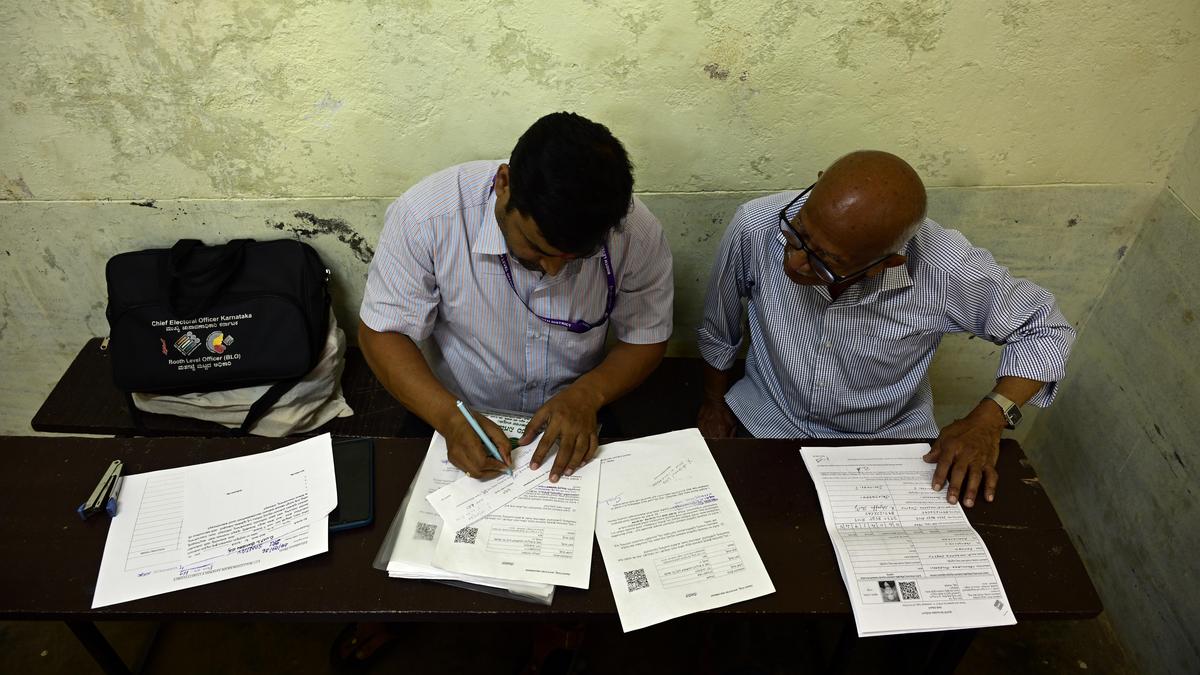


Officials verifying details during the public hearing as part of Special Intensive Revision at Malleshwaram in Bengaluru on September 24, 2026.
| Photo Credit: Sudhakara Jain
Rajiv Chopra (name changed), a resident of Vaishali Colony in North West Delhi’s Pitampura, was making last-minute preparations for a trip abroad when a neighbour called to inform him that his children were on the Election Commission’s logical discrepancy list that was being circulated in his society.
During a quick call to the Booth Level Officer (BLO), he learnt that his children had been flagged despite being in the draft list as the age gap between them was not more than nine months. Well, it cannot be since his 30-year-old children are twins.
The mandatory nine-month age gap between siblings is one of the many categories of logical discrepancies that the Indian electors have to navigate to get into the voter lists during the latest and third Special Intensive Revision (SIR) exercise. Up to 11 distinct categories of logical discrepancies have been identified and applied across various States and Union Territories (such as Karnataka, Haryana, Delhi, Telangana and others), expanding from the original four categories initially used when the concept was introduced during West Bengal’s SIR exercise.
Among the categories are an age gap of less than 15 years between a voter and their parent; age gap of less than 40 years between a voter and their grandparent; more than six siblings linked with a single parent; discrepancies or spelling variations in a parent’s name between the current electoral roll and the previous revision; changes in relative mapping between revisions (e.g., father in previous rolls vs. mother in current rolls); marital mapping mismatch (e.g., female voter linked to her father in the previous roll but mapped to her husband in the current roll without cross-referencing); and age progression discrepancy (implausible age leaps or mathematical discrepancies between different revision cycles).
The discrepancies are flagged under a centralised AI system through the ERONet, or the Electoral Roll Officers’ Network. The software attempts “progeny-mapping” — linking a voter to their parents’ entries on the base roll and the resultant inconsistencies are flagged.
The logical discrepancy category first surfaced during the SIR in West Bengal when approximately 1.36 crore voters received notices. In Delhi, where SIR is being done currently, 19.33 lakh electors have received discrepancy notices while 20.35 lakh have received the notices in Karnataka.
The problem in this is that “logical discrepancies” has never been clearly defined in any official communication — neither in the Election Commission’s notice in May 2026 nor in the original SIR order from June 2025. Thus, the actual parameters or methodology used to assign someone to this category were not publicly documented.
Another problem is with the ERONet software itself, which two Election Commissioners have flagged for having become increasingly centralised. They have said that Electoral Registration Officers have complained that they were unable to access the platform from their end in many cases.
One month before the completion of the SIR in West Bengal, the EC in January 2026 launched the ECINET, and ERONet was incorporated under this wider umbrella along with 40 other applications and portals used for election-related work. The poll body had said that this was aimed at making the process more efficient.
Former Trinamool Congress MP and Right to Information Act activist Saket Gokhale alleged that the EC was “hiding” the details of the software used for SIR, claiming it was a “trade secret”.
In a post on X, he shared RTI applications where he had asked the EC about details of the software, who designed it, and who was given the tender.
“Shockingly, the EC has refused to disclose the details claiming it would affect ‘commercial confidence’”, he said.
“The software consists of an opaque algorithm which has been used to delete voters through a centralised system in Delhi (bypassing EROs). A software used by a public authority is being kept secret for commercial interests,” he said.
Published – September 24, 2026 10:21 pm IST