




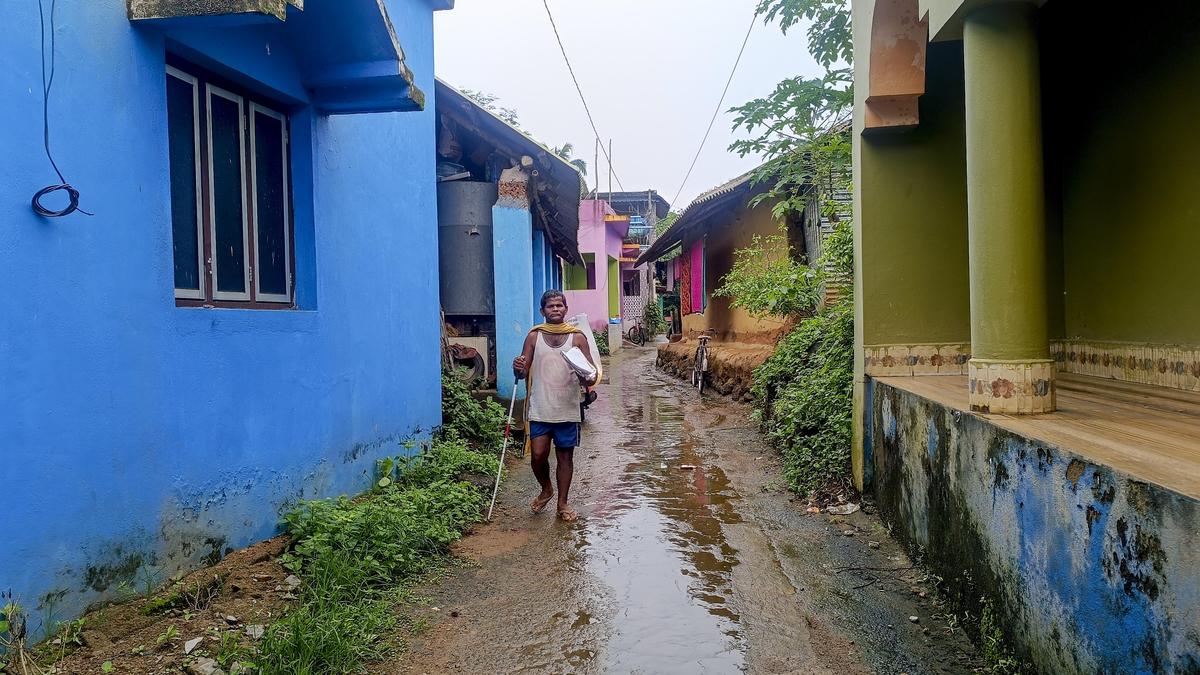

For 35 years, Balunkeswar Paikray has travelled hundreds of kilometres, knocked on the doors of every authority he could think of. He even reachedout to the Prime Minister of India, and, touched the feet of local government officials in the hope that someone would listen. The 55-year-old visually impaired man in Odisha’s Khordha district, says, “I am not asking for charity. I am fighting for a rightful share in my ancestral property.”
Paikray says his share among the three siblings would amount to 40,000 square feet of paternal property in Khordha’s Kadab village. “Now, I live in less than 300 square feet,” he says, of his room, bathroom, and backyard.

Paikray’s long struggle has given him a painful insight into how the world treats those who cannot see, walk, or behave in what is considered regular. His battle has revealed how a disability, whether present from birth or caused by an accident, can deepen a person’s vulnerability, strip away social standing and, in the maze of bureaucracy and family disputes, reduce an individual to almost a non-entity.
In August this year the Odisha government formulated a comprehensive set of guidelines to safeguard the property and inheritance rights of Persons with Disabilities (PwDs) under the Rights of Persons with Disabilities (RPwD) Act, 2016. Paikray and lakhs of others saw hope.
The move has also been welcomed by those working in the disability sector, who see it as a significant step towards protecting PwDs from discrimination in matters of property, including ancestral, inherited, and self-acquired.
The three-page guidelines suggested that the Revenue and Disaster Management Department examine the feasibility of issuing comprehensive guidelines and instructions to all revenue authorities to safeguard the land and property rights of PwDs.

One of the key proposals is to maintain a register of complaints relating to the property rights of PwDs at the tehsil and Sub-Collector levels, with periodic monitoring by the District Collector. Activists pointed out that while revenue laws provide safeguards for Scheduled Caste and Scheduled Tribe communities — including prior permission for transfer of their land or property to persons from the general category—PwDs remain more vulnerable and require similar protection.
Safeguarding the differently-abled
In August this year, the Odisha government’s Suresh Kumar Vashishth wrote to Arabinda Kumar Padhee to issue comprehensive guidelines that would protect all PwDs’ rights over inherited and self-acquired property. Vashishth is principal secretary to the Department of Social Security and Empowerment of Persons with Disabilities (SSEPD); Padhee is additional chief secretary, Revenue and Disaster Management Department, under which property is registered.

The guidelines were formulated based on the RPwD Act, particularly Sections 12, 13, 84, and 85. These cast an obligation upon the government to ensure protection of the rights, property, legal capacity, and the interests of PwDs and to prevent all forms of abuse, violence, exploitation, and discrimination.
“Persons with disabilities are often subjected to unlawful deprivation of their paternal, ancestral and self-acquired properties due to their physical, sensory, intellectual or psychosocial disabilities,” Vashishth wrote. He also observed that numerous instances had come to the department’s notice where vulnerable PwDs were “coerced, deceived or unduly influenced into transferring their immovable properties, are unlawfully deprived of their legitimate inheritance, or their lands are wrongfully occupied, cultivated or alienated by others”. This resulted in economic exploitation and violation of constitutional and legal rights.

He suggested including the establishment of a regulatory mechanism for protection of paternal, ancestral, inherited, and self-acquired immovable properties of PwDs.
Vashishth called for directions to all revenue officers to ensure that PwDs and their lawful heirs are not deprived of their legitimate share in ancestral property through fraud or coercion.
The State Commission for Persons with Disabilities, along with district- and block-level officers, provides a forum for PwDs to seek redressal of their grievances.
Vashishth suggested immediate and expeditious inquiry upon receipt of complaints relating to illegal occupation, encroachment, cultivation, mutation, or alienation of lands belonging to PwDs and strict monitoring of these properties.

The principal secretary suggested capacity building and sensitisation of revenue officers regarding the rights of persons with disabilities under the RPwD Act, and the need for adopting disability-sensitive procedures.
Bratati Harichandan, State Commissioner for Persons with Disabilities, says this is an inter-departmental effort. “We have requested the Panchayati Raj Department to sensitise officials at the grassroots level so that persons with disabilities are accommodated under government housing schemes and are assured of a roof over their heads, particularly when they are forced out of their own homes,” Harichandan says.
The struggle
Milan Kumar Das, 45, his brother Chandan, and sister Mamata, from Bhadrak district, all of whom have 100% locomotor disabilities, are easy targets for those determined to usurp legally inherited property.

Confined to a cramped 100-square-foot room, the siblings and their 80-year-old mother depend on each other for survival. Together, they receive about ₹14,000 a month in disability and other pensions, while subsidised rice keeps hunger at bay. What weighs on them most is not poverty, but the loss of property that they say should have been theirs.
“Our father was an employee of Indian Oil Corporation. He had purchased land and built a house here [in Nadigaon village in Bhadrak district]. After his death, we were driven out by other members of the joint family. Only after a police intervention, were we given a tiny room as shelter,” Milan says.

Milan Kumar Das, 45, his brother Chandan, and sister Mamata, from Bhadrak district, all of whom have 100% locomotor disabilities, are easy targets for those determined to usurp legally inherited property.
| Photo Credit:
Biswaranjan Rout
For nearly 10 years, Milan says he and his siblings have appealed to the Bhadrak district administration and police, seeking justice. “Had we not been physically challenged, no one could have mustered the courage to deprive us of our parental property,” he says.
In Jajpur district, Prakash Mohapatra, 48, who is visually impaired, worries about his future. “Now I live with my mother and brother in the village,” he says, fearing the situation will change with time. “My repeated applications for a house under the Prime Minister Awas Yojana (PMAY) havenot led anywhere, and the application is stuck in some government office,” Mohapatra says.
He had petitioned the Delhi-based Chief Commissioner for Persons with Disabilities, in a letter, to include all persons with physical disabilities in welfare schemes. “I could not follow up the case for its logical conclusion,” says Mohapatra.
The State Commission for Persons with Disabilities (SCPD) is flooded with requests to facilitate houses under the PMAY to PwDs. Following the Commission’s intervention, 19,000 PMAY houses were sanctioned in Odisha for PwDs in 2024-25, according to the State Commission for Persons with Disabilities.
Manjulata Panda, 49, Odisha’s first visually impaired woman to earn a PhD and now a lecturer in a college in Sambalpur district, is fighting to get the family property registered in her and her brother’s names. He too is visually impaired and is a teacher in a government primary school.
“Since both of us have good jobs, we don’t struggle for food or survival. But our ancestral properties are entangled in a procedural mess, we are not able to record it in our name,” Panda says. In Panda’s case, no one else has claimed the land, but she says there are “procedural hurdles” that the government must help with.
Larger concerns
The Odisha government’s move came after Dr. Arabinda Mohanty, a paediatrician by profession and an activist on disability for more than three decades, highlighted the plight of people with physical and intellectual disabilities. In 2025, he wrote to the State Commission for Persons with Disabilities (SCPD) to take up the issue with the government, insisting on the need for such guidelines.
“I have come across numerous cases of discrimination against intellectually challenged and physically challenged persons. Invariably, they don’t get the rightful share of their ancestral property,” says Mohanty. He adds that parents of children with intellectual disabilities worry about their children’s lives after their time.
Harichandan concurs: “Discrimination often begins at home. When parental property is divided, sons and daughters with no physical or intellectual disabilities often get the best rooms and enjoy the finest facilities created by their parents. Children with disabilities, on the other hand, are frequently pushed into a corner — an annexe or a poorly maintained portion of the house. In fact, children with disabilities are the ones who deserve the best part of their parents’ homes.”
For PwDs, life is often marked by layers of uncertainty, emotional trauma, and betrayal. A child born with a disability is sometimes disowned by parents. The issue of property transfer comes later. The child is often treated as a burden that no one wants to shoulder.

“Discrimination often begins at home. When parental property is divided, sons and daughters with no physical or intellectual disabilities often get the best rooms and enjoy the finest facilities created by their parents. Children with disabilities, on the other hand, are frequently pushed into a corner — an annexe or a poorly maintained portion of the house. In fact, children with disabilities are the ones who deserve the best part of their parents’ homes”Bratati Harichandan,State Commissioner for Persons with Disabilities
The Odisha government has established MANODAYA, a residential facility in Bhubaneswarthat provides psychological and neuropsychological assessments, evidence-based psychotherapy, cognitive rehabilitation, and support across the lifespan of those living with disability.
Children with disabilities are often brought to the centre by their mothers, many of whom receive little moral or financial support from their spouses. These mothers carry the additional responsibility of caring for their children with intellectual disabilities, while also dealing with their own emotional and personal challenges.
Redressal of grievances
The RPwD Act provides for the establishment of special courts in every district to deal with offences against PwDs. “If the police themselves are unaware of the provisions of the RPwD Act, 2016, how will they register cases under its relevant provisions? And how will such cases eventually reach the special courts?” Harichandan says.
The Supreme Court in 2025 revised its case-listing priorities, placing cases involving PwDs seventh in the order of priority.
Shruti Mohapatra, 63,a disability rights activist who is herself is a person with orthopaedic disability, says those with intellectual disabilities are among the most vulnerable when it comes to the transfer and protection of property rights. “To some extent, those with visual, hearing, and orthopaedic disabilities can raise their voices against discrimination or injustice. But persons with intellectual disabilities are largely dependent on their parents or trusted legal guardians,” she says.
Mohapatra also points to the lack of disability-friendly facilities in the justice system. The absence of interpreters and accessible court proceedings, including documents in Braille for persons with visual disabilities, further compounds their helplessness, she says.
“While society often ignores and disowns persons with intellectual disabilities, the government has also failed to ensure adequate employment opportunities for them. What use is immovable property if it does not provide a person with an income and help improve their quality of life?” asks Kartik Chandra Pandab, secretary of Rourkela-based voluntary organisation Shradha Foundation, which works in the disability sector.
Firoz Alam, a gold medallist at the Paralympics and Special Olympics, also rues what he describes as the government’s neglect of PwDs. Working at a tea stall in Rourkela for a monthly wage of ₹5,000, Firoz says that, alongside safeguarding their property rights, the government must take concrete steps to protect the livelihoods and lives of PwDs by ensuring that they receive their rightful share of employment opportunities.
Meanwhile, Paikray hopes the government’s guidelines will finally help him claim his share of property before he dies.