






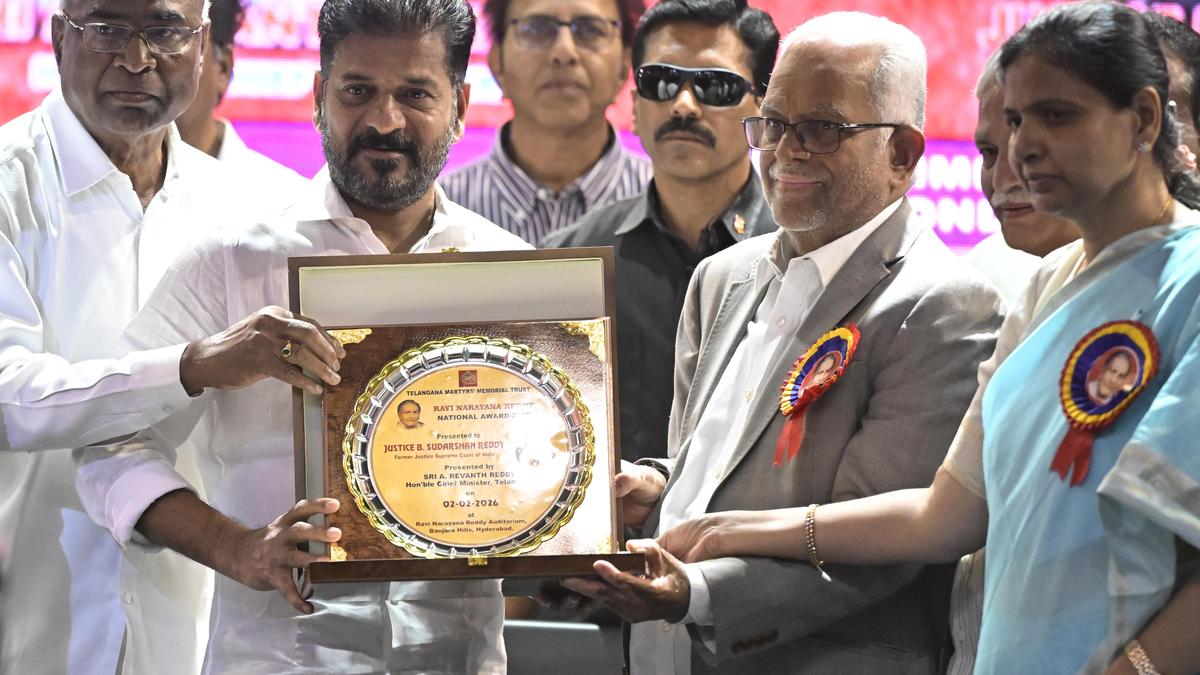

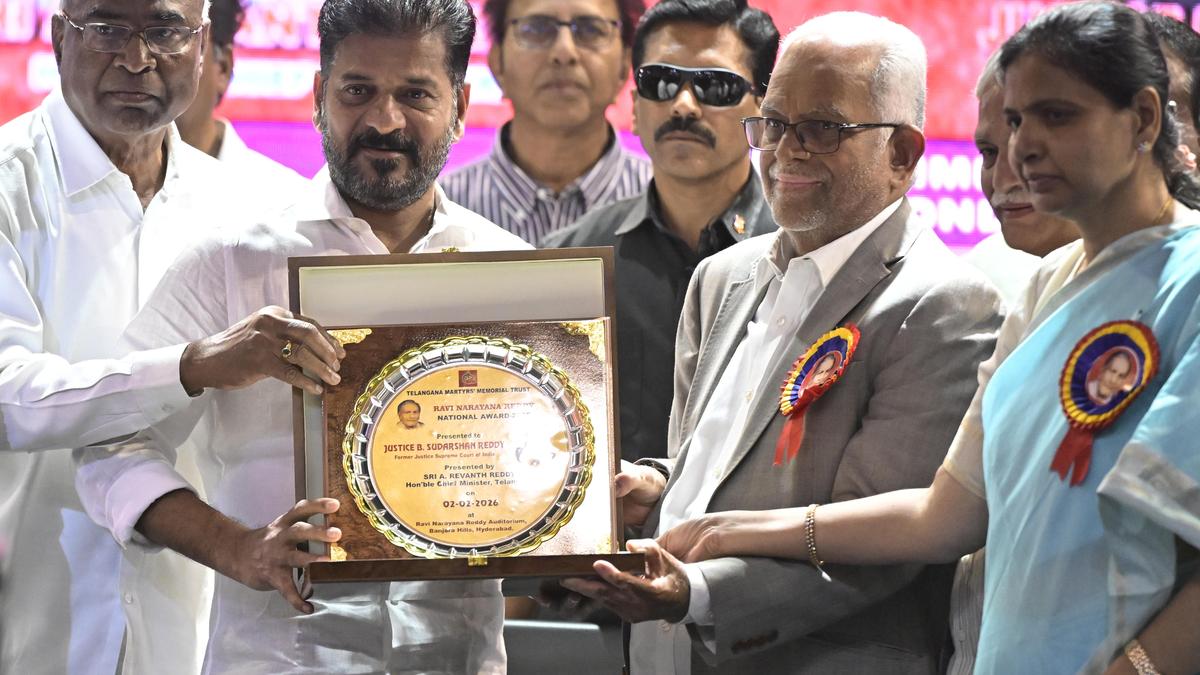
Telangana Chief Minister A. Revanth Reddy presenting the Raavi Narayana Reddy National Award 2025 to former Supreme Court Justice B. Sudharshan Reddy at Raavi Narayana Reddy Auditorium in Hyderabad on Monday (February 2, 2026).
| Photo Credit: SIDDHANT THAKUR
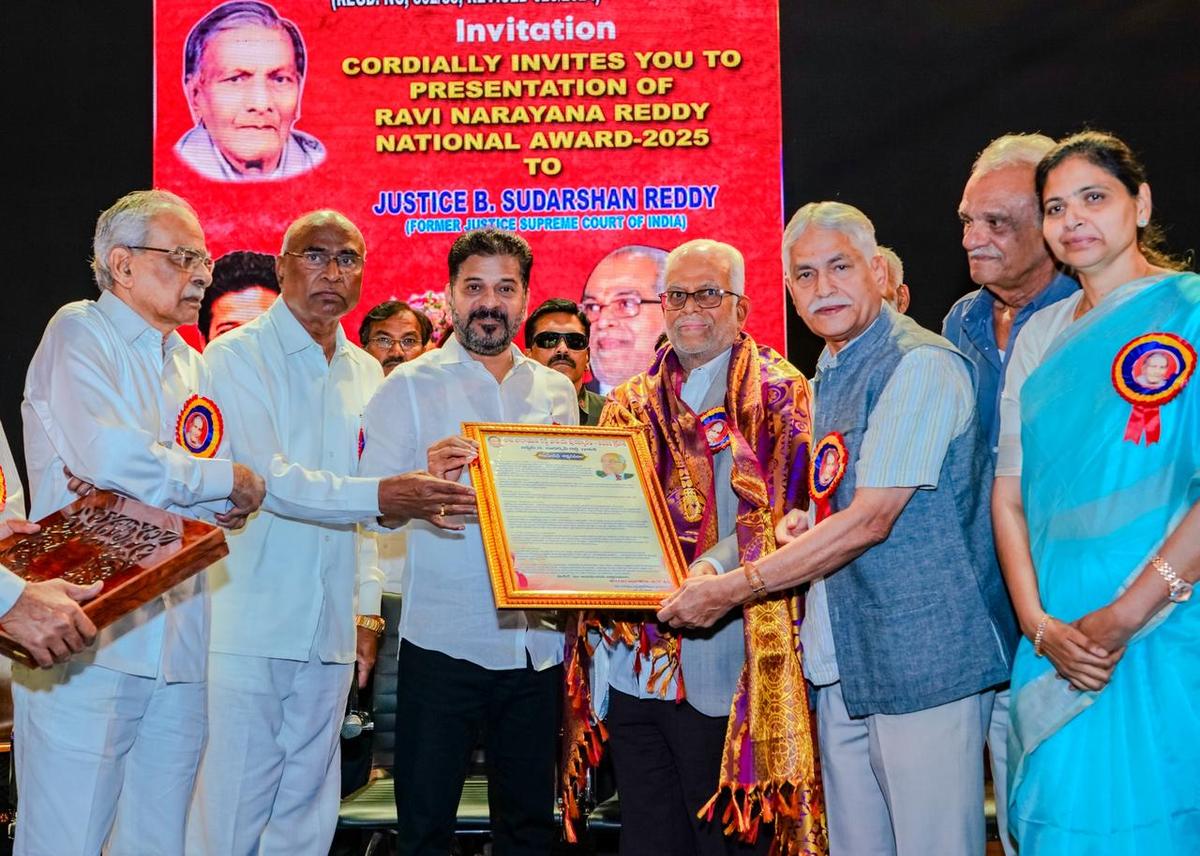
Chief Minister A Revanth Reddy presents the veteran Communist leader Raavi Narayana Reddy national award to Justice (retd) B. Sudharshan Reddy on February 2, 2026.
In a strong counter to those raising objections against notices served on former Chief Minister and Bharat Rashtra Samithi (BRS) president K. Chandrasekhar Rao, Chief Minister A. Revanth Reddy asserted that those indulging in wrongdoings are bound to face inquiries in line with the law.
The Chief Minister took a dig at the BRS leaders for calling Mr. Chandrasekhar Rao as “Telangana’s fatherly figure” and questioning the rationale behind serving notices on him. “Father of the nation Mahatma Gandhi sacrificed his life for the country. What is the contribution of this self acclaimed ‘fatherly figure’?” he asked.
The Chief Minister was speaking after presenting the veteran Communist leader Raavi Narayana Reddy national award to Justice (retd) B. Sudharshan Reddy here on Monday (February 02). He recalled how Telangana ideologue and professor M. Kodandaram was arrested after police gatecrashed into his house during the BRS regime. “Was Mr. Kodandaram not instrumental in bringing together the agitators for separate State? Why did not the then Government remember his contribution to the statehood movement?” he asked.
In sharp contrast, the special investigation team served notices on him (Mr. Chandrasekhar Rao) to attend questioning and did not barge into his house. “Leaders like Raavi Narayana Reddy sacrificed everything for the sake of Telangana. How can people who enjoyed posts and amassed huge wealth call themselves as agitators for Telangana’s cause?”
Mr. Revanth Reddy said the BRS leaders ought to have accepted the people’s verdict when they were defeated at the hustings. “But they are faulting the people for the results. What kind of democracy is this?” he said, recalling that Dr. B.R. Ambedkar had asserted that people indulging in wrongdoings should face inquiries. Senior leaders like Shibu Soren too faced inquires and probe into wrongdoings was inevitable in a democracy.
Justice Sudershan Reddy described Raavi Narayan Reddy as a ‘yugapurusha’, a man of his times and beyond, whose life continues to inspire Telangana’s social and political consciousness.
He said the legendary leader sacrificed both life and property for the principles he believed in, placing public cause above personal interest. His seminal documentary work, ‘Telangana Nagnasatyam’, is regarded as a profound and courageous exposition of the region’s historical and social realities.
Justice Reddy said the questions raised in the document are not merely political arguments but are of such depth and relevance that they critically examine the responsibilities of leadership during the historic Telangana Peasants’ Armed Struggle for liberation, offering insights that remain relevant in the present socio-political context.
He said one of the most debated aspects of Raavi Narayan Reddy’s position was his argument that the movement should have been halted when Indian forces entered Hyderabad, at a time when large sections of the population welcomed the Army. This stance reflected his independent thinking and commitment to principles.
Despite donating nearly 500 acres of his land, Raavi Narayan Reddy was accused by the then leadership of Andhra Pradesh of carrying a zamindar mindset for airing his views. The ‘Telangana Nagnasatyam’ document offers a clear definition of the then feudal system, explains what Telangana truly represents, and explores the very soul of the region, its people, struggles, and aspirations, and it merits a serious research in the Universities.
Justice Sudharshan Reddy said though Raavi Narayan Reddy was a Marxist, he was deeply influenced by Jawaharlal Nehru’s letters, the socialist ideology of Jayaprakash Narayan, and Mahatma Gandhi’s moral and ethical framework. This rare synthesis of ideologies made him distinct in India’s political and revolutionary landscape.
Rejecting the politics of mere performance, Raavi Narayan Reddy firmly believed in the substance of programmes and policies, he said adding that leaders who rely only on dramatic gestures and symbolic politics, without meaningful action, are ultimately bound to fail.
Published – February 02, 2026 09:13 pm IST