







One of the hallmarks of a champion outfit is the propensity to eke out match-turning performances from different quarters and not depend on just one or two individuals to carry the day. India are nothing if not a champion outfit, their 20-over June misadventures in Ireland and England notwithstanding. There is a reason why they have won the last two T20 World Cups, there is a reason why they have been able to tide over potentially crippling loss of personnel through injuries and still put out formidable, fighting fit units.
India have numerous fallback options for almost every position when it comes to the T20 format, specifically. Especially from a batting standpoint, there is so much depth and quality and choices that it is inevitable that many who might have walked into any other side are not even on the fringes of consideration for selection. Why, India didn’t think twice before giving Suryakumar Yadav the heave-ho immediately after the Mumbaikar masterminded a successful defence of the World Cup, and that too on home soil – neither feat accomplished previously. His middling to ordinary form overshadowed his leadership and man-management chops as preparations for the next World Cup began immediately after the trophy was lifted in Ahmedabad in March.
For the longest time, Suryakumar was ranked the No. 1 T20I batter globally and even though his form slumped dramatically in his last 15 months in charge, he still has plenty of cricket left in him. Yet, to sever ties ruthlessly pointed to prudence over sentiment, never mind if it wasn’t a popular call or, to many, even an immediately warranted one.
While there are deserving and excellent alternatives for most roles within the Indian cricketing landscape, the one most coveted for obvious reasons is a fast-bowling all-rounder. So many countries take that spot for granted, almost. Even today, Australia have Mitchell Marsh (who doesn’t bowl so much these days) and Marcus Stoinis, not to mention Cameron Green and Beau Webster. England have a long list, as do South Africa who, since their return from isolation, have thrown up numerous such luminaries. West Indies too can dip into that giving bag while New Zealand have a generous assortment to select from.
India, though, haven’t always been blessed with an overflowing cup when it comes to this specific requirement. There have been all-rounders of various degrees of proficiency in the post-Kapil Dev era, with Irfan Pathan perhaps being the most successful of the lot. It was a given that Kapil was irreplaceable; the Haryana Hurricane was a generational genius and any quest to unearth a like-for-like substitute was always going to be an exercise in futility. As India meandered from one alternative to another, they stumbled upon Hardik Pandya, a natural athlete who could crank up the pace, who struck the ball a mile and who was an electric fielder.
Pandya slammed a century and snared a five-wicket in his brief Test career – 11 Tests in 13 months between July 2017 and August 2018 – but taking a cue from his complaining body, decided that the longer version was not his cup of tea. It wasn’t that the spirit wasn’t willing, but his body couldn’t take the load of Test cricket. India would have loved for Pandya to keep continuing to play the five-day game but instead were happy to settle for his services in the two white-ball versions, though even there, he has been compelled to miss increasingly more matches in the last couple of years as he sidles towards his mid-30s.
The closest India now have to a Pandya sub is Nitish Kumar, himself no stranger to injuries though he is only 23 and has been an international for exactly as many months. Nitish’s appearances for the country across the three formats has been restricted to a mere 22 games – 10 in Tests and six apiece in ODIs and T20Is, not so much because he has been considered superfluous to requirement as owing to the fact that he has often been unavailable for selection.
This ongoing Afghanistan series marks another comeback from the infirmary for the young man from the port city of Visakhapatnam. In June, he picked up a quadriceps injury that kept him away from the twin tours of Ireland and England, and the subsequent three-match sojourn in Zimbabwe. The quadriceps problem is the latest in an already long and burgeoning list of injuries – hernia (June 2024), side strain (January 2025), knee (July 2025), neck spasms (October 2025) and quadriceps (also October 2025).
Around all this, in his desire to become the ‘best all-rounder’ (his words), Nitish embarked on a mission to ramp up his pace, ahead of IPL 2026. After watching Instagram videos on biomechanics and fast bowling, he got in touch with protagonist Steffan Jones, the Englishman who plied his fast-bowling wares on the county circuit for 20 years and played three years of professional rugby too. An unforgiving one-week crash course ahead of the tournament helped Nitish add a staggering 10 kilometres per hour to his bowling as he went from late 120s to 140 occasionally, but whether that has come at a cost remains to be seen.
Nitish’s career, still in its infancy, is already a tale of what might be. Every performance of promise has been followed by a trough, either through loss of form or because of the unwelcome injury malady. When he made a spectacular breakthrough hundred in the Boxing Day Test at the MCG in December 2024, Nitish seemed to have made himself undroppable, but for various reasons, he has only played six subsequent Tests. Among them was the third of five Tests against England at Lord’s last year, when he picked up two quick wickets to stymie a blazing start by the hosts, but he was forced to miss the rest of the series with a knee injury.
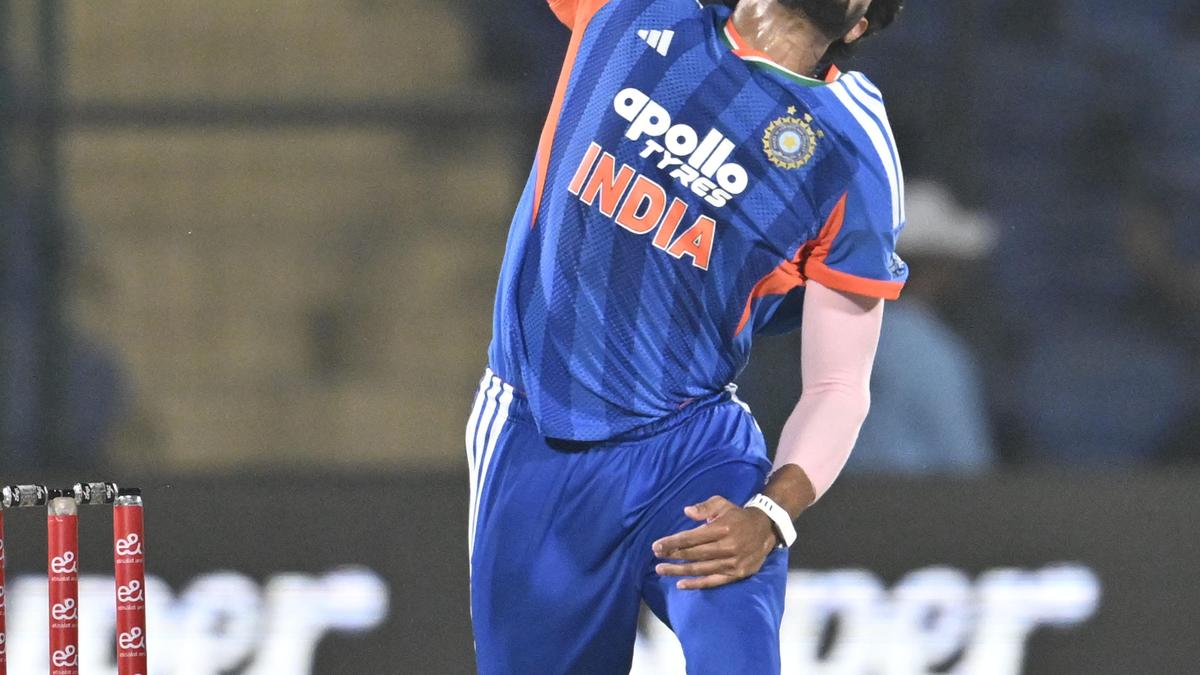
The soft-spoken young man with a ready smile is currently back in business again, and hopefully this time, it won’t be another cameo appearance. As if to reiterate the value he brings to the side, Nitish walked away with the Player of the Match award in the second T20I against Afghanistan on Tuesday for his three for 24 from three good overs. A wicket with the first delivery of each of his three overs did the trick as the Afghans failed to touch 160 for the second time in three nights, allowing India to breeze home on the back of the pyrotechnics of openers Sanju Samson and Abhishek Sharma. Abhishek was the Player of the Match in the big win in the series-opener, showing that India boast match-winners aplenty at both ends of the spectrum.
Scope for improvement
Nitish’s inconsistencies, especially with the ball, can be easily explained away simply because he is still reasonably inexperienced, with less than 1,000 overs under his belt in representative cricket. Internationally, he has bowled a little over 125 overs (for 16 wickets) and it might appear a stretch to label him an all-rounder immediately, but while he may not be able to influence – yet – the course of a match with his bowling alone, one can state with confidence that he will be a force to reckon with with the ball too once he manages to keep himself free from injuries.
Nitish’s immediate aim will be to steer clear of injuries for at least the next two and a half months, build up a decent volume of bowling work – at the very minimum – and remain in the fray for selection for the two Test matches in New Zealand in November. There are a host of white-ball internationals between now and November 19, when the first Test gets underway at Wellington’s Basin Reserve, for Nitish to achieve that goal, starting with Thursday’s final T20I in New Delhi. He has been withdrawn from the Asian Games where India will kick off their gold medal defence in the quarterfinals on September 28. Instead, he will figure in three ODIs followed by five T20Is at home against West Indies, and as many such contests in New Zealand that will segue into five further ODIs before the Test series begins.
At No. 8, where he will most likely slot in should he be available, Nitish will offer the balance India so desperately crave away from the subcontinent. It was from that position that he uncorked a fabulous hundred against the Aussies, which means there is batting depth as well as an additional pace bowling choice which is so essential on what are certain to be seaming surfaces in New Zealand. Nitish’s presence will allow Shubman Gill to go into with three frontline quicks and still have five proper bowling options – Ravindra Jadeja should provide variety and experience with his left-arm spin – which is such an essential requirement in the quest for 20 wickets that could translate into victory and 12 World Test Championship points.
The recent prolificity of the Indian top-order hasn’t allowed Nitish to have a bat internationally since January, and maybe there is a case for him to be pushed up the order from time to time so that he has competitive game-time in that discipline as well. As those who have played the game at any level – and even those who haven’t – have pointed out repeatedly, there is no substitute for time in the middle. No number of balls hit at nets will replicate the intensity of a match scenario and India wouldn’t want Nitish to go in cold from a batting standpoint when the Test matches come around with so much hinging on the outcome. That’s where Gill and head coach Gautam Gambhir will have to walk the tricky tightrope of balancing the immediate (results) with the immediate future (match readiness).
India have been forced to approach several fixtures in the recent past with the full complement never available for selection. Some of the ‘offenders’ in the injury list fall in the ‘serial’ category – Jasprit Bumrah, Pandya (who hasn’t represented the country since March), Harshit Rana, Washington Sundar and Nitish. Despite the depth that speaks to the vibrancy of Indian cricket, this is far from an ideal scenario. Gill, the Test and ODI boss, and T20I captain Shreyas Iyer, will be desperate for the luxury of picking from the complete riches. Nitish might not be on top of the ‘riches’ section, but he is a much-coveted resource whose progress over the next 75 days will be followed with interest. And optimism.