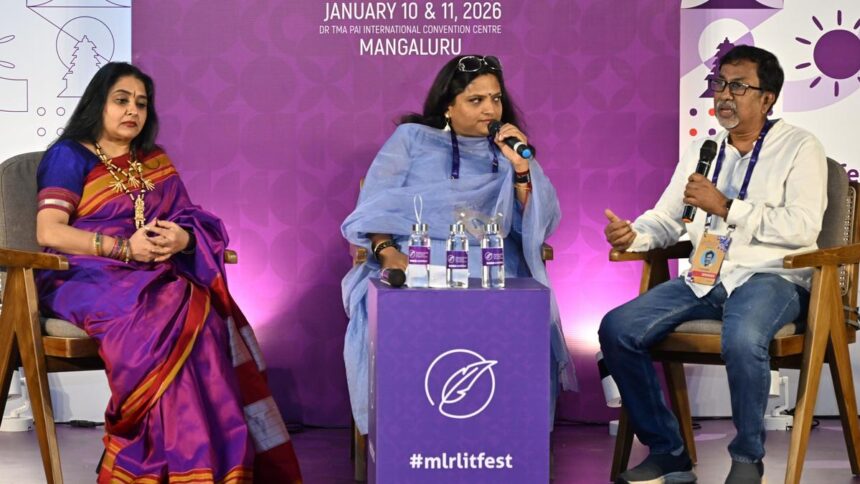





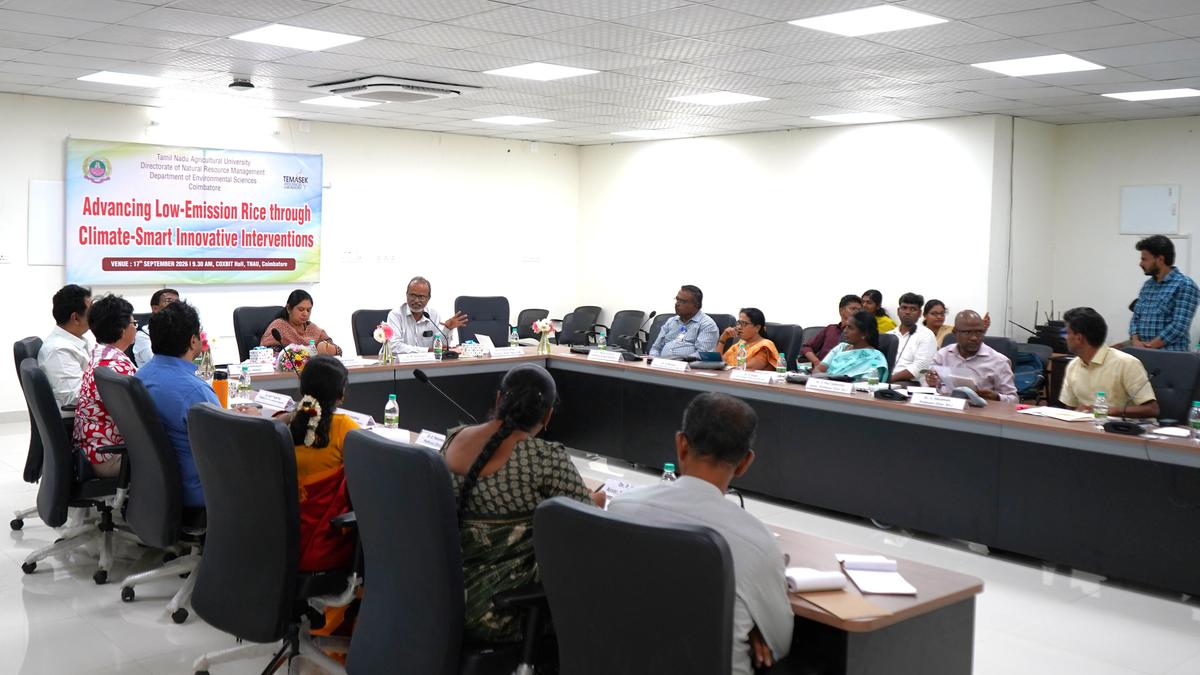


Scientists, researchers, agricultural experts and stakeholders discuss innovative approaches for sustainable, climate-smart and low-emission rice production at TNAU in Coimbatore on Thursday.
| Photo Credit: SPECIAL ARRAGEMENT
:
Tamil Nadu Agricultural University (TNAU), Coimbatore, has demonstrated through field-scale trials, the scope for advancing low-emission rice through climate-smart innovative interventions.
Usage of Singapore-based TLL (Temasek Life Sciences Laboratory) fertiliser cocktail, AWD (Alternate Wetting and Drying), and Methanotroph Consortium (microorganisms that break methane into carbon dioxide, biomass or methanol) resulted in substantial increase in yield, and reduction in carbon dioxide emission.
A 20% yield increase in field trials on 100 acres, and 369.4 tonnes of carbon dioxide equivalent emission reduction were recorded, when compared to the productivity and environmental impact caused by conventional farmers’ practices .The field-trial demonstration, the TNAU believes, will pave way for scaling up climate-smart rice production.
An international workshop on Thursday (September 17, 2026) focussed on integrating scientific innovation with practical, economically feasible and farmer-friendly practices for low-emission rice production.
The outcome of field trials on 100 acres across two seasons at Paruthikottai was presented by E. Parameswari, Professor, Nammalvar Organic Farming Research Centre, TNAU, with respect to agronomic performance, methane mitigation and rice yield.
Teaming up with TLL, the Department of Environmental Sciences under the Directorate of Natural Resource Management (DNRM), TNAU, organised the workshop that brought together scientists, researchers, agricultural experts and stakeholders to exchange knowledge and discuss innovative approaches for sustainable, climate-smart and low-emission rice production.
M. Raveendran, acting Vice-Chancellor and Registrar, TNAU, initiated the deliberations. The round-table discussion addressed future research directions, scaling pathways, adoption challenges, institutional collaboration, future projects, responsibilities, funding opportunities and a roadmap for continued TNAU–TLL collaboration.
Published – September 19, 2026 12:33 am IST