





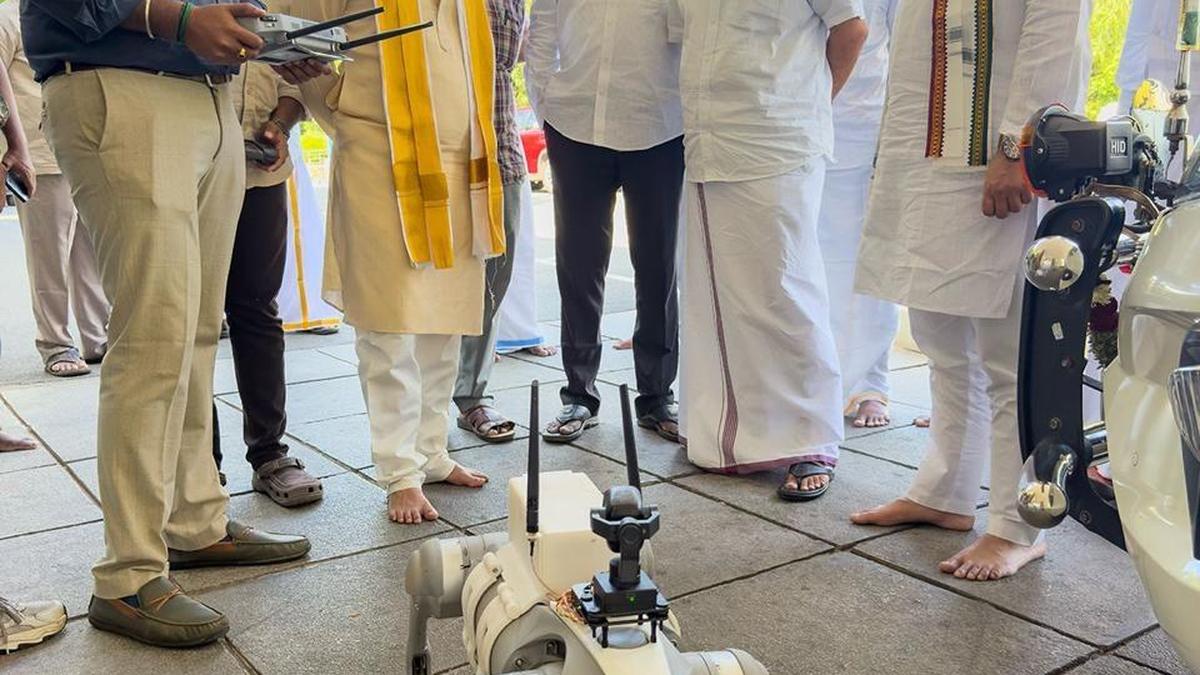


TTD authorities view the quadruped robotic dog which will be used for real-time wildlife surveillance and safety of devotees walking through the Tirumala forests.
| Photo Credit: TIRUMALA
The Tirumala Tirupati Devasthanam (TTD) is exploring the deployment of a quadruped robotic dog to strengthen real-time wildlife surveillance and enhance the safety of devotees traversing forest areas around Tirumala.
TTD Additional EO, Ch. Venkaiah Chowdary, accompanied by officials, reviewed the performance of the robotic dog at the Sri Padmavathi Guest House on Thursday, and assessed its suitability for surveillance in difficult and potentially hazardous terrain where human access is constrained.
Equipped with optical and thermal imaging cameras, 360-degree LiDAR, multiple sensors and artificial intelligence, the robotic dog is designed to detect and track wildlife even in low-visibility conditions, including darkness and fog. Its AI-enabled system can distinguish between large animals, humans, vehicles and domestic animals.
On detecting wildlife movement, the system can generate geo-tagged alerts while transmitting live video and thermal feeds to control rooms and patrolling personnel, enabling quicker responses.
The Alipiri-Tirumala footpath and adjoining forest stretches have been identified as priority zones, where early detection of leopards and other wildlife could facilitate timely warnings to devotees and ensure rapid deployment of forest, vigilance and security teams.
Officials also examined the feasibility of using the robot’s sound and light systems to deter animals from entering pilgrim areas without resorting to physical intervention, there-by potentially reducing direct human-wildlife encounters.
The robotic system is envisaged as a complement to existing camera traps, foot patrols and forest surveillance rather than a replacement. Its mobility could allow rapid deployment to locations witnessing heightened wildlife activity.
Data collected by the robot including video, thermal imagery and movement patterns could further help analysis wildlife behaviour and assist the TTD in refining patrol schedules and surveillance deployment in critical areas.
Published – August 20, 2026 09:29 pm IST