






In my 48 years in public life, I have seen political parties rise and fall. I have seen leaders emerge with great promise and fade away. I have seen governments change, economies transform and technology alter our lives beyond recognition. One lesson has become increasingly clear to me: ultimately, leadership matters.
Comment | In 25 years, has Modi made lasting changes?
In today’s world, technology, knowledge, capital and ideas are freely available. But the true differentiator for nations is leadership — one with vision, integrity, credibility and the ability to execute.
On October 7, 2026, Prime Minister Narendra Modi completes 25 uninterrupted years in executive office — first as Chief Minister of Gujarat and, since 2014, as the Prime Minister of India. It is a remarkable journey of leadership sustained by public trust. Through changing circumstances, Mr. Modi has remained remarkably consistent in his purpose: the development of India and the empowerment of its people.

The world around us has been turbulent. We have witnessed a global financial crisis, a once-in-a-century pandemic, wars, geopolitical realignments, technological disruption and economic uncertainty. Several democracies have experienced frequent changes of leadership and consequent policy uncertainty. Through all this, India has remained steady at the wheel and an oasis of economic hope.
Leadership built on trust
Such stable leadership cannot sustain itself for 25 years merely through politics. It requires trust. Mr. Modi has earned that trust through an established track record, impeccable personal integrity and tireless self-discipline. In today’s world, public leaders effectively live in glass houses. Every decision and every action can be seen and questioned. To retain the confidence of people over decades under such scrutiny is an achievement in itself.
Mr. Modi brings a unique ability to understand people’s aspirations, translate them into action and communicate those results back to the people.

The results are visible. Over the last decade, India’s National Highway network has expanded from about 91,287 kilometres in 2014 to more than 1,46,000 km. The airport network has grown from 74 airports in 2014 to over 160. Railway electrification has accelerated dramatically. India’s installed renewable-energy capacity has now reached nearly 296 GW, including large hydro, with solar alone crossing 168 GW. Infrastructure today is being conceived not as isolated projects but as an integrated national network through initiatives such as PM Gati Shakti (Prime Minister Gati Shakti — National Master Plan for Multi-Modal Connectivity).
At the same time, India’s welfare architecture has expanded basic security and dignity. Around 80 crore people receive free foodgrains, including five kilograms a person per month for eligible priority households. Tapwater coverage in rural homes has risen from about 17% in 2019 to over 82%. An estimated 24.8 crore Indians moved out of multidimensional poverty between 2013-14 and 2022-23. The significance lies not only in the scale of these programmes, but in their reach. Technology has enabled the State to deliver basic entitlements more directly, transparently and at a scale that was once unimaginable.
Technology in nation-building
Mr. Modi has a deep appreciation of technology and its role in transforming India. He understands emerging technologies, adopts them early and, more importantly, applies them to nation-building. He sees technology as a tool to improve governance, empower people, create opportunities and accelerate development. India’s Digital Public Infrastructure has shown how technology can democratise access to banking, welfare and public services at unprecedented scale. This deep appreciation of technology has enabled him to launch a host of frontier policies aimed at making India take a giant leap and put it in the league of global tech titans. India’s quantum mission, semi-conductor mission, and a host of Production Linked Incentive (PLI) schemes across electronics and advanced manufacturing are instances of this vision.
India’s space sector is another great example. For decades, India’s extraordinary capabilities in space were centred overwhelmingly around government. By opening the sector to private enterprise and creating an enabling ecosystem, the government has unleashed a new generation of entrepreneurs. Companies such as Skyroot Aerospace, Pixxel, Agnikul, Dhruva and Bellatrix demonstrate what young Indians can achieve when regulation gives way to innovation.
As a Chief Minister first and then a Prime Minister, Mr. Modi has a strong belief in “Team India”. He knows that India cannot be transformed from Delhi alone. Growth needs to be decentralised with States and cities competing. His emphasis on cooperative and competitive federalism has given States a larger role in India’s development journey.
India’s place in the world
In his tenure, India’s stature abroad has also changed profoundly. Today, India’s voice is heard with greater respect on global platforms. India protects its national interest while engaging with different centres of global power, preserves strategic autonomy while building deeper partnerships, and projects its civilisational confidence as a modern, technology-driven nation. India today is among the world’s fastest-growing major economies. But I believe the most consequential phase of our journey is still ahead.
Few countries possess India’s combination of strengths. It has a demographic dividend, an extraordinary entrepreneurial energy, technological capabilities and a young generation that is ambitious, confident and increasingly connected to global opportunity. If we make the right decisions now, the benefits will last for centuries. This is why leadership at this moment assumes historic importance.

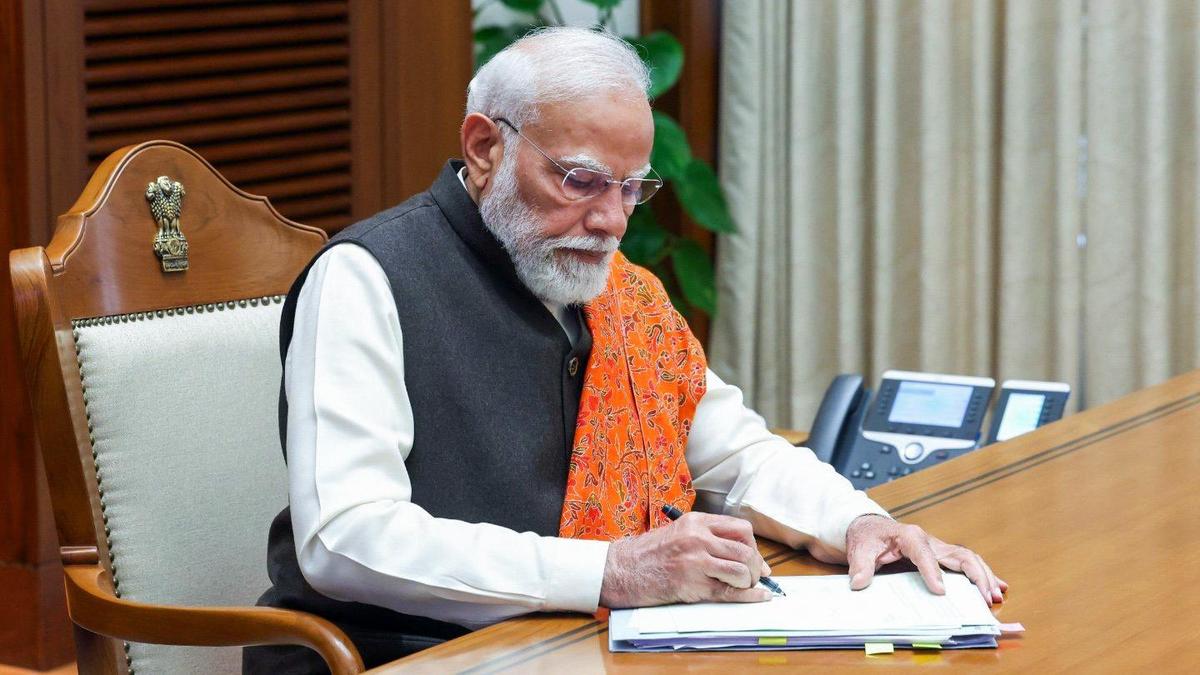
‘Mr. Modi has a strong belief in “Team India”’
| Photo Credit:
Special Arrangement
Mr. Modi’s 25 years in executive leadership have demonstrated the qualities such a moment demands. The Narendra Modi who became Chief Minister of Gujarat on October 7, 2001, and the Prime Minister leading India today are connected by the same clarity of purpose and unshakeable belief in India’s potential.
Twenty-five years have established his record. The next 20 years can establish India’s place in history. The true significance of these 25 years, however, will be judged by what they enable India to achieve next. Mr. Modi has shifted the country’s development trajectory — from incrementalism to ambition, from hesitation to confidence, and from managing limitations to believing in possibilities. I am confident that the direction he has set and the institutional momentum created during these years will help India realise its ambition of Viksit Bharat 2047 and reclaim its place among the world’s leading nations.
Few leaders are given the opportunity to shape a generation. Rarer still are those who can shape the destiny of a nation. After 25 years of leadership, Mr. Modi’s greatest contribution may ultimately be that he made India believe once again in the scale of its own possibilities — and gave the nation the leadership to turn that belief into reality.
N. Chandrababu Naidu is the Chief Minister of Andhra Pradesh
Published – October 07, 2026 12:16 am IST