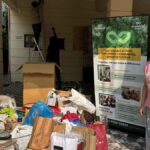





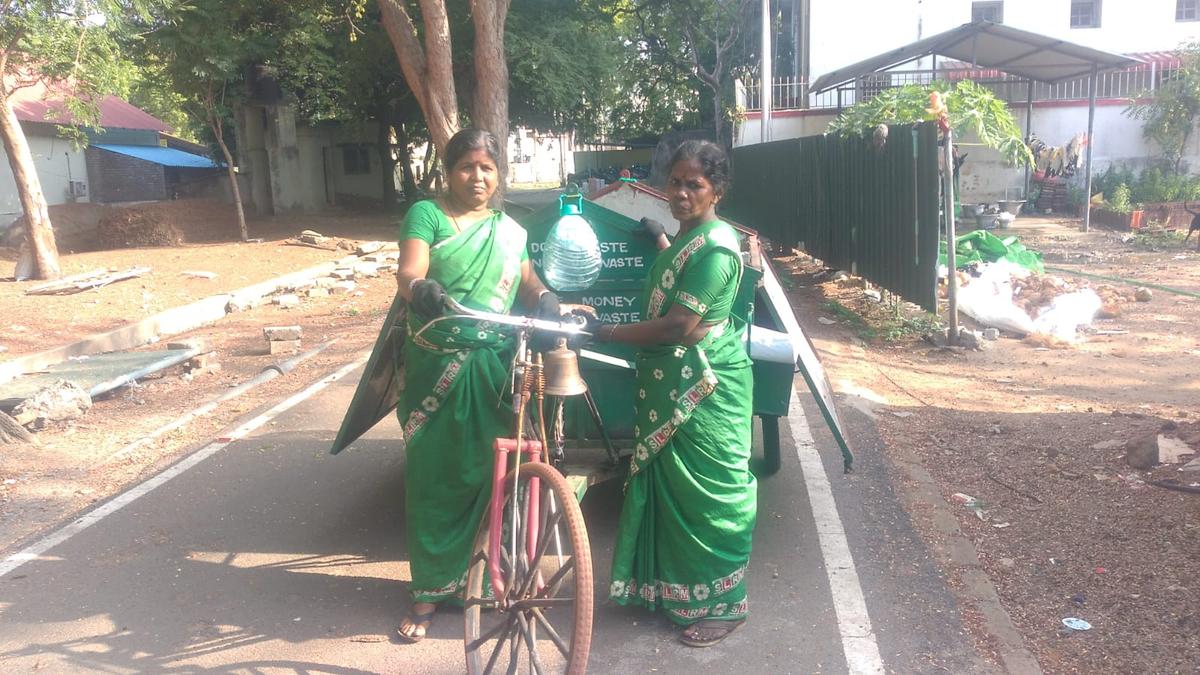

Green tri-cycles trundles down the commercial streets in Pallavaram, picking up waste from shops every four hours to be transported to a secondary segregation unit less than a kilometre away. Here 14 workers are engaged in sorting recyclables into different categories, and the biodegradable waste is separated for composting.
For the last one week, shops in this busy neighbourhood, there are 650 as per data, are getting used to an attendance system where they are marked based on a few criteria including if they handed over segregated waste.

From the households, waste is picked twice a day
St. Thomas Mount-cum-Pallavaram Cantonment Board has engaged the service of Vellore-based C. Srinivasan to adopt the Solid and Liquid Resource Management (SLRM) concept to strengthen the waste collection and segregation system in the neighbourhood that extends from Le Royal Meridian Hotel to the Pallavaram bus stop.
Dubbed the “Vellore Model” or the SLRM Project, here greater emphasis is laid on dispatching waste within 12 hours so that it can be converted into a resource. The collection interval increases depending on the nature of waste generated and the location. For hotels, restaurants, marriage halls, road side vendors, the workers are required to collect the waste every six hours; bulk generators such as markets every four hours; and for shops selling non-vegetarian items three hours is the duration.

Red and green bins were given to commercial establishments during the inauguration of the SLRM project
“When collected garbage is bundled in black plastic covers without aeration, anaerobic decomposition occurs leading to bad odours. In our model, waste collection is done twice a day to ensure collected inorganic waste is processed and packed ready for sale and organic waste is spread in aerobic compost beds or tanks, after mixing with cow dung slurry as a bacterial inoculum,” says C. Srinivasan, project director and consultant, Solid and Liquid Resource Management, who first implemented the model in Vellore.
Involving women from self-help groups from in and around the neighbourhood is another highlight of this model which ensures a sense of ownership, and also ticks one of the key SDG (Sustainable Development Goals) boxes.
Srinivasan, a resourceperson for SLRM Project of the Ministry of Housing and Urban Affairs, says under this decentralised model of managing resources they ensure no waste is sent to dumping grounds, and revenue is generated through decentralised segregation, aerobic composting and recycling. All this reduces transportation cost and overflow of waste at dumping sites.
The SLRM model was launched as a pilot six months ago at RWA SOL Army Married Accommodation now to be extended to other residential areas. From the households, waste is picked twice a day (8 a.m. to 9 and 4 p.m. to 5 p.m.).
“We collect the materials before they start decomposing so workers do not have a reason to complain. That is why we call it resource management,” says Srinivasan.
Vinod Vikneswaran A., Indian Defence Estates Service, Chief Executive Officer, St. Thomas Mount-cum-Pallavaram Cantonment Board, says the Board does not work either with the Greater Chennai Corporation or the Tambaram City Municipal Corporation to manage its waste. “We were following a door-to-door collection mechanism but disposal was a challenge. Non-biodegradable waste was not being processed. With SLRM, we will be sending non-biodegradable waste to industries to be used as raw materials,” says Vinod, adding that 13,500 household come under the network.
Punjab Association forays into a new segment
Punjab Association, which runs five schools and a college in Chennai, has stepped into a new segment – environment management by sponsoring the SLRM project in the Cantonment area. The tricycles used for waste collection, red and green buckets and the infrastructure for decentralised management of waste has all been funded by the Punjab Association.
Vikram Aggarwal, president, Punjab Association, says a study was conducted by a consultant that identified the Cantonment area as needing a higher education institute. “We have started an arts and science college from this academic year in Cantonment and thought it was good to partner for a cleaner and sustainable neighbourhood,” says Vikram.
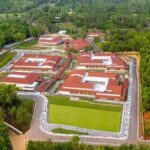
Dr Vikram Aggarwal Adarsh College of Arts and Science offers undergraduate programmes across arts, science and commerce streams. “Like the other institutions under our banner, the college will offer holistic education and cater to student from less-privileged communities,” says Vikram.
Published – July 04, 2026 05:51 pm IST