






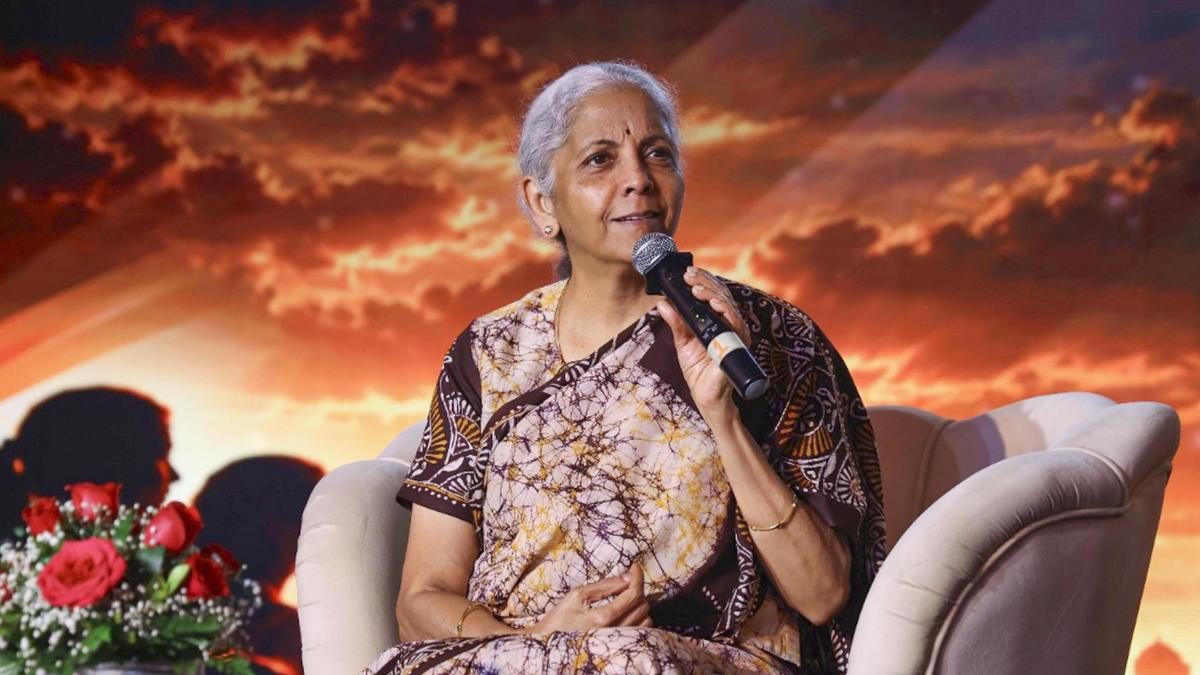


Finance Minister Nirmala Sitharaman said the Opposition was “searching for issues” and making allegations without fully understanding the matter.
| Photo Credit: PTI
Finance Minister Nirmala Sitharaman has rejected as “absolutely baseless” allegations by the Opposition that the decision to levy a 0.4% Merchant Discount Rate (MDR) on specified UPI transactions above ₹2,000 was taken under external pressure, saying it was a professional decision by the payment ecosystem.

Talking to PTI, Ms. Sitharaman said the decision was completely professional, and it was taken jointly by the National Payments Corporation of India (NPCI), payment banks and merchant banks, and not imposed by the government.
She rubbished the Opposition’s allegations that the government had yielded to foreign pressure, saying the MDR was not a tax and would not accrue to the government.
“Absolutely baseless. And I totally deny it,” she said when asked about Opposition allegations that the decision on Unified Payments Interface (UPI) MDR was taken under external pressure, particularly from the U.S..
The Finance Minister said the Opposition was “searching for issues” and making allegations without fully understanding the matter.
Also dismissing criticism by Opposition parties, including the Congress, that it is a tax on consumers, Ms. Sitharaman said, “This is not a tax, this is not a cess, this is not even a surcharge. And the collection is not coming to the Consolidated Fund of India.”
The collected amount will be shared among banks and other entities in the UPI ecosystem. Of the MDR collected, 40% will go to customers’ banks, 30% to payment gateways, 20% to the UPI app and the remaining 10% to the sponsoring bank of the UPI app.

From October 15, a 0.4% MDR will apply to person-to-merchant UPI payments above ₹2,000. The charge will be paid by merchants, not consumers, and will be capped at ₹300 for transactions of ₹75,000 or more. Payments between individuals, as well as the vast majority of everyday merchant payments, will remain free.
Essential services, such as railways, telecom, fuel, and insurance, will attract a flat ₹5 fee per transaction above ₹2,000. Capital markets transactions (mutual funds, stockbroking) get a lower 0.02% rate, also capped at ₹300.
Small merchants collecting up to ₹1 lakh a month via UPI QR codes remain fully exempt from any new charge and shield about 96% of all merchant transactions.

The NPCI, which operates the UPI platform, on September 15, issued a circular providing for MDR on certain UPI transactions, with the move aimed at creating a sustainable revenue framework for the digital payments ecosystem.
A dedicated fund for promoting the use of UPI by small merchants will be set up, with a contribution of 5% of total MDR collections. This initiative will expand UPI acceptance, encourage sustained usage, and accelerate the inclusion of small businesses in India’s digital payments ecosystem.
Published – September 25, 2026 03:22 pm IST