






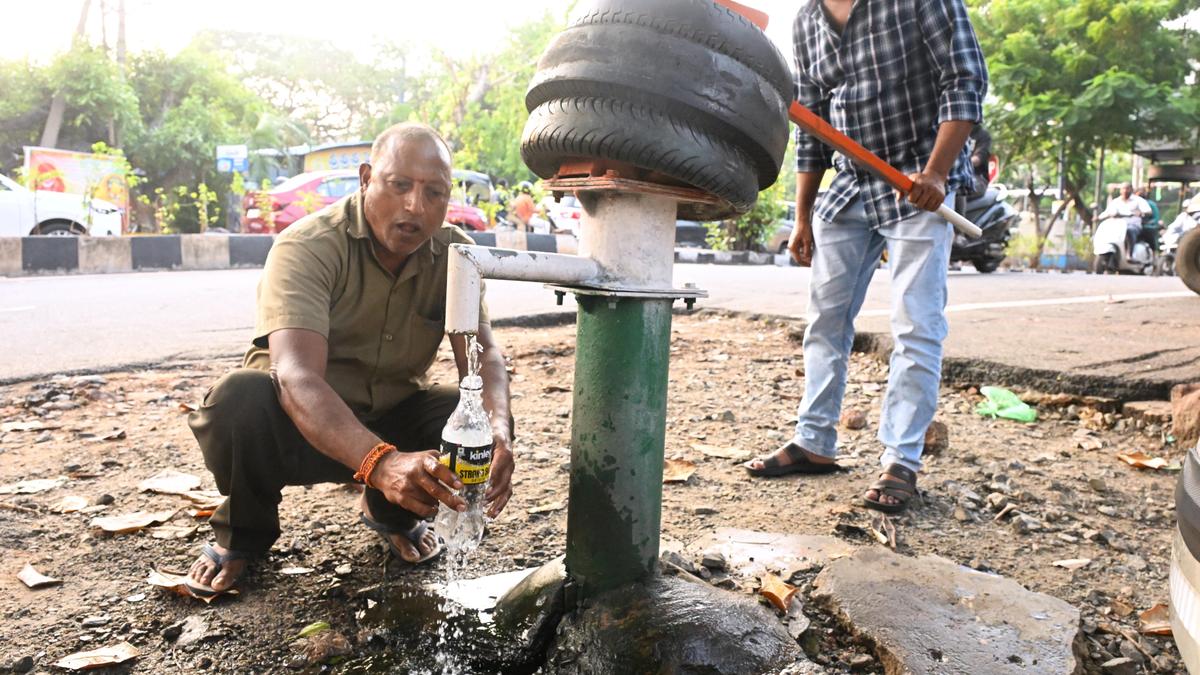


Auto-rickshaw drivers and locals draw water from a handpump at Akkayyapalem in Visakhapatnam on Tuesday following a rise in groundwater levels after heavy rain associated with the recent deep depression over the Bay of Bengal.
| Photo Credit: V. RAJU
Groundwater levels in Visakhapatnam district have improved following heavy rain, with the real-time district average recorded at 7.20 metres below ground level on September 29. The corresponding level on the same date last year was 5.91 metres, making the current level 1.29 metres deeper.
The district’s monthly average groundwater level, based on readings taken up to September 25, stood at 9.88 metres below ground level, compared with 11.51 metres in August. This represents a 1.63-metre rise in the water table. The 9.88-metre figure is the monthly average, while 7.20 metres is the real-time district average recorded on September 29.
The district received 337.6 mm of rain between September 21 and 26 following the development of a deep depression over the Bay of Bengal. Cumulative rainfall since June 1 stood at 654.9 mm on September 29, which was 15% above the normal rainfall of 571.2 mm for the period.
Monthly groundwater readings in Visakhapatnam Rural, taken up to September 25, showed a rise of 5.90 metres at Endada, from 30.94 metres to 25.04 metres, and 4.11 metres at Arilova, from 35.23 metres to 31.12 metres. At Madhurawada, however, the groundwater level fell by 1.34 metres, from 27.24 metres to 28.58 metres.
District Groundwater Officer Kankipati Pushpa Latha attributed the variations partly to differences in local geography and groundwater recharge conditions. Arilova has a larger catchment and is relatively low-lying, while Madhurawada has a smaller catchment. Madhurawada also has extensive cement-concrete surfaces and, as far as she knew, lacked recharge pits or open tanks, she said.
Real-time readings on September 29 showed groundwater levels of 22.88 metres at Peda Rushikonda, 22.56 metres at Endada, 19.99 metres at Madhurawada and 15.70 metres at Arilova. Compared with the corresponding readings a year earlier, the levels at Peda Rushikonda and Endada were 11.41 metres and 8.73 metres deeper, respectively. Madhurawada was 1.83 metres deeper, while Arilova was 7.76 metres shallower.
Ms. Pushpa Latha said the rise recorded in the September monthly average should not be considered the final response to the recent rainfall. “It is essentially an instantaneous reading,” she said, explaining that it could take 10 to 15 days for rainwater to infiltrate the rock layers and result in a more representative groundwater level.
She called for recharge pits or rainwater-harvesting systems to be installed in every house, with rooftop rainwater channelled through filters to recharge structures or borewells. Four days of rainfall could result in a rise of nearly two metres in groundwater levels, she said.
Commercial establishments are subject to recharge-related conditions while obtaining permissions, but residential areas do not have an equivalent mandatory requirement, she said. Gated communities and residents’ associations should take collective responsibility for installing recharge systems, or builders should provide them during construction, she added.
“Groundwater is only a temporary source,” Ms. Pushpa Latha said, stressing the need for households to capture rainwater and use it for groundwater recharge.
Published – September 29, 2026 08:47 pm IST