





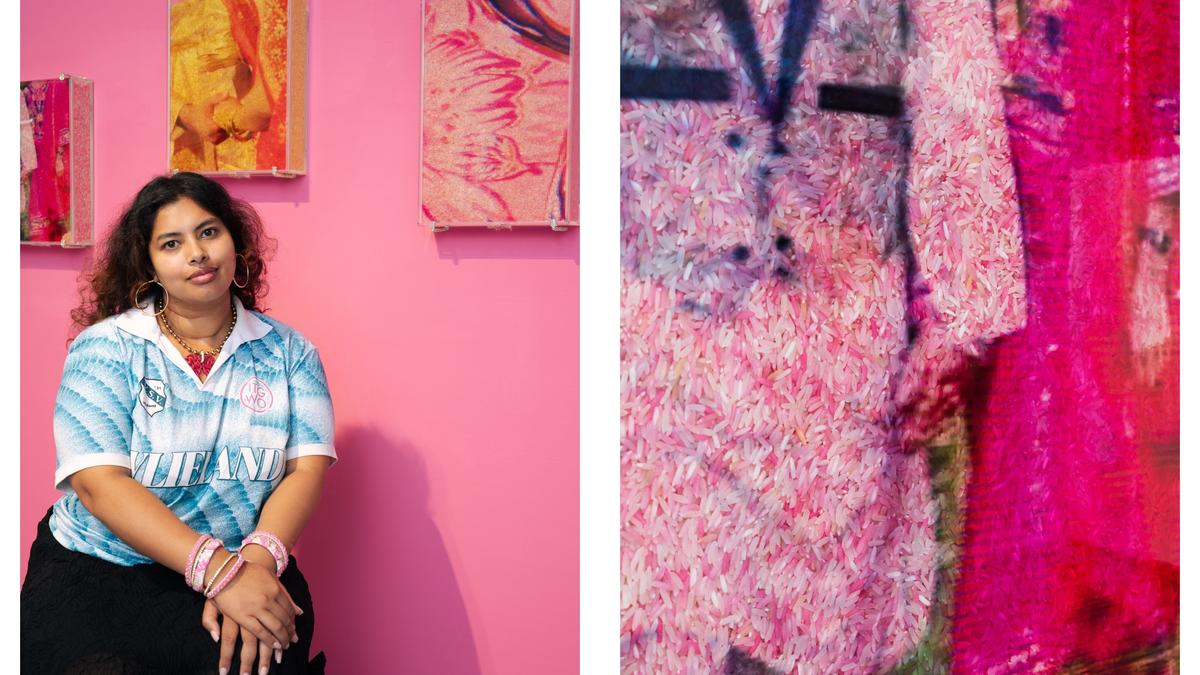

There is something almost mischievous about Angel Rose’s pink rice creations. It sits behind perspex, dyed pink, looking at first like confectionery or confetti or the aftermath of a children’s party. Then you notice the photograph, the television image, and then the rice again. By the time you have made the circuit, the object has acquired the uncomfortable density of an archive.
This is the trick Angel-Rose Oedit Doebé likes to play: make you look at something because it is pretty, and then make you stay because it is not.

Angel Rose’s works on display at Method, Delhi
| Photo Credit:
Special Arrangement
The 31-year-old Amsterdam-based visual artist showcased her untitled series at Method in Delhi as part of Fresh Produce, the exhibition’s third edition, which brings together emerging artists from India alongside Angel. The series grew out of her research into the archives of OHM, the former Dutch broadcaster devoted to Indian, Surinamese and South Asian programming. Working with Beeld & Geluid, she found images from the 1990s and 2000s that returned to her something she had spent much of her childhood consuming at a distance: pop culture.
Rice, for Angel, carries several histories at once. It is food, plantation crop, material, memory. It also resembles the television static of the 1990s and early 2000s. “The works that I make currently are very minimal, but because of that, every decision is very precise,” she says.
The rice refers to the history of Surinamese-Hindustani people whose lives became entangled with Suriname’s plantations. Angel’s family history is part of that story.
Angel grew up in the Netherlands with the visual vocabulary of Western pop culture: rhinestones, glossy surfaces, hyper-feminine clothes, excess, the delicious vulgarity of more is more. Later, she began recognising those same impulses in South Asian aesthetics: the jewellery, fabrics, saturated colour, elaborate wedding clothes, the refusal to apologise for taking up visual space. What had appeared to her as Western pop culture began to look, in part, like a culture whose origins had been badly edited.

“It was very difficult for me to really love my culture where I come from,” she says. Her mixed Indian, Surinamese and Caribbean background, she explains, was both a richness and a complication: Indian, Surinamese and Black ancestry, growing up in a predominantly white Western society, trying to understand which pieces belonged where.

Angel’s characteristic pink rice features prominently in her work.
| Photo Credit:
Special Arrangement
Art became a way of putting those pieces back on the table. Her practice began in photography and expanded into installation, archival work and ready-made sculpture. The organising principle is what she calls the “angel-rose coloured glasses”, a phrase that borrows from the familiar instruction to look at the world more optimistically and turns it into a private universe. “If people want me to look through these rose coloured glasses, I will show you the world through my rose coloured glasses,” she says.
The glasses are pink, naturally. They are also rhinestone-studded, camp, funny and occasionally furious.
Her earlier works include I HOPE YOU HAVE THE CONFIDENCE OF A MEDIOCRE WHITE GUY TODAY, IF YOU ARE CIS, STRAIGHT AND WHITE THIS AIN’T FOR YOU, WHITEWASHED BUT STILL I LOVE YOU and Excluded from Reparations. There is a pleasure in those titles, but also a trap: they invite the viewer to laugh before making the laughter slightly difficult. In Bitch I’m a Cow, a sculpture of a cow becomes another such collision of references, its Dutch and Indian associations sitting beside one another.

Angel’s sculpture of a cow
| Photo Credit:
Special Arrangement
Her flamboyance is deliberate. She is interested in what happens when things dismissed as “bimbo”, superficial or low culture enter the supposedly serious territory of contemporary art. Her pantheon includes Lady Gaga, Missy Elliott, Lil’ Kim, Dolly Parton, Rosalía and Charli XCX. Pop culture, she argues, is not a decorative side-room of society. It is one of the places where society reveals its appetites, prejudices and cruelties.
“Low culture can be highbrow. It can be high culture. It is very intellectual,” she says.
In her untitled series, rice becomes the hinge between ancestry and television, between plantation history and the pixelated snow of an old screen. Angel describes rice as a material of community, something people touch and eat together, but also as a material tied to the history of Surinamese-Hindustani labour. The rice is placed inside boxes, almost held hostage by the frame. The work is simultaneously image and object, memory and surface. Artsy describes the works as using print on perspex, rice, paint and archival material.
The pink is, inevitably, Angel-Rose. And then there are the cows, named Juliette, Jeanette and Bernadette after her great-grandmother and grandmothers. They came from India, along with the bricks, fabrics, traffic sounds and visual fragments she has gathered over several visits. Her phone contains a folder called “Brown History”, a private museum of things she sees and does not want to lose.

There is an earlier work called vroeger was je anders :$ wjnmk, a title that looks like the residue of an adolescent MSN conversation. The abbreviation means, roughly, “never want to lose you”, and the work circles memory, nostalgia, love and trauma. It is a useful key to Angel’s practice: she is suspicious of nostalgia when it is merely decorative, but deeply attached to what nostalgia can recover.
India has become part of that recovery. She has returned repeatedly, collecting images and conversations, meeting artists and women, watching the streets. She describes finding friends and peers here who make her feel, in her words, that she has “found my girls on the other side of the world”.

Yet she is careful about the position from which she looks. “I acknowledge that I grew up and I live in a Western country. So my perspectives are built on being from a Western country.”
Decolonisation, in Angel’s hands, is not a pose of arrival. It is a willingness to keep discovering that the thing you thought you knew had another beginning. The rice remains pink but the history inside it is considerably harder to colour.
Published – October 08, 2026 10:40 am IST