






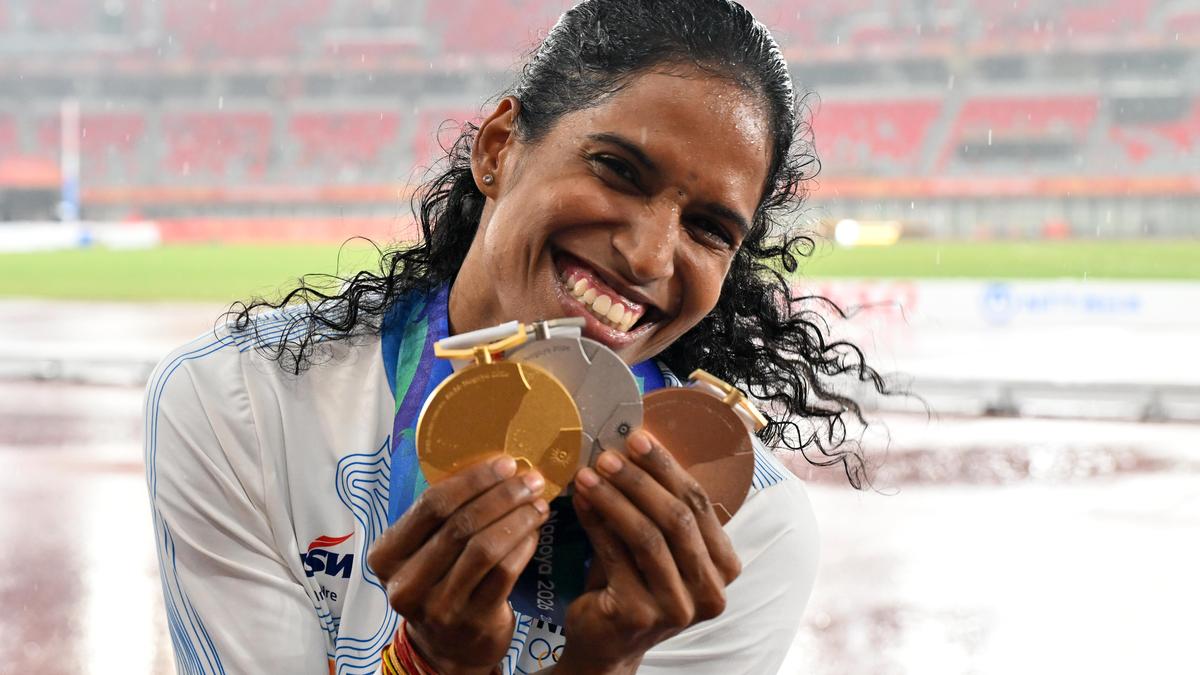


Medal hat-trick: Vithya Ramraj with her three medals from the 2026 Asian Games at Aichi- Nagoya, Japan on September 29, 2026.
| Photo Credit: MOORTHY RV
As Vithya Ramraj entered the final stretch of the 400m hurdles in Aichi-Nagoya, the race for gold was still open for India at the 2026 Asian Games. Vithya and the UAE’s Mariam Kareem were neck-and-neck over the final two hurdles, with Kazakhstan’s Adelina Zems just behind them. But at the last hurdle, Vithya lost some ground as Mariam surged ahead to take gold in a Games-record 54.31 seconds, while Adelina moved past Vithya to claim silver in 54.58. The Indian crossed the line third in 54.75.

But by then, the colour of the medal had become almost secondary. Vithya had done what she had been trying to do since 2023, when she equalled P.T. Usha’s 55.42-second national record that had stood for more than 40 years. She was 0.67 seconds faster than Usha and became the first Indian woman to break the 55-second barrier in the 400m hurdles. “I met Usha ma’am a year ago, and she said, ‘Go for 54 seconds.’ She encouraged me. So doing this today makes me so happy,” the 28-year-old said.
She is now the fastest Indian woman in the event, but her record places her 187th on the all-time world list.

That list is led by Sydney McLaughlin-Levrone, followed by Femke Bol and Dalilah Muhammad, whose bests are 50.37, 50.95 and 51.58 seconds, respectively. She remains more than four seconds behind the world’s fastest mark, but has moved from 56th before the Asiad to 35th in the current world rankings, putting her among the leading athletes in the event today.

Moreover, the record places her among a relatively small group of the fastest performances in Asia, ranking 12th on the continent. Bahrain’s Kemi Adekoya leads the regional list, while athletes from China, Kazakhstan and the UAE also feature prominently. The regional landscape was very different when Usha set her record in 1984. Until then, the 55-second barrier had been breached only by European athletes, with one African athlete also having gone under the mark. In fact, Usha remained the only Asian performance on the list until 1990 because World Athletics’ historical list captures performances faster than 57.3 seconds only. Since then, the depth of competition in Asia has grown considerably, with 12 performances now under 55 seconds.

These broader improvements in performance have coincided with a steady progression in Vithya’s own performances. Her best in the 400m hurdles was 59.7 seconds in 2018, which improved to 56.57 in 2022. In 2023, she matched Usha’s record. Her best then stood at 56.04 in 2025, before she made her biggest improvement yet in 2026.
Her coach, Nepal Singh Rathore, believes the progression in the hurdles cannot be separated from her improvement in the flat 400m. When Vithya began training under him, her coach said other coaches questioned why she was being prepared for both events. “Only when she runs well in the flat, she can run hurdles well. Because speed plays a major role in all events,” he told The Hindu, explaining his approach.
And the progression in the two events, he added, has followed the same pattern: “Whenever she has improved in the flats, she has improved in the hurdles.” Vithya’s best time in that event improved from 54.48 seconds in 2018 to 51.96 seconds in 2026. Over the same period, her hurdles best fell by nearly five seconds, from 59.70 to 54.75.

The versatility her coach had sought to build through that training approach was on full display in her overall Asian Games campaign. She won a medal of each colour, anchoring India to gold in the women’s 4×400m relay and silver in the mixed 4×400m relay, alongside her record-breaking bronze.
Note: The data for the charts were sourced from World Athletics.
Published – October 04, 2026 07:00 am IST