





When Bikaner-based graphic designer Laxmi Rajpurohit, 22, began noticing changes in the taste, smell and consistency of the milk her family was getting from a big, reputed brand, she suspected foul play and decided to take things in her hands. She had read about simple ways of testing milk at home to check for water, starch or detergent. For instance, an iodine test would reveal starch if the milk turns blue-black. She picked up the water test from the Detect Adulteration with Rapid Test, or DART, programme manual of the Food Safety and Standards Authority of India (FSSAI).
She put droplets of the milk on a sloping surface. “It flowed quickly,” she says, “like water instead of leaving a thick white trail.” She complained to the company’s customer care, who asked her for further information about the product. She hasn’t heard back ever since.
Rajpurohit can test a drop of milk at home but the test cannot tell her everything that happened before the packet of milk reached her. It can’t tell her if the milk contains an adulterant or is contaminated or if it might fail some food safety standard.

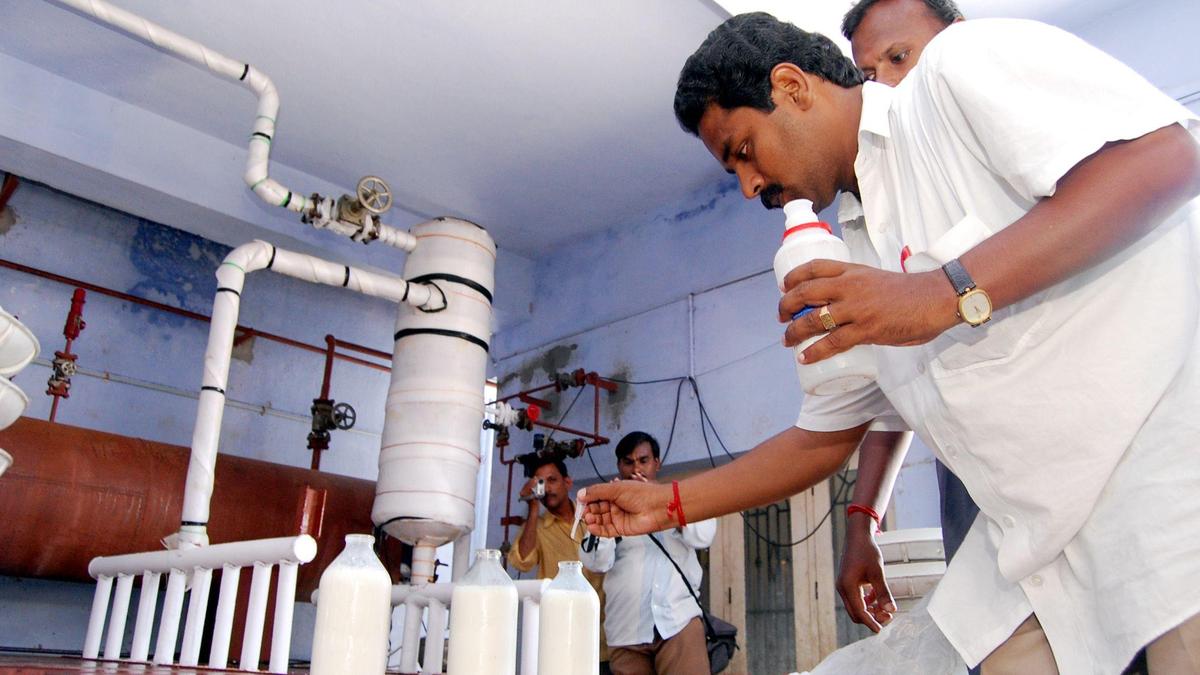
Corporation workers destroying adulterated milk seized from milk vendors during a surprise raid conducted in Madurai.
| Photo Credit:
K. Ganesan
The FSSAI has initiated legal action against Nestlé India over non-compliances with regards to regulations for infant food products.
Enough is enough
Between shiny paraffin-wax-coated apples, calcium carbide (“masala”) ripened mangoes, brick dust in red chilli powder, boric acid powder in maida and rice, and synthetic milk (detergent, urea, caustic soda, refined oils, milk powders, carbonates/ bicarbonates, melamine, heavy metals, pesticide residues), fake/ analogue paneer, and spurious ghee (dairy cream with palm oil and vanaspati), the average Indian is sick, cautious, angry and fed up. Milk, in particular, is consumed daily by infants up to the elderly, making its adulteration a widespread public health and consumer safety concern.

An installation at a carnival in Goa.
| Photo Credit:
Getty Images

Sampling spices.
| Photo Credit:
Getty Images
Bengaluru-based doctor and food writer Nandita Iyer (@saffrontrail on Instagram) recalls how once an ice cream arrived looking like “some separated liquid or oil”. From then on, she has become really cautious. She checks labels carefully, sticks only to brands she trusts, and rarely orders from restaurants now.

Bengaluru-based doctor, nutritionist and food writer Nandita Iyer.
| Photo Credit:
Special arrangement
Luke Coutinho, a wellness and lifestyle coach, argues that adulterated foods can add chemical stress burden to the body, triggering diseases. While “genuine mistakes happen sometimes,” he says, adding, the problem is “when companies/ brands with a running history of false marketing claims, fancy packaging, small print, wrong/misleading labels, and wrong accuracy, believe they can get away with it.” His advice is simple: stop buying from repeat offenders, encouraging others to boycott them, and buy instead from ethical brands.

Luke Coutinho, wellness and lifestyle coach.
| Photo Credit:
Special arrangement
The Supreme Court is now pushing FSSAI to set a clear timeline for introducing front-of-pack warning labels on unhealthy foods, while also urging stronger nutrition education in schools so consumers can make informed food choices.

Fraud remains invisible
“A home test may indicate some things. It cannot establish that everything else is absent. Moreover, a food laboratory can establish what is present in the sample but not if it is an intentional adulteration,” says Nilesh Amritkar, managing director of Envirocare Labs, an FSSAI notified food testing laboratory in Mumbai and Goa.

A lab test.
| Photo Credit:
Special arrangement
Amritkar uses detergent to explain the problem. “Detergent accidentally left on dairy equipment because it was not properly rinsed would be contamination. But if detergent were deliberately added to manipulate the appearance of milk, the same substance would become part of an adulteration,” he says. Heavy metals, pesticide residues, antibiotics or aflatoxin may make food unsafe without necessarily being adulterants. A product can be substandard because it fails a prescribed composition or quality benchmark without there being deliberate fraud.

A file photo of an official raid that seized 8,000 litres of spurious milk, that was also kept in unhygienic conditions, in Thanjavur.
| Photo Credit:
M. Srinath
In 2024-25, food-safety authorities analysed 1,70,535 enforcement samples and found 34,388 non-conforming, roughly one in five of the samples tested. Of these, 7,945 were classified as unsafe and 22,516 as substandard, while the rest involved labelling defects, misleading claims or other violations. While the numbers are significant, they cannot be read as a survey of everything we Indians eat. These were enforcement samples, often collected because regulators had a reason to look.

A file photo of corporation workers destroying adulterated milk seized from milk vendors during a raid conducted in Madurai.
| Photo Credit:
K. Ganesan

Destroying synthetic milk during a raid in Vellore.
| Photo Credit:
D. Gopalakrishnan
By the time a litre of milk reaches Rajpurohit’s or any kitchen in India, it may have passed through a long chain, running from the dairy farmer to the village collection centre, chilling facility and tanker, and then to a processing plant, packaging unit, distributor and retailer. The consumer doesn’t see the chain.

A milk factory in Gujarat.
| Photo Credit:
Getty Images
Unless one buys fresh, directly from farms. Consumers can purchase a greater degree of traceability. But not all farms might reveal if any banned antibiotics, hormones, or steroids were administered to their cows/ buffaloes, for instance.
Finding the sweet spot
In Kolkata, Partha Nandy, 42, has spent much of his life around milk. His family has owned Girish Ch. Dey & Nakur Ch. Nandy, the sweetmeat shop known for its kada-pak and naram-pak sandesh, since 1844. Nandy is its fifth-generation co-owner. The shop has maintained relationships with vendors for decades. Milk with added water produces less chhena. Adding milk powder for cost benefit produces low-quality, grainy chhena. During festivals, when demand for milk rises, these variations can become more common, he says.
Nandy adds he can also recognise impurities that appear during the preparation of chhena. The shop has historically relied on experience and relationships with suppliers rather than laboratory testing for adulterants. If there is something wrong with the milk, the vendor is warned. The problem, however, is that not every consumer is making sweets with it.

Buyers check khoya at a Delhi shop.
| Photo Credit:
Kamal Narang
FSSAI’s risk-based inspection and surveillance system dates back to at least 2022. In 2026, FSSAI’s Central Advisory Committee called for intensified risk-based inspections and sustained surveillance of high-risk commodities such as milk and milk products, edible oils, spices and honey.
Milk illustrates the difficulty particularly well. The world’s largest milk producer, accounting for nearly 25% of global output, India produced nearly 248 million tonnes in 2024-25. In that period, the FSSAI’s data shows: of 33,405 milk samples tested, 12,780 were non-conforming. This does not mean 40% of India’s milk is defective, just that regulators found a significant number of problems. The consumer has no equivalent way of investigating.

Cheese analogues.
| Photo Credit:
Venkatesan R.
Paneer presents similar challenges. An August briefing from the Centre for Health Equity flagged dairy analogues being sold as paneer. While not inherently unsafe, passing these off as traditional paneer is misleading. In Maharashtra, 109 of 308 samples were non-compliant between April 2025 and March 2026. Consequently, the FSSAI’s West Region has mandated accurate labelling for cheese analogues.
What can consumers do? Udai Kumar Saxena, a food-safety accreditation assessor and FSSAI-listed expert in risk assessment and analysis, says: “Check the date. Check the ingredients. Check the FSSAI number.” But exercise caution. An FSSAI licence or registration “establishes that the food business has entered the regulatory framework and is required to comply with its conditions but doesn’t mean the regulator has laboratory-tested and certified the packet in your hand,” he says. The law places the larger responsibility on the business and the regulator.
What the lab tells us
The regulator and the laboratory have different roles, but the objective is the same: “safer food”.
Ashwin Bhadri, founder-CEO of Navi Mumbai-headquartered Equinox Labs, which tests food, water and air, recalls a large food-service business that came to his laboratory concerned about the dairy product supplied to its kitchens. Tests showed it didn’t meet the expected specifications and indicated manipulation.

Ashwin Bhadri, CEO and founder, Equinox Labs.
| Photo Credit:
Special arrangement
Equinox Labs, which has been working with food manufacturers, QSR (quick service restaurant) chains and cloud kitchens, for the last 21 years across five cities, have, at times, asked food companies to remove or review claims such as “100% pure” or “100% natural” when unsubstantiated. The big change now, Bhadri observes, is that individual restaurants, clubs, cafeterias, hospitals, and schools are starting to reach out to them for auditing.

Equinox Labs headquarters in Navi Mumbai.
| Photo Credit:
Special arrangement
“The FSSAI and FDA don’t care about intent. They care about the final outcome. Today, there are millions of SKUs (unique code or number to identify/ track products) in the market. One brand itself will have 50-100 different SKUs. FSSAI can’t test every batch, the country doesn’t have the budget or bandwidth,” says Bhadri, “One good thing FSSAI is doing is self-approval. They tell food brands to get their products tested by a third party and upload the quality reports to their websites. There’s a FosCos (Food Safety Compliance System) website, where regulation mandates uploading quality reports every six months.”

A lab test at Equinox Labs.
| Photo Credit:
Special arrangement
The lesson for Bhadri is that testing needs to happen before the inspector, or the customer, discovers the failure. “A food company shouldn’t discover a problem because an inspector found it,” he says. “It should discover the problem through its own quality-control system.” Testing, he says, should work as an early-warning system rather than a compliance formality.
Price of awareness
Another sample revealed microbiological contamination, including Coliforms, Enterobacteriaceae, E. coli, yeast, and mould. For an individual consumer, a food test at Equinox can cost between ₹500 and ₹25,000. A milk adulteration test may cost ₹1,000. A microbial safety test costs ₹1,500-₹2,000. A comprehensive panel covering pesticides, heavy metals and other tests can run into tens of thousands of rupees.

A laboratory text at Equinox Labs.
| Photo Credit:
Special arrangement
“Why should any consumer have to pay a premium merely to obtain food that is safe?” asks consumer-rights advocate Bejon Kumar Misra. A better-off consumer can choose an organised supermarket, a familiar brand or a subscription-based direct farm-to-home service. She can switch products when she loses trust. She can even pay for a laboratory test. “Money can buy more choices, but it cannot buy complete food safety,” adds Misra. Bhadri points to a section of society that does not read labels, or recognise food fraud when taste or consistency changes, and doesn’t have the money or power to pursue a complaint. The inequality here is glaring.
Making the system work
But here’s the thing: “As an individual, you don’t need to do this. Your job is simple. Just complain to FSSAI,” says Bhadri, mentioning that the Maharashtra FDA recently launched an AI portal to speed up food safety complaints, “where you literally talk and it will write the complaint for you”. The more privileged Indians complain, the more it benefits all Indians.

Maharashtra FDA commissioner Tukaram Mundhe addressing a public gathering at a dialogue program titled ‘#Unstoppable Tukaram’ in Pune, in August.
| Photo Credit:
PTI
In the last few months, Mumbaikars have been tagging the FDA on social media and checking before eating if restaurants and packaged foods have passed the ‘Tukaram Mundhe test’. Mundhe, who took over as Maharashtra FDA commissioner in May, has been busting profiteering food-fraud rackets, seizing adulterated and suspect milk/ dairy products, and suspending licences across the State. Mundhe’s tenure illustrates what active enforcement can achieve — and its limits.
Can a suspect packet of milk/ paneer be quickly traced to the farm/ factory that made it and packaged it, revealing the ingredients used? So that consumers like Rajpurohit aren’t compelled to test at home/ labs? That brings us to the question of accountability: who is responsible? The manufacturer, to ensure quality control. And the regulator, to inspect, test, penalise and enforce. While the laboratory can establish what is present in a sample, and the consumer can identify irregularities and complain, their job is only to notice and report, not inspect, test, investigate, prove or prosecute.
Bhadri doesn’t believe in “more raids” but credits Mundhe for removing the “chalta hai” attitude. He says, “Enforcement is necessary, but enforcement alone won’t fix the system.” The goal, as Bhadri puts it, should be to “make adulteration difficult to do, easy to detect, and costly to ignore”.
The writer is a Kolkata-based freelance journalist.