



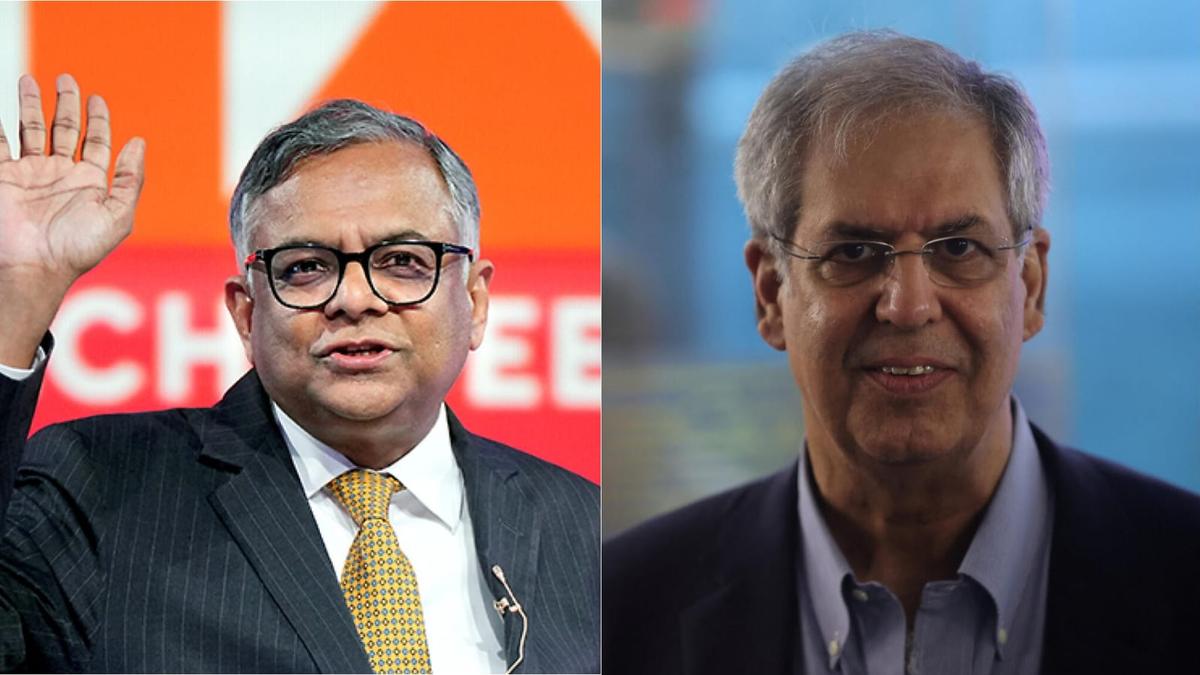

The story so far: At a board meeting of Tata Sons on Thursday (September 17, 2026) the Board, following a decision by the Nomination & Remineralisation Committee (NRC), requested Executive Chairman N. Chandrasekaran to reconsider his decision of not seeking re-appointment, and instead asked him to continue for a period of five years. Mr. Chandrasekaran “acceded to the request” and was re-appointed for the third term starting February 2027. This has now sparked off a back-and-forth between Tata Sons and Tata Trusts .
Who are the board members and what did they decide?
The Board members include Mr. Chandrasekaran (Chairman), Venu Srinivasan (Tata Trusts nominee direction), Noel Tata (Tata Trusts nominee director), Harish Manwani (Independent Director), Saurabh Agarwal (Executive Director & CFO), and Anita M. George (Independent Director).
After Mr. Chandrasekaran agreed to accept the request of the NRC, the Board “thereafter” resolved by a majority vote to re-appoint him as Executive Chairman for a further term of five years upon the expiry of his current tenure. Four directors, other than Noel Tata, voted in favour of the resolution.
Tata Trusts, which holds a 66% stake in Tata Sons, has termed this reappointment and decision as illegal since Noel Tata vetoed it.
The Tata Sons Board also resolved to initiate steps to comply with the applicable RBI Guidelines and decided it would seek guidance from RBI, Tata Trusts and other stakeholders on applicable compliance requirements.
Earlier, on September 11, the RBI had rejected Tata Son’s application for de-registration of its Core Investment Company NBFC license and had asked it to immediately comply with the regulations, which has been interpreted by some as ordering it go for mandatory listing.
Why did Mr Chandrasekaran opt out of the race in the first place?
On August 12, 2026, Mr Chandrasekaran in a letter to the Board had expressed his desire not to seek reappointment at the expiry of his tenure, stating that it lacked unanimity because one board member [Noel Tata] had not approved the re-appointment.

What was the reason given by the Board to take Mr Chandrasekaran back?
The Tata Sons Board stated it had received from Tata Trusts their unanimous resolution dated July 28, 2025, expressing their appreciation of Mr. Chandrasekaran for his stewardship of the Group from 2017 onwards. In recognition of these efforts, Tata Trusts resolved that he be re-appointed as Executive Chairman for a further term of five years. Subsequently, in September 2025 the Board of Tata Sons agreed in principle to re-appoint Mr Chandrasekaran as Executive Chairman for a further term of five years.
Pursuant to the applicable provisions of the law, the Board decided to obtain the relevant formal approval in February 2026. But, in the absence of unanimity, the resolution was deferred for decision. In subsequent Board meetings in May 2026 and June 2026, this matter was discussed but was not resolved.
In view of the above, on August 12, 2026, Mr Chandrasekaran opted not to offer himself for re-appointment upon the expiry of his current term. But on September 3, 2026, the NRC of the Board of Tata Sons [comprising Mr. Srinivasan, Mr. Manwani & Ms. George] met to discuss his letter and the issue of his re-appointment as Executive Chairman.

”After due deliberation and in recognition of his contributions and the larger interests of the Tata Group, the NRC unanimously resolved to request him to reconsider his decision and to recommend him for re-appointment at the next Board meeting [that took place on Thursday],” Tata Sons said in a statement.
What is the dispute now?
Tata Trusts, the majority owner of Tata Trusts, with a 66% holding, through its Chairman Noel Tata has vetoed both the resolutions & decisions of the Tata Sons Board.
The Trusts said Mr Chandrasekaran, having already expressed his desire to opt out, cannot now revisit his re-appointment as this decision has been “duly accepted and has attained finality”.
As per the Trusts, this decision was freely taken, clearly expressed and was not the outcome of any process of review. It was made public without prior intimation or any deliberations with the shareholders of the company. Once such a decision has been publicly communicated, it has consequences that cannot be afterwards undone, since the Group’s employees, its lenders and counterparties, the market and the majority shareholder have all proceeded on it.
The Tata Trusts said they formally placed on record their acceptance of the decision the following day (August 13, 2026) and advised Tata Sons to initiate the process for setting up a Selection Committee for the appointment of a successor, in accordance with the Articles of Association of Tata Sons.
“The Trusts’ position remains unchanged, as a considered judgement of a majority shareholder. This position was reiterated in today’s board meeting by the Chairman, Tata Trusts. The resolution seeking to reappoint Mr. Chandrasekaran in the Board meeting today, with four Directors voting in favour, and Mr. Noel against, was a legal nullity in view of the provisions of the Articles of Association of Tata Sons,” Tata Trusts Chairman Noel Tata said in his statement at the board meeting.
Why does Tata Trusts say the re-appointment is illegal?
As per Tata Trusts, the process for appointing a Chairman of Tata Sons under the Article of Association requires a majority of the Trusts’ Nominee Directors voting in favour of the resolution. That process applies equally to a first appointment (when Mr. Chandrasekaran was appointed in 2017) and to re-appointing someone who already holds the office.
“The Board, accordingly, cannot lawfully hold a meeting or pass a resolution on the Chairman’s appointment or reappointment unless both nominee directors are present, and cannot validly pass such a resolution unless both nominee directors vote in favour. [In this case the two nominee directors are Venu Srinivasan and Noel Naval Tata],” Tata Trusts Chairman said in his statement at the board meeting.

Given that Mr. Noel, being one of the Trust nominee directors, voted against the proposal, it was rendered legally void and without any basis even though the other nominee director Venu Srinivasan voted in favour.
Justice D.Y. Chandrachud (former Chief Justice of India) has given a legal opinion regarding the correctness of the Trusts’ stand.
What is Tata Trusts stand on the RBI order and likely listing of Tata Sons?
Tata Trusts has asked Tata Sons to explore options other than listing and “save” the Tata model. It has completely opposed the listing to preserve the more-than-a-century-old structure of Tata Sons and the Tata Group.
According to Tata Trusts, the Tata Sons Board had already considered the matter of public listing and reached a unanimous conclusion in March 2024, under the guidance of the late Ratan Tata, and had resolved that the Company should remain unlisted.
In July 2025, the Sir Dorabji Tata Trust and the Sir Ratan Tata Trust also unanimously passed resolutions that the Company should remain unlisted and the same was duly communicated to Tata Sons for necessary action.
Why are the Tata Trusts opposed to the listing of Tata Sons?
According to the Trusts, Tata Sons is not a holding company in the ordinary sense. Approximately 66% of its equity is held by the Tata Trusts. Dividends received from the operating companies flow, through the Trusts, into public charity.
The argument is that the interests which Tata Trusts bring to this Board is public interest held for the millions of beneficiaries of the charities which the dividends of this Company sustain. The commercial enterprise and philanthropy are not adjacent to one another — they are one structure seen from two ends.
That structure is more than a hundred-years-old, and it has permitted this Company to act, repeatedly, in ways that a purely commercial calculus would not have supported, Mr Noel said.
The Tata Group was conceived as national service carried on through business and has been so conducted for more than hundred years and the structure of its ownership is what has allowed it to remain so, the Tata Trusts have argued.
The principal activity of the company is to invest in and support the companies of the Tata Group. If Tata Sons is publicly listed, the rights of Tata Trusts as majority shareholders stand to be seriously impaired.
A listed Tata Sons would be accountable to institutional and foreign shareholders whose legitimate interest is financial return. It is doubtful that such shareholders would sanction the deployment of capital to rescue a Group company in distress, or the funding of a greenfield venture whose returns lie fifteen years away, the Trusts reasoned.
”What is at stake is something very fundamental. The nature and character of the Tata Group as a unique institution,” Tata Trusts stated.
A listing will destroy its character and strike at the heart of this principle, Mr. Noel said.
What is the view of the Shapoorji Pallonji (SP Group), which holds an 18% stake in Tata Sons?
Shapoorji Pallonji Group Chairman Shapoorji Pallonji Mistry has “wholeheartedly” welcomed the RBI’s decision on the status of Tata Sons and has supported its listing for the sake of transparency, accountability, fairness and responsible institution-building.
He said a transparent and publicly accountable Tata Sons can strengthen the entire ecosystem, broaden participation, enhance governance, give greater visibility to value, protect the legitimate interests of investors and provide the basis for a more robust and equitable dividend policy.
“Most importantly, it can strengthen the capacity of the Tata Trusts to pursue their philanthropic responsibilities over generations,” Mr. Mistry stated.
“From my side, I want to make my views unequivocally clear. I look forward to working closely and constructively with Tata Sons on this pathway,” he stated.
How has Tata Trusts interpreted RBI communication?
The September 11, 2026 communication received from the RBI records that the company’s request for voluntary surrender of its certificate of registration cannot be acceded to, and it advises the company to take necessary actions to ensure full compliance, immediately, with the guidelines and instructions applicable to a non-banking financial company in the Upper Layer.
The communication does not specifically mention listing. It prescribes no particular step, and it does not say that the company is in breach.
The RBI has not held the company’s reasoning to be wrong, Tata Trusts has argued. It has declined an application for voluntary surrender of registration without providing any reasons.
The RBI’s decision to lodge caveats in anticipation of a challenge to its order is an unusual step for a regulator.
Tata Trusts further said that the same RBI’s Scale Based Regulations that require an Upper Layer NBFC to mandatorily list also expressly provides that an Upper Layer NBFC can move out of the enhanced regulatory framework.
The board must explore all avenues and possibilities to move out of the regulatory framework that requires mandatory listing and engage fully with the RBI for this purpose, Mr Tata said.
What Tata Trusts want Tata Sons to do as a way forward?
Tata Trusts wants Tata Sons to make a detailed representation for reconsideration and fully engage with the regulator. It added that the reasons for the rejection must be known.
It has asked Tata Sons to explore all permissible avenues and options to avoid public listing. “There are other options and avenues available. The Company can consider restructuring.”
“Engage with the regulator immediately upon the question of time. Even assuming for argument’s sake that a listing was required, and the only option is that the Company must list, the Company should be given a period of three years to comply. The three-year period should start now,” Mr Noel said in his statement.