




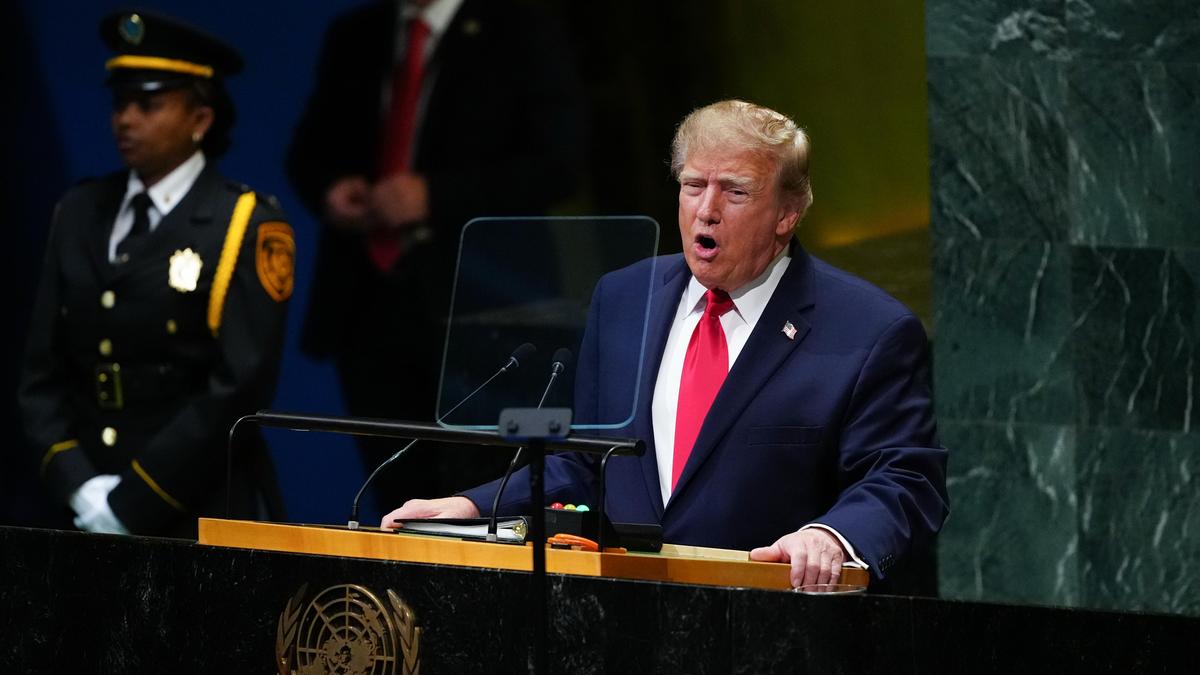

On a day of high-stakes diplomacy on the global stage, U.S. President Donald Trump began his United Nations visit by telling a prominent U.S. journalist, “You should not be here.”
“It’s an honour to be here,” Mr. Trump said as he entered the UN doors on Tuesday (September 22, 2026) ahead of his speech to the General Assembly and faced Kaitlan Collins of CNN, a frequent target of his ire.

“I’m surprised that CNN is here covering me. You should not be here covering me. You said you weren’t going to cover me.”
As Ms Collins noted later on air, CNN said nothing like that. The administration had banned CNN from White House grounds days earlier — along with MS NOW and Politico — and removed the network from pool duty. But CNN had been admitted into the UN as regularly credentialed media.
In any case, the tense moment was a stark reminder of how dramatically the bitter conflict between Mr. Trump and news outlets whose coverage he objects to as “fake news” has escalated in just a few days.

The current ban was the subject of a joint lawsuit filed Monday (September 21, 2026) by the three outlets, asking a judge to find the administration’s move unconstitutional.
The White House had until Tuesday (September 22, 2026) to respond, and a hearing is scheduled for Wednesday (September 23, 2026) afternoon.
Later Tuesday (September 22, 2026), Mr. Trump doubled down on his remarks and said negative coverage was dangerous for the country.
Asked whether he would allow the outlets back in if the court rules against the White House, he said, “Well, it probably will, because this is a judge who’s not a particularly fair judge.”
He was referring to U.S. District Judge Timothy Kelly, whom he appointed in 2017 and who ordered a CNN journalist’s access restored in a similar case in 2018.
“So you never know,” Mr. Trump added. “I think we have a right to clean out fake news.”
Mr. Trump’s comments echoed others he’s made since announcing the ban on Friday (September 18, 2026). He has referred to “purposely negative stories,” but cited no specific stories — only generally “fake news” — as justification for the ban.
The ban and lawsuit are part of a long-running conflict between the President — especially in his second term — and media outlets he finds unfavourable.
Mr. Trump has responded in the courtroom or with regulatory action. He’s also lashed out at individual reporters in person or over social media, sometimes in strikingly personal terms — as he has with CNN‘s Collins, most recently in a speech at the White House Correspondents’ Association dinner.
On air, after her exchange with Mr. Trump on Tuesday (September 22, 2026), Ms. Collins said: “We never said we were not going to cover the President. We will do our best to cover him each and every day.”

Tuesday (September 22, 2026) began with an item missing from the daily press schedule issued by the White House: It did not list the U.S. network pool, a departure from the norm.
CNN had been the designated pool network for the President’s trip to New York, according to a schedule that divides coverage of certain events between the five major networks. But Mr. Trump’s ban removed it from pool duties.

The other pool members agreed, in solidarity, not to replace CNN with another network on the coverage, and further to suspend all pool coverage until further notice.
Other news outlets also took steps in solidarity. The Associated Press joined a number of news organisations, including The Washington Post and The New York Times, in a decision not to publish photographs of presidential events Monday (September 21, 2026).
It remains to be seen how long both the ban and the collective media action will continue.
In speeches and meetings on Tuesday (September 22, 2026), Mr. Trump was seen plenty by global audiences, thanks to UNTV — the official United Nations broadcast arm — and pool journalists covering other international leaders.
Meanwhile, a sign was spotted in the White House workspace: “I stand with AP, CNN, MS NOW, Politico.”
One longtime TV analyst says the lack of constant coverage will prove damaging to a spotlight-loving President — which may be one reason the standoff ultimately ends.
“This ban is not going to go on forever because he doesn’t want that to happen, any more than anybody else,” said Robert Thompson, director of Syracuse University’s Bleier Centre for Television and Popular Culture.
In the short term, Mr. Thompson said, audiences won’t feel the impact in a lasting way — after all, he noted, there are many ways people get news outside of network coverage.
“We are not going to be deprived of important civic information,” Mr. Thompson said, as might have happened years ago when outlets and options were fewer.
On the other hand, if viewers were interested in what Mr. Trump said as he inaugurated a helipad at the White House on Monday (September 21, 2026), they were out of luck: The sound of Mr. Trump’s whirring, waiting helicopter drowned out his remarks. TV network crews usually work to capture clearer audio.
On a deeper level, Mr. Thompson said news consumers will be impacted in a more serious way. He called out Mr. Trump’s remarks labelling negative media coverage “dangerous” as troubling.
“These casual remarks, not even disguised, about what we always considered basic freedoms of the press … that, I think, is a lot more serious,” he said.
Published – September 23, 2026 06:47 am IST