






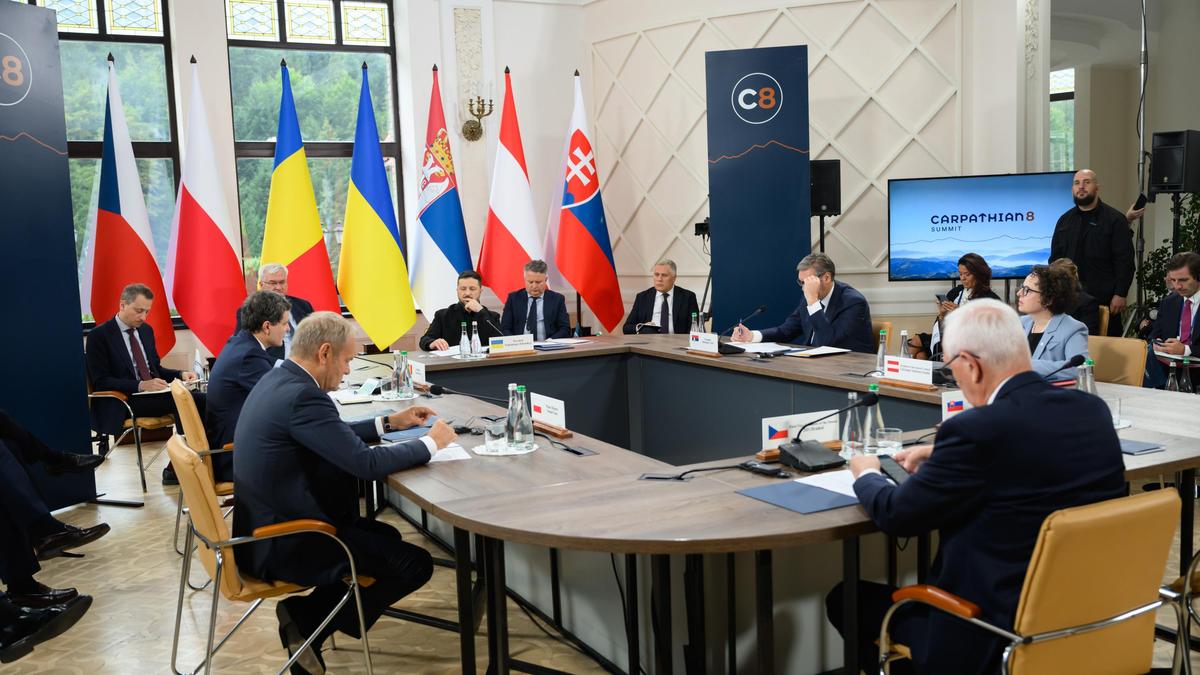


Ukrainian President Volodymyr Zelenskyy and EU officials attend a summit in a Carpathian 8 Summit in Bukovel, western Ukraine, on September 18, 2026.
| Photo Credit: AP
Ukrainian President Volodymyr Zelenskyy hosted leaders and representatives from seven regional countries for talks on deepening cooperation on Friday (September 18, 2026), after overnight Russian strikes in multiple regions sparked fires and caused several deaths and injuries.
The inaugural summit of the so-called “Carpathian Eight” brings together Ukraine, Romania, Serbia, Poland, Slovakia, the Czech Republic, Austria and Hungary, with the European Union also involved.
It comes as U.S.-mediated efforts to end Russia’s 4.5-year full-scale invasion have stalled, with the issue of territorial concessions in eastern Ukraine among the central sticking points. Ukraine is also seeking security guarantees from partners for a deal.
The summit also comes as three days of voting began in Russia’s first wartime parliamentary election, which features virtually no opposition to President Vladimir Putin’s party and is all but certain to secure the Kremlin’s political dominance.

Some of the nations attending the meeting in western Ukraine’s Ivano-Frankivsk region, such as Poland and Romania, have been staunch supporters of Ukraine. Others, such as Hungary, Serbia and Slovakia, have refused to provide Kyiv with direct military assistance.
Mr. Zelenskyy wrote on Telegram that the summit was a “significant beginning” of a movement intended to “further strengthen ties between our countries and create another strong element of cooperation at the EU level.” He added that the participating countries would work together on security, energy, logistics, cross-border economic ties and support for local communities.
European countries concerned over Russian hybrid threats
The meeting in the western Ukrainian ski resort of Bukovel came amid increasing concern among many European countries that Russia is ramping up hybrid threats including sabotage, cyberattacks, disinformation and potential drone incursions into NATO territory.
Mr. Tusk, Poland’s Prime Minister, warned on Thursday (September 17, 2026) before departing for Ukraine that Moscow is planning hybrid strikes with drones or rockets on European countries supporting Kyiv, among them Poland.

Officials in Poland, Germany and Denmark have in recent weeks accused Russia of involvement in drone incursions, sabotage, arson, surveillance of defense facilities and planning to use a drone carrying explosives to attack an airport.
European Commission President Ursula von der Leyen said on Wednesday (September 16, 2026) that the EU needs a NATO-like mechanism to better respond to hybrid attacks blamed on Russia, and to develop “a consensus on how to respond to certain incidents … that fall below armed aggression but clearly threaten our national security.”
Putin issues a new warning against seizing Russian ships
Speaking at a meeting of a government commission on new weapons, Mr. Putin declared that the Western claims about Russia’s purported aggressive plans were intended to justify a boost in defence spending. He again denied that Russia has any hostile intentions toward Europe, but warned that it will be forced to respond to any aggressive action by Western allies, such as the seizure of merchant vessels operated by Russia.
“Let’s live in peace, otherwise we will be forced to respond in kind – it must be quite obvious to everyone,” he said.
Last month, Mr. Putin threatened retaliation for Western seizures of Russia’s commercial vessels, describing them as “piracy.” He warned that the Russian response wouldn’t necessarily come in the waters where the Russian ships were seized, noting that Moscow could retaliate in any area.
Russia is believed to be using a fleet of hundreds of ships to evade international sanctions imposed after Moscow sent troops into Ukraine in February 2022.
France and the U.K. have detained tankers suspected of being part of Russia’s “shadow fleet” shipping oil in violation of international sanctions. The EU has sanctioned hundreds of “shadow fleet” ships.
Russia has recently started deploying warships to escort its commercial vessels.
Published – September 19, 2026 03:56 am IST