



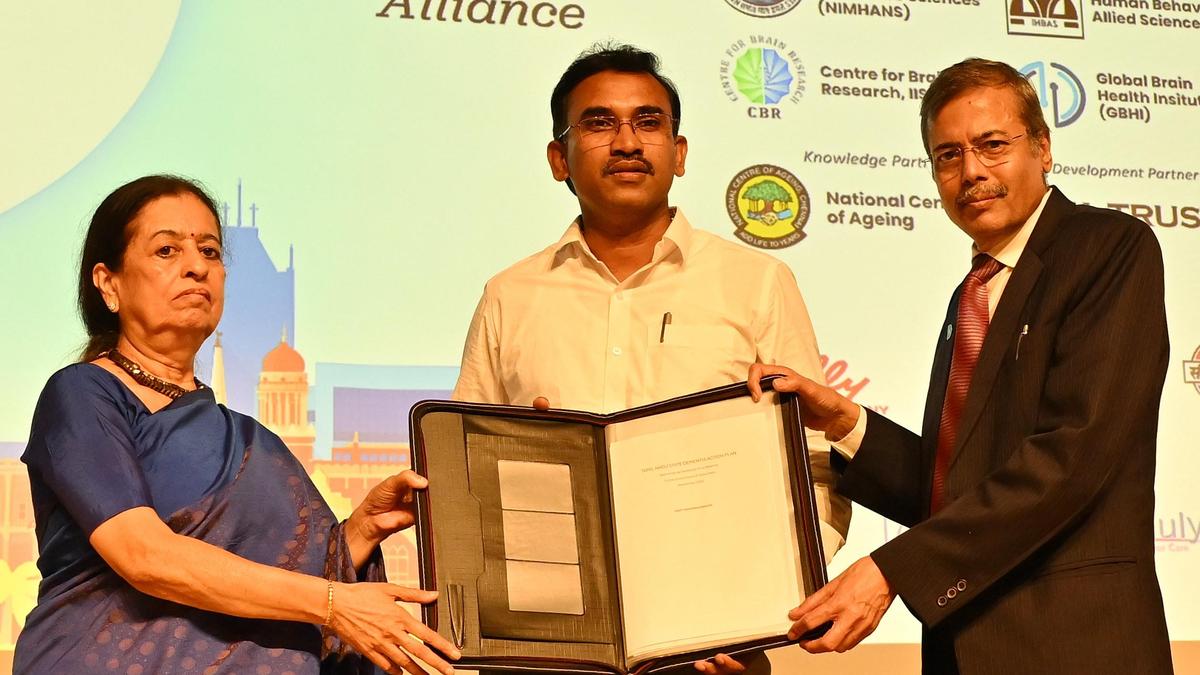


Health Minister K.G. Arunraj and representatives of the Dementia India Alliance signing an MoU on the ‘State Dementia Action Plan’ at IIT-Madras Research Park in Chennai on Friday.
| Photo Credit: B. VELANKANNI RAJ
Health Minister K.G. Arunraj said on Friday that dementia would be treated as a public health priority in Tamil Nadu and the State government would work with its partners to develop and implement a coordinated “State Dementia Action Plan”.
Speaking at DemCon 2026, an international dementia conference organised by the Dementia India Alliance (DIA), in association with the Department of Health and Family Welfare, Government of Tamil Nadu, he promised that Tamil Nadu would become a dementia-friendly State.
The State, Dr. Arunraj said, has always been recognised for its strong public health systems and commitment to taking healthcare to the community. “As our population ages, we must ensure that healthy ageing, brain health, and dementia care become an integral part of our public-health agenda,” he said. With a Memorandum of Understanding (MoU) signed between the Health Department and DIA, he called it an important step in this direction. It provides a framework for strengthening awareness, early identification, screening, diagnosis, care pathways, caregiver support, capacity building, and research across the State, he added.
“Dementia is not simply a condition affecting memory. It affects a person’s independence, dignity, and quality of life. It also has a profound emotional, social, and economic impact on families and caregivers,” he said.
Dr. Arunraj said as doctors, they understood the importance of early identification, timely diagnosis, appropriate clinical care, and continued support. “But we also know that medical care alone is not enough. Dementia requires a continuum of support — from awareness and risk reduction to screening, diagnosis, treatment, rehabilitation, caregiver support, and long-term community-based care,” he said.
The objective must be to ensure that a person living with dementia, whether in a city or in a rural community, can access appropriate support as early as possible and that families do not have to navigate this journey alone, he said.
Dr. Arunraj said there was a need to work towards improving public awareness and reducing the stigma surrounding dementia, promoting early identification and timely referral, strengthening the capacity of doctors, nurses, and community health workers, building dementia-responsive services within the existing health system, supporting caregivers and families, promoting healthy ageing and brain health across one’s life, and encouraging research, innovation, and evidence-based approaches to dementia care.
“I am confident that Tamil Nadu, with its strong public health foundation and its network of healthcare professionals and institutions, can demonstrate a model for dementia care that can inspire other States across India,” he added.
Ramani Sundaram, executive director, DIA, said: “Dementia is not only a medical issue. It affects families, communities, and the health and social care systems that support them. A State-level approach gives us an opportunity to bring these pieces together — from recognising the signs earlier and strengthening diagnosis to building care pathways, supporting caregivers, and developing a trained workforce.”
Published – September 18, 2026 10:01 pm IST