


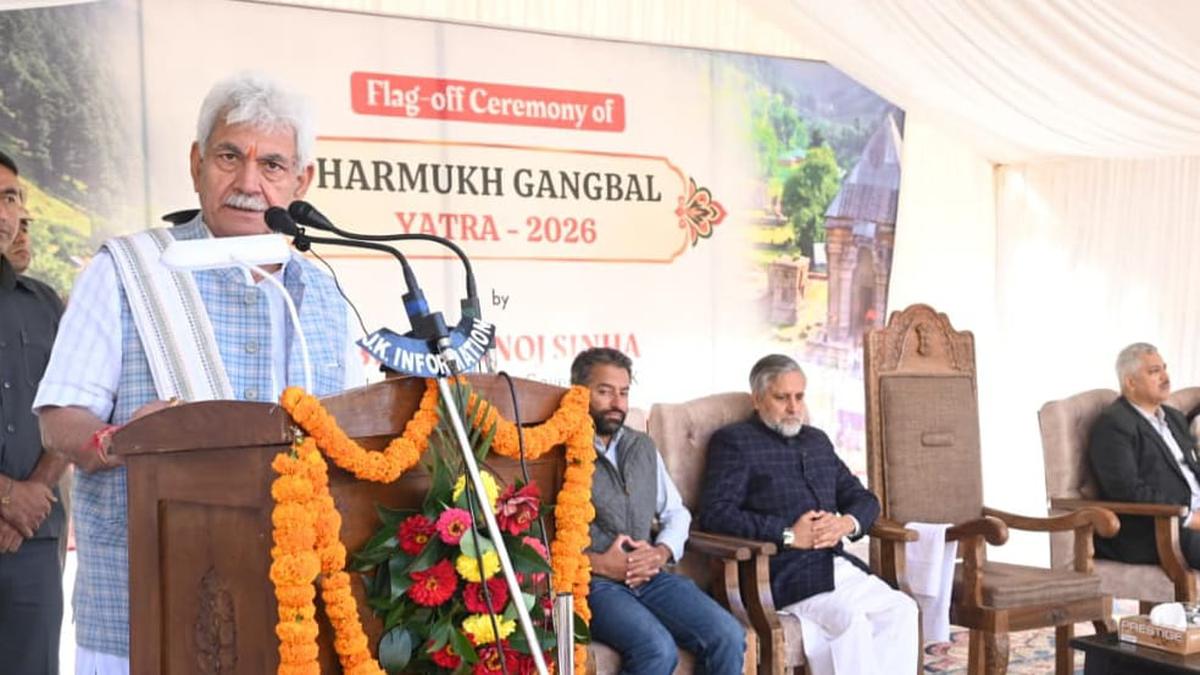


Jammu and Kashmir’s Lieutenant-Governor (L-G) Manoj Sinha, speaking at the Harmukh–Gangbal pilgrimage at Ganderbal Central Kashmir on September 18, 2026. Photo: X/@manojsinha_
Jammu and Kashmir’s Lieutenant-Governor (L-G) Manoj Sinha on Friday (September 18, 2026) flagged off the Harmukh–Gangbal pilgrimage at Ganderbal in central Kashmir. He described Harmukh as the abode of Lord Shiva and the Gangbal lake as the embodiment of the sacred presence of Mother Ganga.
“Mount Harmukh, also known as Harmukut, is revered as the abode of Lord Shiva, while Gangbal Lake at 14,500 feet is regarded as the sacred presence of Mother Ganga,” said Mr Sinha, while citing the Nilamata Purana.
He said the sacred yatra embodied purity, devotion, and unity in diversity, and that it is a living expression of eternal faith that strengthens our soul, connects us with nature, and inspires harmony. “The Yatra is a sacred bridge between India’s glorious past and vibrant present,” said Mr Sinha.
The L-G said that Jammu and Kashmir has, for millennia, been nourished by an unbroken stream of faith, with every step of its land imbued with spiritual energy, as highlighted by Kalhana in the Rajatarangini. “Despite difficult terrain and historical upheavals, devotees have preserved their spiritual bond with this pilgrimage site, which is also associated with paying homage to ancestors, comparable in sanctity to Haridwar,” he added.
The L-G said the Himalayan pilgrimages teach humility before nature and inspire noble thoughts from all directions, fostering social harmony. “I firmly believe that the Harmukh–Gangbal pilgrimage is a living expression of this immortal faith. On the pilgrimage, no one is superior or inferior. All are seekers of truth, united in spirituality. This is the strength of our eternal culture,” he said.
Highlighting the relevance of pilgrimages in contemporary times, Mr Sinha urged pilgrims to pledge to protect nature, especially in the context of climate change and environmental challenges. Such spiritual journeys strengthen the nation’s soul and collective consciousness, he added.
“I often say that Himalayan pilgrimages teach us two important lessons. First, I am not the master of nature but its custodian. Second, noble and beneficial thoughts should come to us from all directions so that we may make society more prosperous. I believe that, in our eternal culture, pilgrimage has always been a great force for social harmony.
He stated that the Harmukh–Gangbal pilgrimage enables us to convey to the younger generation that our eternal culture embodies not only the consciousness of the present but also the direction of the future.
He appealed to the citizens and the Harmukh Ganga Gangbal Trust to actively participate in activities such as cleanliness drives, blood donation camps, health camps, tree plantation drives, and youth programmes.
“May the snow-clad peaks of Harmukh inspire us to cultivate lofty thoughts, and may the blessings and compassion of Lord Shiva remain with all the pilgrims,” he said.
Published – September 18, 2026 10:29 pm IST