






The elevation of seven district judges to the Delhi High Court recently has once again drawn attention to the narrow path from the subordinate judiciary to the higher Bench, where judicial officers account for only a fraction of the judges despite spending decades deciding cases at the trial-court level.
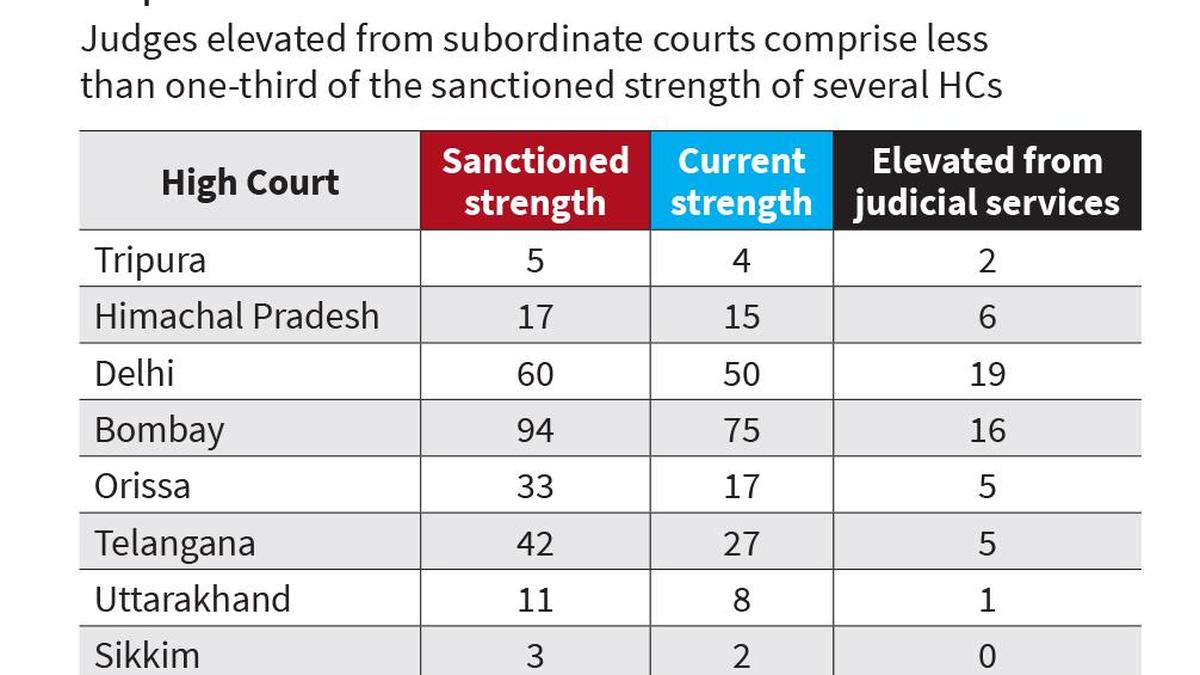
With Chief Justice D.K. Upadhyaya having administered the oath of office to the new judges, the Delhi High Court’s working strength has risen to 50 against a sanctioned strength of 60, of which 19 judges have been drawn from the subordinate courts.
While Article 217 of the Constitution provides two distinct streams for High Court appointments — members of the Bar and judicial officers — it prescribes no fixed numerical ratio between them. However, a conventional norm has been that two-thirds of vacancies are drawn from the Bar while only one-third are from the judicial service cadre.
The origins of this skewed ratio go back to British rule, said Justice (retd.) R.K. Gauba, who rose from the subordinate cadre to serve on the Delhi High Court Bench.
“Under colonial rule, magisterial courts were predominantly manned by Indian Civil Service officers, focused heavily on faujdari (criminal) administration. They were not interested in deewani (civil) courts. The Constitution mandated a clear separation of the executive from the judiciary, which led to the creation of independent State Judicial Services,” he told The Hindu.
“As the grassroots judiciary developed, logic dictated providing a structured career path. With two constitutional sources, the cake ought to have been divided equally if not more for the judicial services given their vast Bench experience,” he added.
Most law graduates join the judicial service as civil judges in their late twenties. From there, it’s a slow climb. It usually takes about 10 years to become a senior civil judge, and another decade to reach the rank of a district and sessions judge.
Fleeting opportunity
By the time an officer enters the zone of consideration for elevation to the High Court, they are often in their late fifties, leaving them with just a few years before reaching the retirement age of 62.
This progression bottleneck also severely restricts their presence in the Supreme Court. The current composition of the Supreme Court includes no sitting judges who began their careers in the trial court judiciary.
The last such appointment was Justice Bela M. Trivedi in August 2021, who retired in June 2025.
As per official data, the one-third norm has also not been achieved in most States. Across the country’s sanctioned strength of 1,114 High Court judges, only 233 judges elevated from the district judiciary are currently in office.
The High Courts of Tripura (40%), Himachal Pradesh (35.29%) and Delhi (31.67%) exceed or come close to meeting the norm, even as other States lag far behind. Service judges constitute just 9.09% in the High Courts of Uttarakhand and Chhattisgarh, 11.90% in Telangana, 15.15% in Odisha and 17.02% in Bombay HC. Sikkim currently has zero representation from State Judicial Services.
In 2023, an application was moved by the Judicial Service Association of Delhi before the Supreme Court seeking a direction to fill 50% of the seats in the High Court from the service quota.
However, in the order passed on April 25 of that year, a Bench of Justices B.R. Gavai, Vikram Nath and Sanjay Karol stated it was “not inclined to consider the prayer, leaving it open to the applicants to pursue the remedies before such forum as is permissible in law”. It directed the High Courts to recommend names from the service cadre before vacancies arose, noting that service judges often had only a few years of tenure in the High Courts.
Attracting talent
Former Principal District and Sessions Judge Pawan Kumar Jain told The Hindu that the lack of clear career progression discourages top law graduates from joining the lower judiciary.
“If after serving 20 to 30 years one fails to reach the High Court at a reasonable age, the system will fail to attract brilliant minds. The institution must prioritise the litigant and fill vacancies efficiently,” he said.
Justice Gauba argued that filling High Court vacancies from the service cadre is significantly faster.
“With judicial officers, performance appraisals, integrity reports, and decades of judgment records are already available. Recommendations can be processed months in advance without leaving vacancies open for years. By reserving a disproportionate share for the Bar, we are ultimately depriving citizens of judges who are trained, experienced, and ready to deliver prompt justice,” he added.
Published – September 29, 2026 12:56 am IST