


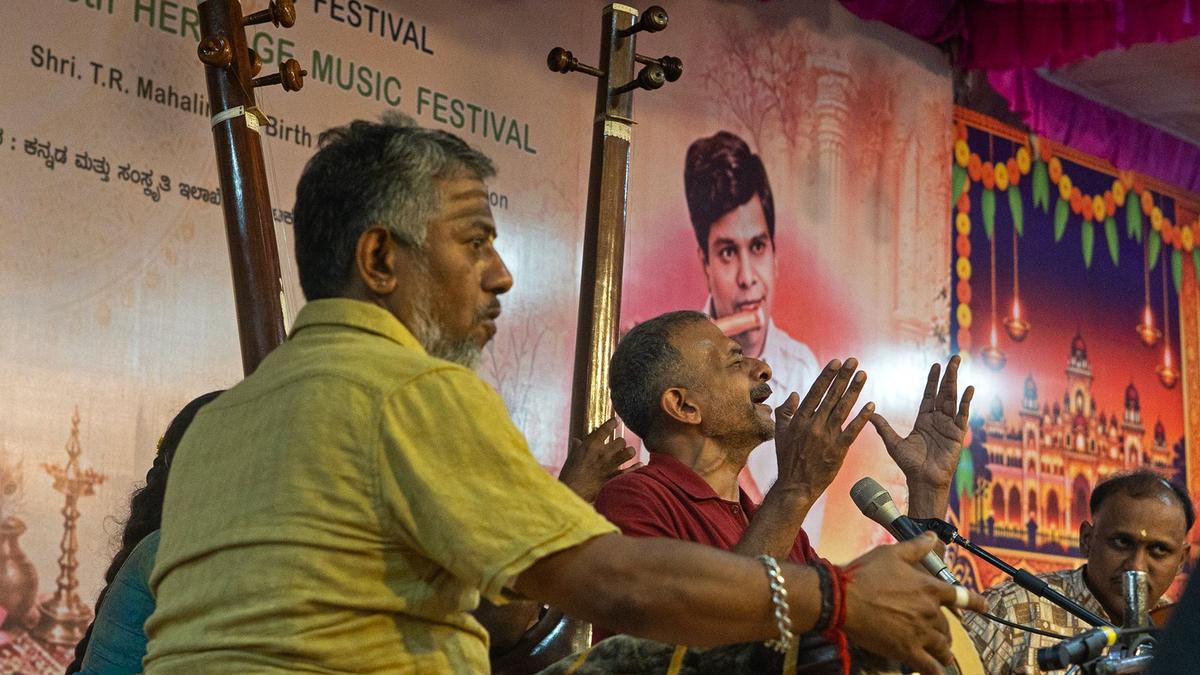

Perhaps, after many years, the audience in Mysuru witnessed T.M. Krishna begin a concert with a varnam, as has been the Carnatic convention. He was at the 8th Cross Ganapathi Music Festival, organised by SPVGMC Trust, with Tiruvananthapuram Sampath on the violin, B. Sivaraman on the mridangam and Guruprasad on the ghatam. At this pandal that celebrates 65 years of bringing music to – literally – the street, rasikas sat before him and, to his right, spread in an L-arrangement (a new feature this year). Krishna opened his concert with the ata tala varnam ‘Sarasijanabha’.
Even so, there were no regulations governing his music, only timely possibilities: out of nowhere, like the stretch of the phrase had split open a byway, Krishna embarked on a niraval at the anupallavi, ‘Niratamu nee’. In a sweeping single round, he covered three octaves and, in the same momentum, continued in a different kalapramana.
While he usually sketches Kamboji with serenity, cued by ‘O rangasayee’, ‘Sri subrahmanyaya namaste’ or ‘Tiruvadi sharanam’, the markers of this presentation were its robustness and muscularity, especially as the niraval built to a crescendo.
Sampath was in full form in the very first song, responding to Krishna’s dynamism. Krishna’s manodharma mostly hinges on a phrase: when you find an interesting pakad, as Hindustani musicians would call it, you must hover around it and explore its many variations. The sarvalaghu cocooning phrase ‘ma ga ma ri ga sa pa ma pa ga ma ga…’ in the third ettugade swara was one such pakad. Krishna egged his violinist on to stay with the phrase and work around it for the swaraprastara, where otherwise the temptation may have been to move linearly, forward and backward.
Krishna’s ‘Sarasijanabha’ presentation at Mysuru’s Ganabharathi eight years ago, suffused with that soft tonality, stretched for about 40 minutes. This rendition, though, with more gusto, gave us a different experience. At points, the sheer power one was bracing for was such that — with the mridangam no doubt adding volume — Krishna’s voice, slightly ajar, the acoustics as good as they could be on a road – one had to wonder if this was a new turn in his music.

While Krishna usually sketches Kamboji with serenity, the markers of this presentation were its robustness and muscularity, especially as the niraval built to a crescendo.
| Photo Credit:
Courtesy: M. Prabhu Prasad
The rest of the concert put an end to such speculation, for we were led into a contemplative territory, first transported to a reposeful Yamunakalyani and the familiarity of his much-cherished ‘Jambupathe.’ A few years ago, Krishna rendered the kriti in its accurate tranquil version. The 8th Cross edition gained even more poise as Sivaraman and Guruprasad chose not to complement, a wise accompaniment decision. There has, perhaps, not been a single occasion when Krishna reaches ‘Anirvachaneeya nada bindo’ without everyone and everything falling silent. It must be observed, if only to note how space affects musical experience, that there was a strange restlessness among the audience, in my estimation, because the agape atmosphere did not fully allow the kind of singular immersion that ‘Jambupathe’ inspires.
What followed was ‘’Chinna nade na’ in raga Kalanidhi, a kriti whose melody has been immortalised by the legendary flautist T.R. Mahalingam. The music festival was dedicated to his memory on the occasion of his birth centenary year.
After a binding Dhanyasi alapana, Krishna took up ‘Meena lochana’. The singing showcased the uniqueness of Syama Sastri’s style, in which the phrases coalesce around one another — only accentuated by the specific gamakas of Dhanyasi. An immense composition, it is intense rather than expansive, like ‘Sangeeta gnanamu’ in the same raga. ‘Meena lochana’takes musicians of true regard to apprehend and recreate its compact and dense universe. We can continue to believe that a raga exists fully formed and is emptied, in parts and parcels, into a composition. But what’s immanent in Krishna’s rendition is that a specific aesthetic of a raga emerges from a good kriti.
It one of the most beautiful kalpanaswaras, the gandhara traversed the entire raga and returned, without ever seeming like the singer had ascended and descended through the many notes of the raga’s scale. Even when Krishna expanded a phrase to a larger set of notes, he had to spin through the entiretyof the range. Sivaraman’s mridangam layered this presentation with its own repetitive charm. Krishna exploited the musically complex rhyme scheme in the charanam, and hung the final notes on a different hook every time. The resultant shifting of enjambments, in a clustered composition such as this one, ensured that we heard a percussive variation in the very instruments of melody: the voice and the violin.
Given that the thani continues to carry the trace of the immediate composition, for the percussion to have continued without a break after ‘Meena lochana’ might have ushered in a kind of claustrophobia. Fortunately, a vigorous thani only came after the next song, ‘Nadopasana’ in Begada. Throughout, Guruprasad’s patterns were innovative.
After ‘Tunga teera virajam’, in Salagabhairavi (rather than Yamunakalyani, which he presented a month ago in Mysuru), there was a sense that the music for the day was done, even as music never suffices, amongst some audience members and perhaps Krishna himself, who was at a loss about the next number. He emphasised that insatiability when he performed three audience requests one after the other: ‘Irakkam varamal’in Behag, ‘Eppo varuvaro’ in Jhonpuri, and ‘Maye tvam yahi’ in the Tarangini of the Sangita Sampradaya Pradarshini. All melodies of pleading, he left us in a state of longing even after a grand concert of three hours.
Published – September 30, 2026 04:20 pm IST