





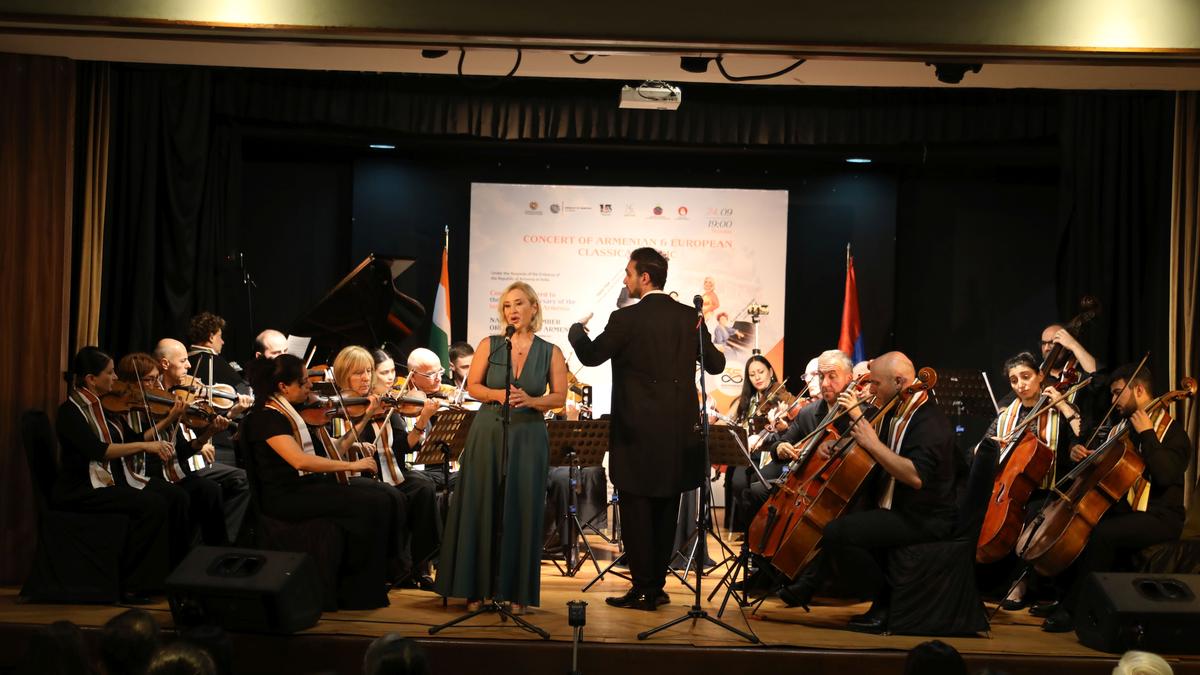

Music can travel across borders without needing a passport. That was evident at the Armenian and European classical concert presented by the National Chamber Orchestra of Armenia at the Music Academy, Chennai, on September 24. It was part of the celebrations marking the 35th anniversary of Armenia’s independence.
Hosted by Shivkumar Eashwaran, Honorary Consul General of the Republic of Armenia, the evening brought together a 21-member chamber orchestra under the direction of conductor and artistic director Sipan Olah. Violinist Astghik Vardanyan, pianist Katarine Hovsepyan and soprano Shoghig Torossian joined the ensemble for a programme that moved from Armenian classical music and folk-inspired works to ballet excerpts and European compositions.
Armenian music carries within it a remarkable layering of history, spirituality and cultural resilience. Its traditions encompass the austerity of monophonic folk song, the expressive contours of sacred music and the more elaborate vocabulary of concert music. The programme, comprising 13 pieces, offered glimpses into this diverse landscape.
A central figure in the preservation and development of Armenian musical identity is Komitas Vardapet, whose meticulous documentation of folk traditions helped connect the musical life of Armenian villages with the concert platform. His Al Ailughs was among the works presented, providing an important reminder of the folk roots that continue to inform Armenian art music.

The 21‑member Armenian Chamber Orchestra was conducted by artistic director Sipan Olah
| Photo Credit:
Special Arrangement
The evening’s most intriguing point of convergence with India came through Arno Babajanian’s ‘Nocturne’. Olah mentioned Babajanian’s visit to India in 1976. Listening to the piece, one was struck by similarities in the melodic contours of the song ‘Tu mera jaanu’ from the 1983 Hindi film Hero, composed by Laxmikant-Pyarelal. Whether it is coincidence or influence, the resemblance was unmistakable. Katarine’s piano established the nocturnal atmosphere before the strings gradually took over the principal melody, eventually returning to the piano. The effect was less a literal depiction of night than an evocation of its stillness — music that seemed to linger rather than move forward.
Such moments also revealed Olah’s sensitivity to the relationship between individual sections and the larger musical architecture. The ensemble displayed considerable attention to unified bowing, intonation, tone, phrasing, vibrato and articulation. More significantly, these elements did not appear as isolated technical achievements, but contributed to a cohesive orchestral sound.
In Khachatur Avetisian’s ‘Blossomed Cherry Tree’, the interplay between piano, contrasting instrumental voices and pizzicato passages created a finely textured sonic surface. ‘Parlami d’amore, Mariù’, the Italian romantic song, brought the soprano into focus, with Torossian shaping the melodic line against the flowing strings. The gradual crescendo towards the upper register was handled with control, allowing the voice to remain integrated with the ensemble rather than dominating it.
Charles Aznavour’s ‘She’, with music by Aznavour and lyrics by Herbert Kretzmer, offered another change of mood. Olah took the vocal line himself; his controlled phrasing, supported by the strings, and bringing to the piece the understated intimacy associated with the song.
Aram Khachaturian’s ‘Sabre Dance’ provided a sharp contrast. Its rhythmic propulsion and rapid exchanges between instrumental sections highlighted the precision of the chamber ensemble. The dialogue between violins, violas, cellos and double basses gave the familiar work an energy that felt both tightly controlled and spontaneous.

The closing ‘Our Beloved Yerevan’, also by Babajanian, brought together Torossian and Olah in a vocal harmony.
| Photo Credit:
Special Arrangement
The closing piece ‘Our Beloved Yerevan’, also by Babajanian, brought together Torossian and Olah in a vocal harmony. By then, the distinction between performers and audience had begun to dissolve, with Olah inviting the listeners into the celebration. The applause became part of the conclusion, turning the finale into a shared expression of Armenian musical identity.
After performances in Kolkata and New Delhi, the National Chamber Orchestra of Armenia’s Chennai appearance offered the city an opportunity to encounter a repertoire that remains relatively unfamiliar to its concert audiences. More importantly, the evening demonstrated how musical traditions, separated by geography, can nevertheless find common ground in melody, rhythm, tonal colour and, ultimately, the emotional language of music.
For Chennai, a city with an enduring and vibrant concert tradition, such encounters are valuable. The Armenian ensemble’s visit underlined the possibilities of creating a more sustained platform for international chamber music, allowing audiences here to discover artistic traditions beyond the familiar repertoire.
Published – September 30, 2026 05:55 pm IST