






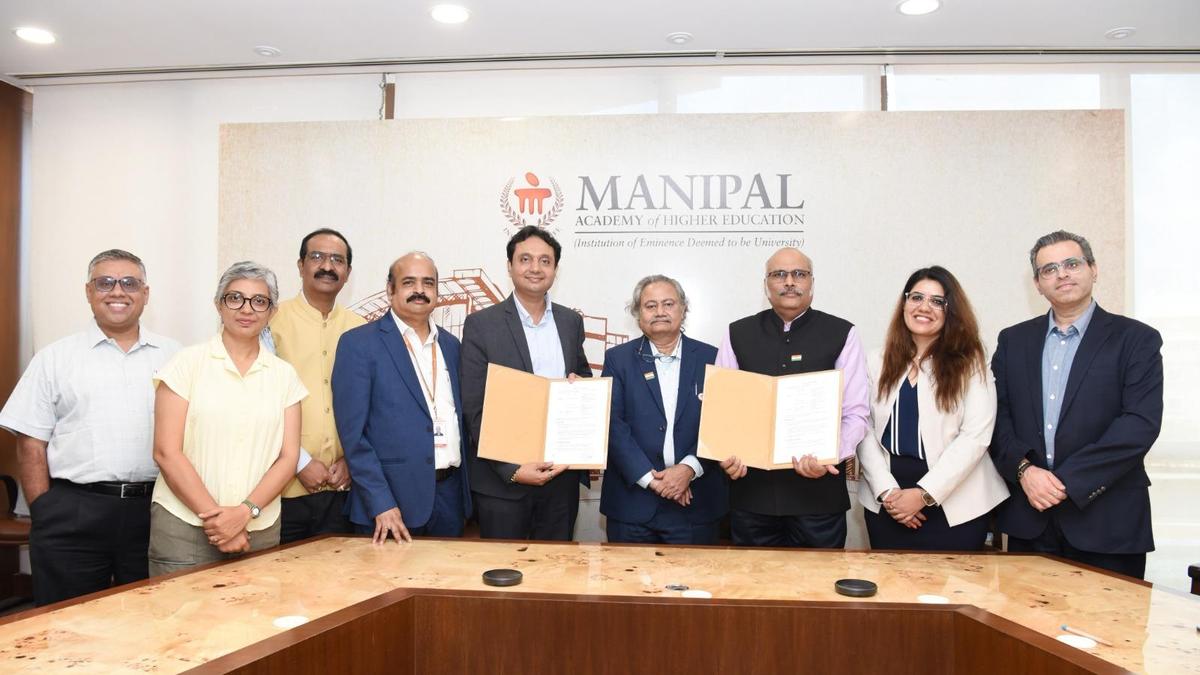


MAHE and Google India signed a Memorandum of Understanding on September 26.
| Photo Credit: SPECIAL ARRANGEMENT
Manipal Academy of Higher Education (MAHE), an Institution of Eminence and a Deemed-to-be-University, has entered into a partnership with Google India to accelerate the adoption of Artificial Intelligence (AI) across the university, with a particular focus on healthcare and medical education.
The partnership forms part of MAHE’s MAGIC (MAHE Agentic Intelligence Console) initiative, through which the university is advancing its vision of becoming a full-fledged AI-agentic university. Under this initiative, MAHE is engaging with global technology organisations to strengthen AI-led innovation, research, education and institutional applications, a MAHE release said.
MAHE and Google India signed a Memorandum of Understanding (MoU) on September 26. The partnership will enable the university to leverage Google’s expertise, technologies and AI capabilities to develop and implement solutions across key areas.
As part of the collaboration, MAHE will work towards establishing a Google-powered AI Centre of Excellence, exploring AI-enabled healthcare research using Gemini and other Google tools, and developing academic collaborations to strengthen AI-based teaching and learning. The partnership will also create opportunities to explore the application of AI in healthcare and medical education and to support faculty and students in adopting emerging AI technologies, it said.
Speaking about the collaboration, K. Sharath Rao, Vice-Chancellor, MAHE, said, “AI is transforming the way universities approach education, research and healthcare. Through MAGIC, MAHE is building an ecosystem that integrates agentic AI into our academic and institutional processes. Our partnership with Google India will bring global expertise and advanced AI capabilities to this effort, with a particular focus on healthcare and medical education. We look forward to developing meaningful applications that enhance learning, research and healthcare outcomes.”
Published – October 07, 2026 08:07 pm IST