


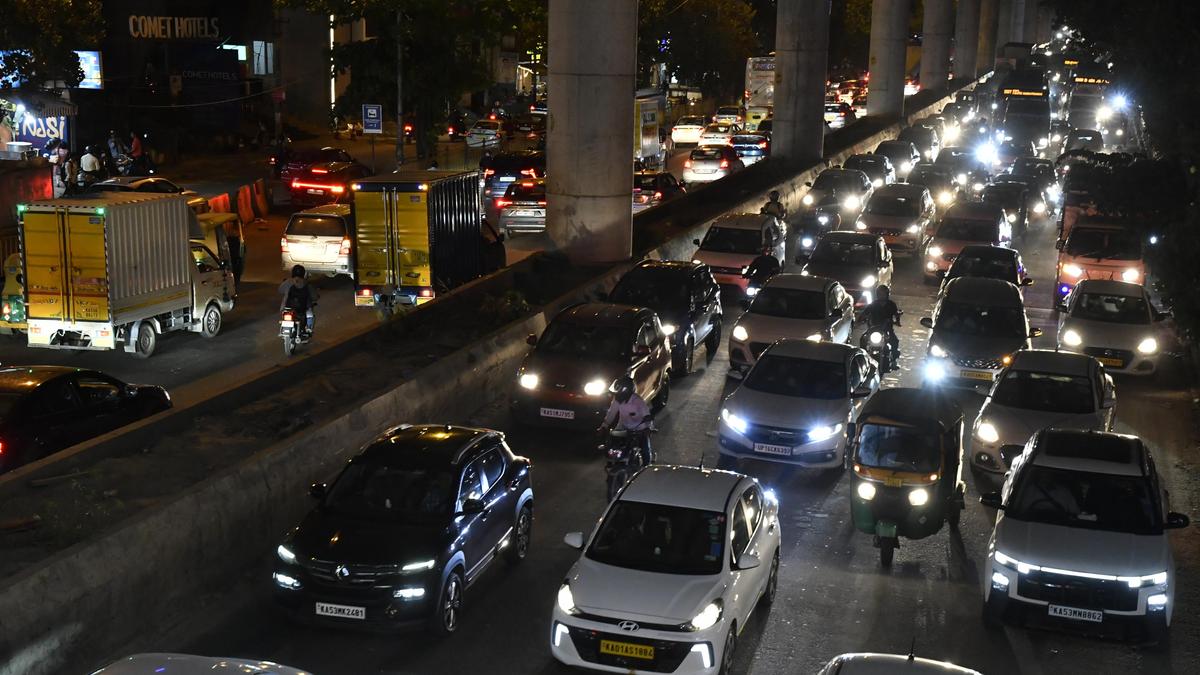

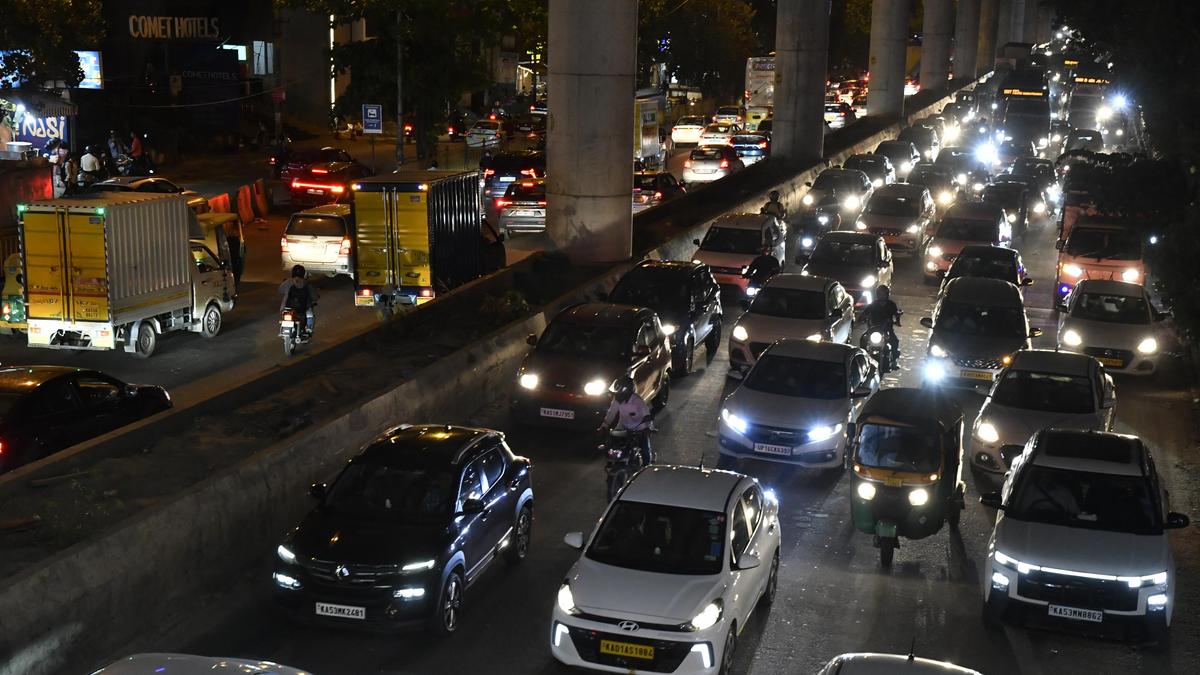
The Outer Ring Road carries four times more vehicles than its original carrying capacity during peak traffic hours.
| Photo Credit: file photo
Following the latest TomTom report that ranked Bengaluru as the second-most congested city in the world, Bengaluru Traffic Police (BTP) officials cited the increasing number of vehicles and ongoing infrastructure works as the primary reasons for the growing congestion.
According to the report by the Netherlands-based technology firm TomTom, Bengaluru was the third most congested city in 2025. In 2025, the average speed in the city was recorded as 16.6 km per hour.
A senior BTP official told The Hindu that daily around 3,000 vehicles are being added across the 10 RTOs in Bengaluru.
Adaptive signals to be introduced
“The ongoing infrastructure works, such as the construction of the metro lines, are also adding to the congestion,” said the official, adding that the department would soon be introducing 110 adaptive signals which are hoped to ease the situation.
The official also stressed on the need for increased usage of public transport to reduce congestion.
The ORR problem
According to the official, one of the biggest pain points has been the heavy traffic on Outer Ring Road (ORR), which carries four times more vehicles than its original carrying capacity during peak traffic hours.
“We have called for a meeting with major companies on ORR early next month to look at ways to solve the issue and encourage public transport for commute. If the ORR problem is solved, it will help ease Bengaluru’s congestion to a large extent,” he said.
Frequent breakdowns
According to data from the Traffic Department, the city witnesses 90 vehicle breakdowns daily on an average, many of them causing slow movement of traffic. “Around 10 to 12 of them are BMTC electric buses,” the official said.
Bus stands located close to junctions and pedestrians crossing roads in the absence of foot overbridges also contribute to the congestion problem.
“We have identified 103 bus stands located next to junctions and have asked the GBA to shift them. Seventy-eight spots, where pedestrians cross the road in the absence of skywalks, have also been spotted, and we have requested GBA to construct foot overbridges in those spots,” the official said.
Published – January 22, 2026 08:21 pm IST