





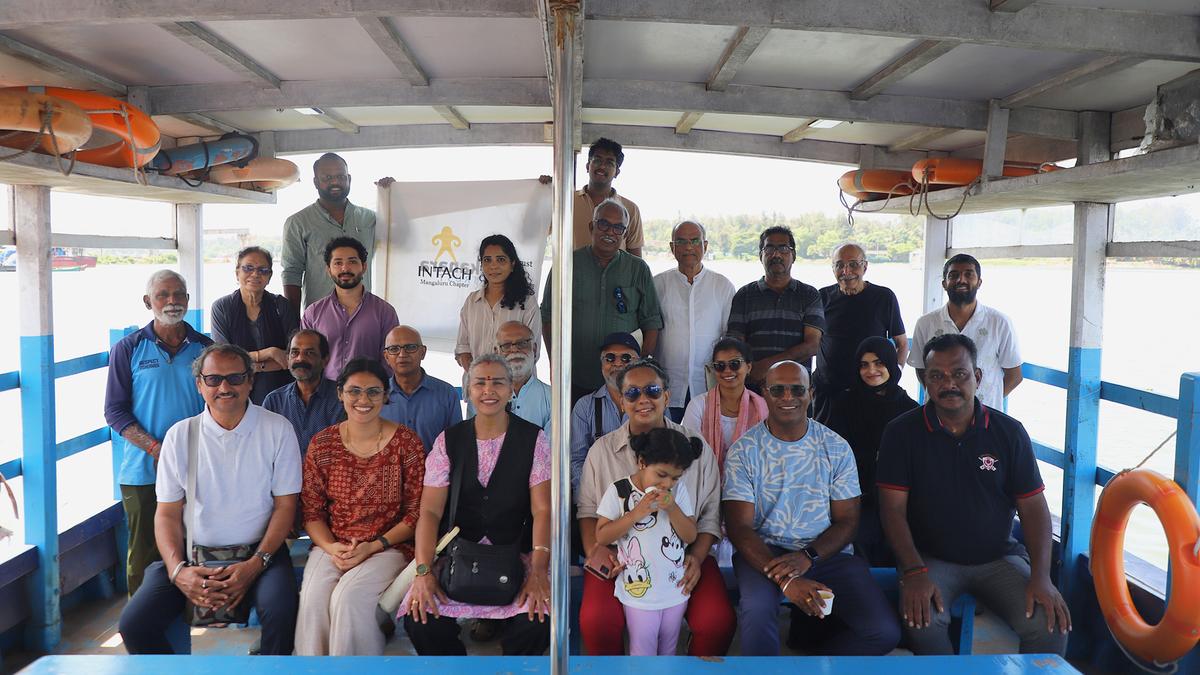


The Mangaluru Chapter of the Indian National Trust for Art and Cultural Heritage (INTACH) organised a special boat-based programme titled ‘A morning by the river’ on Sunday to mark World Rivers Day in Mangaluru.
| Photo Credit: SPECIAL ARRANGEMENT
The Mangaluru Chapter of the Indian National Trust for Art and Cultural Heritage (INTACH) organised a special boat-based programme, ‘A morning by the river’, on Sunday to mark World Rivers Day.
The programme, held on the Phalguni (Gurupura) River, began at the Sultan Bathery ferry point and brought together nature lovers, artists and citizens to reflect on the river’s ecological, historical and cultural significance. The programme also highlighted the gradual loss of traditional knowledge associated with the Gurupura River, including the seasonal formation of temporary islands that once supported the livelihoods of traditional fishermen.

Participants interact with organisers during A Morning by the River, a boat-based programme organised by the Mangaluru Chapter of the Indian National Trust for Art and Cultural Heritage (INTACH) on the Phalguni (Gurupura) River to mark World Rivers Day in Mangaluru on Sunday.
| Photo Credit:
SPECIAL ARRANGEMENT
Introducing the programme, INTACH Mangaluru Chapter convener Subhas Chandra Basu said rivers were an important part of the region’s heritage. “The Gurupura River was crucial to the development of Mangaluru from ancient times. Ports and forts were built along its banks, and water transport was an essential means of moving people and goods. Unfortunately, the city’s development today does not adequately take the river into consideration. It is becoming a dumping ground for the city’s waste,” he said.
Temporary islands
Social activist and environmentalist Yatish Baikampady said the river was once an important means of transport, with people from the Ghats travelling downstream by boat to coastal towns. He recalled a little-known phenomenon associated with the river during the monsoon. Natural debris carried by the river would accumulate at certain places to form temporary islands, locally known as palke, he said.
“These temporary islands were a boon to traditional fishermen. Fish would breed around them, providing an important source of livelihood during the monsoon when fishermen could not venture into the sea. Today, due to dams and other interventions, this system has disappeared,” he added.
Chartered accountant Giridhar Kamath recalled a time when the river was closely integrated into everyday life, with children swimming and bathing in its waters. He noted that the region had historically been blessed with abundant water and that the rivers also served as natural barriers against forces from the sea. “People here knew how to live with floods. But the floods we experience today are largely the result of human intervention,” he said.
The one-and-a-half-hour boat journey offered participants an opportunity to observe the river and its banks while reflecting on the communities and landscapes connected to it. The programme also highlighted the importance of preserving not just the physical river but also the traditional knowledge, memories and ways of life that have evolved around it.
Published – September 30, 2026 10:09 pm IST