





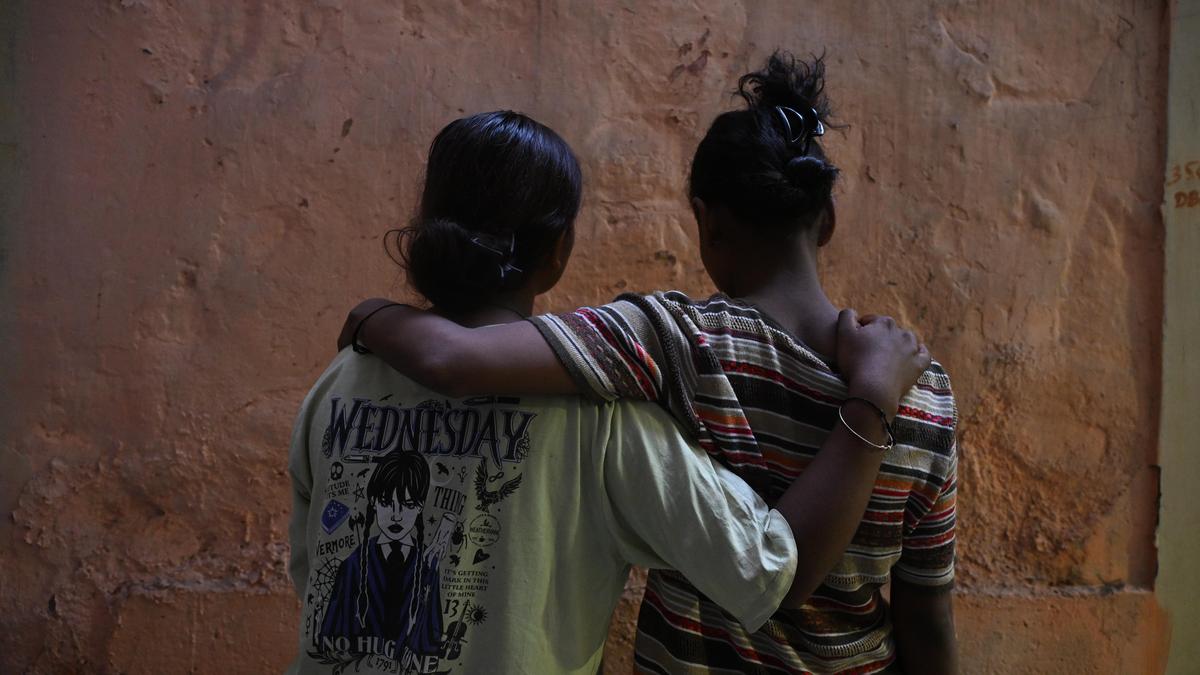

(The names of the two sisters have been changed to protect their privacy)
Shobha, 46, lives in a makeshift home along a road in Old Delhi’s Yamuna Bazar. She came here two decades ago, from Kanpur, in Uttar Pradesh, after she separated from her husband and found no support from her family. She brought her five children; one of them went missing as a baby and another died, she believes, of a drug overdose. Initially, she begged for survival, but soon realised it was not enough to feed her children. She started selling stickers, earning ₹100-150 a day. “I dream of my daughters living their lives without having to beg for safety and freedom. I know I haven’t been able to provide for them but despite that, they have done way better than me in their lives. I am also changing because of them,” she says.
Seema and Neha, her two daughters who grew up on the streets, now live about 20 kilometres away from their mother in paying guest accommodation in south Delhi’s Mehrauli. While Seema goes to college and works part-time at a pizza place, Neha is grappling with depression and trying to find her footing in life.

Seema: the hope for a home of her own
For Seema, 19, home has always been a road in Yamuna Bazar. Here, traffic hurtles past footpaths lined with tarpaulin-covered dwellings. Located on the western bank of the Yamuna river, about a kilometre away from the old Yamuna bridge, “sadak”, road in Hindi, is how she describes her childhood home. Her matter-of-fact tone belies the complexity of the life she has lived there.
“I was seven when I first sniffed ‘sulochan’,” she says, a corruption of solution, the fast-drying glue used to plug holes in cycle tyre tubes. “My sister started it first when she was nine. Our peers were already into it, so naturally, we fell into it too,” she says. The glue is easily available at any cycle repair or mechanic’s shop.

In Seema’s words, the inhalant provided a cushion from the hard everyday life of road-dwelling: fighting off sexual offenders, bullying by older kids, hunger, and a general sense of loss and non-belonging.
“We would not have a sense of the world (after inhaling the solution). My sister’s condition kept getting worse,” Seema says. Once, she kept on saying, ‘Mai kaun hoon (Who am I)?’ She was 13 then. That’s when our mother decided to seek help.”
Someone had told their mother about a shelter home. “We went to Kilkari, a shelter home run by the Salaam Baalak Trust at Kashmere Gate. Later we were shifted to Udaan, also run by the same organisation, which was in Kamla Nagar then (now in Dilshad Garden),” she says.
The shelter home had a strict daily regimen: wake up at 6 a.m., get ready for school, go to school at 8 a.m., come back at 4 p.m., have dinner at 8 p.m., and be in bed by 9 p.m.
“It took some time to get used to it. Initially it felt like it was curbing my freedom,” Seema says. “But gradually, I settled there, found an interest in reading books, even found art, dance, and music. For the first time, someone asked me what I wanted my life to be like. That made all the difference,” Seema says.

“For the first time, someone asked me what I wanted my life to be like. That made all the difference”SeemaStudent and part-time worker
That’s when she began to dream, to see herself living near the mountains, in a home with a room of her own. “No one would be able to enter or touch my things without my permission. I want a place where I am not judged, where I feel safe and respected,” she says.

She adds that she was able to anchor her life with the counselling and guidance she received in the shelter home. Seema says she has no interest in marriage. “I have seen my parents’ marriage fail. I don’t think I can marry anyone ever,” she says. But she did hope for a foster family.

A Comptroller and Auditor General report tabled in the Delhi Assembly in March 2026 flagged systemic gaps in the childcare system, from unreliable data, dysfunctional child-protection bodies to a 76% staff shortage, poor infrastructure and healthcare. It also flagged delayed rehabilitation and the failure to implement sponsorship and foster care schemes.
Having enrolled in Class VI, Seema was forced to leave by Class XI, when her mother fractured her hand. “I had thought I had left Yamuna Bazaar forever. When that happened I felt I would always end up there,” she says.
While taking care of her mother in the hospital, she studied, earned money, and financially supported her family. After passing Class XI, she managed to get admission at Tech Mahindra Smart Academy for Healthcare, where she is pursuing a year-long Diploma in Medical Laboratory Techniques, with the help of NGOs Rainbow and Udayan.
Seema worries about her mother. “Members of the Bajrang Dal and local police continue to harass her for setting up a tiny shop on the road. They use force and extract money, saying it is illegal to set up shops in that area,” she says. She complained to senior police officers about a mobile theft. “They directed all their anger at us and started harassing my mother,” she says. Shobha is exhausted. She plans to move back to Mathura and live with friends.
On May 11, the Delhi government announced the Aftercare Scheme for Young Persons, meant to support those who leave childcare institutions at 18. The scheme, with a ₹3.5 crore budget, aims to provide financial assistance and guidance for higher education and employment opportunities. Officials say it is yet to come into operation.

While Seema goes to college and works part-time at a pizza place, Neha is grappling with depression and trying to find her footing in life.
| Photo Credit:
Sushil Kumar Verma
Neha: somewhere over the rainbow
Ever since she was born, Neha, 21, has only known that to survive, she had to fight, says her mother. “She fought off sexual assaulters, she fought to live on her own terms. Neha cannot be contained,” Shobha says.
“Even in school, she was the first to run away the moment any teacher forced discipline upon her. At the shelter, she got interested in art and craft, and after she turned 18, she found a job at an art studio,” she says, viewing her daughter’s ability to overcome struggles as an achievement in itself.

Neha, dismissing her mother’s analysis of her experience, says she never felt “at home” anywhere: not on the streets, not in the art studio, not even where she lives now. “Drugs have been a part of my life since I was born. The group of children around us used it; so did I,” she says. “I did not want to be rescued. I wanted to stay with my family,” she adds.
In 2018, their elder sister died. “Our mother married her off. She had stopped using (inhalants), but after marriage she started again. Then one day, we heard she had died,” Neha says. That day, she went and bought drugs worth ₹2,000 and used them all in one go. “I had to be hospitalised after that. I don’t remember what happened to me. I just lost all control,” she says.
Her mother, worried about her, sent her off to the shelter home after that. She went, reluctantly. “I did not like the controlling environment at the shelter. On the streets, both of us would roam around freely, eat whatever we wanted to, and sleep wherever we felt safe. There, I had to ask for permission for everything,” she says.
At the shelter, Neha did not find anyone who understood her. Lonely, she started chatting with a stranger on Instagram. “Gradually, I developed a bond with him and we started dating,” Neha says. After three years, Neha left the shelter with a ₹12,000 job at the art studio. At the shelter, she says she was judged for being in a relationship. “People would assume I was not serious about my life,” she says.
However, things did not go as planned. A year into the relationship, she left her job and began to take drugs again despite abstaining for three years. “I was living in a tent in a park with him. We started fighting a lot. He would not go to find work and was dependent on me,” she says. Two months ago, Neha realised she did not want to live with him anymore. “I had a fight. I hit him with a cooker lid,” she says. She moved in with her sister.
Seema worries about Neha. “She doesn’t talk much. I prepare food and leave it in a tiffin box in front of her before leaving. When I come back, I find it there, untouched,” Seema says. Seema approached Udayan and Rainbow for help. At a counselling session, Neha was diagnosed with depression.
Rita Singh, former member, Delhi Commission for Protection of Child Rights (DCPCR) and founder of Udayan, says, “The mental health of children at childcare institutions is a major issue. There is a shortage of trained counsellors and psychologists who can guide children, especially adolescents,” Singh says.
Neha says some day she will go abroad, though she is not too sure where. For now, just moving out of the city will do. “We have decided to take her to Bangalore. There is an NGO that provides support till 23 years of age. We hope she finds her footing in the next two years,” Seema says.
Kundan Kanskar, a member of DCPCR says children do not exist in a vacuum. “We need to address the root causes: poverty, family distress, migration, school dropouts, substance use, trafficking, and exploitation. Every intervention must remain child-sensitive and centred on the child’s best interests and dignity,” he says. He hopes that the system can move from a rescue-oriented approach to a comprehensive protection, rehabilitation, and reintegration system.
For help with de-addiction call 14446
Edited by Sunalini Mathew and Amarjot Kaur
Caught in a safety net
· There is no recent official census of children living on Delhi’s streets. Estimates by non-profits have put the range between 50,000 and 80,000. In 2021 the Kailash Satyarthi Children’s Foundation undertook a rapid assessment, interviewing 481 children on the street. The report said, “A very conservative calculation suggests that the approximate number of street children in the NCT (National Capital Territory) of Delhi is 60,431.”
· Kundan Kanskar, a member, of the Delhi Commission for Protection of Child Rights, says Delhi faces multiple and interconnected challenges. One is that there are several entities involved in the system: the Delhi Police, Child Welfare Committees, District Child Protection Units, the Women and Child Development Department, local bodies, health and education authorities, and non-profits. A child rescued from a vulnerable situation requires a coordinated response rather than an isolated intervention, and there are gaps between the working of these agencies.
· There are 88 childcare institutions in Delhi, which take care of Children in Need of Care and Protection (CNCP): those who may be in conflict with the law or may not have parental support. Of these, 58 are operated by non-profits.
· Any child on the streets without parental support can go to the Child Welfare Committee (CWC) to seek help. Sometimes the CWC, non-profits, or the police take a child in. CWCs are statutory authorities responsible for CNCP. It conducts inquiries into children’s circumstances and decides on whether they should stay in a Child Care Institution (CCI) — shelter homes — or with their parents. A CWC has five members: one must be a woman, and one must be a childcare professional. Delhi currently has 10 CWCs in different districts.
· Many children on the street take to sniffing Chemical Vulcanising Fluids (CVF), inhalants that produce a high when breathed in. “Inhalant abuse in India has been tracked since the 1970s,” says Jateen Ukrani, a psychiatrist with experience of working with children who have substance use disorder. The gases replace oxygen in the lungs and can cause suffocation. “CVFs are dangerous as they can cause sudden death due to arrhythmias. Even the first use can cause sudden sniffing death.” Beyond six months, children may experience a loss of memory, hearing, and vision.