






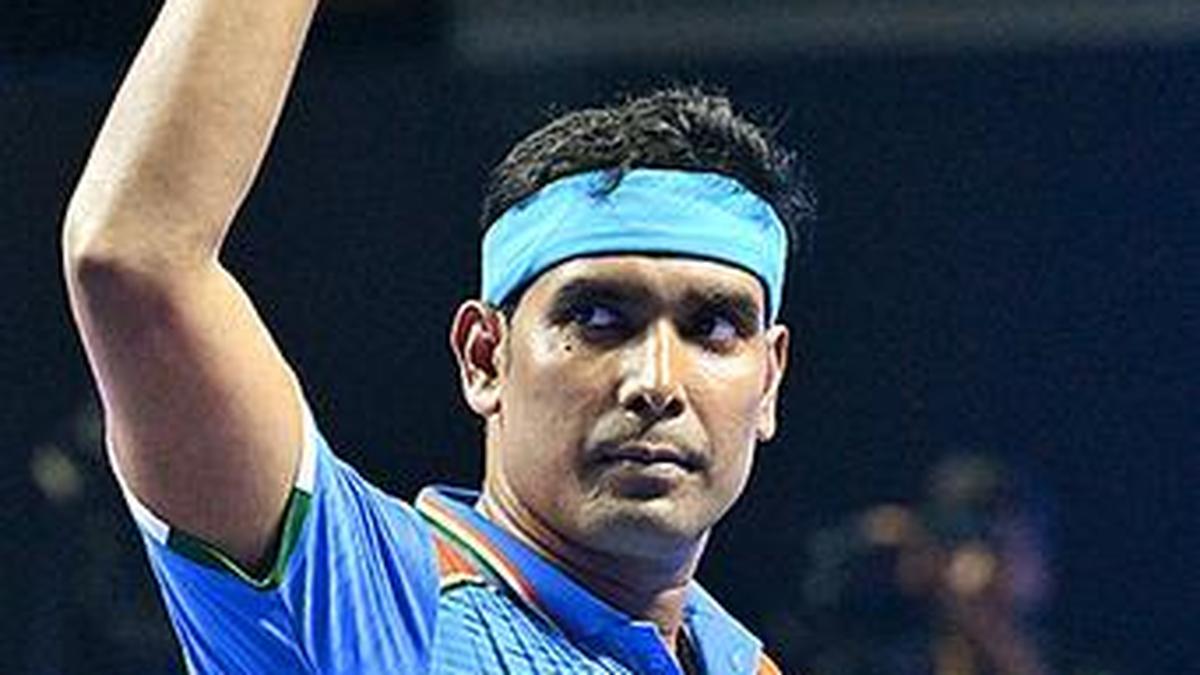


For the players, by the direction of the Sports Authority of India, we have had some containers built in various SAI campuses, where the athletes got an experience to stay in containers. And of course, cruise ships, we tried to replicate something like that, Sharath Kamal said
| Photo Credit: The Hindu
India’s deputy chef-de-mission for the Asian Games, A. Sharath Kamal, says the unique container room and cruise ship accommodation at the event will not be particularly challenging for Indian athletes despite the mixed reactions that the arrangement has got from participating nations.
India’s contingent of 501 athletes and 265 officials will be spread across container style rooms, a docked cruise ship and hotels much like the nearly 17,000 other participants who will be in Aichi-Nagoya for the Games beginning September 19.

The container rooms have been criticised as too small by the South Korean contingent and some Asian Cricket Council members have also voiced concerns about the quality of accommodation on offer.
Asked how the Indian athletes will cope with the unique arrangement, which is being described as slightly cramped for an average athlete’s comfort, the table tennis great said he is more concerned about the officials, who unlike the athletes, did not get the opportunity to acclimatise through makeshift containers set up at Sports Authority of India Centres.

“For the players, by the direction of the Sports Authority of India, we have had some containers built in various SAI campuses, where the athletes got an experience to stay in containers. And of course, cruise ships, we tried to replicate something like that,” said Sharath who is also the vice chair of the Athletes Commission of the Indian Olympic Association (IOA).
Around 4000-5000 athletes will be housed in a luxury cruise liner, the Costa Serena, to be docked at Nagoya Port.

Around 2,000 athletes will stay in converted shipping container units at the Garden Pier in Nagoya Bay.
The remaining athletes and officials, in fact the majority of the total participants, will be accommodated at commercial hotels near competition venues across Aichi perfecture, and even in Tokyo, where a few events like swimming will be held.
“But at the same time, players know what to expect. We have educated them very well. And I am pretty sure they will get accustomed quite quickly,” he said.

“The important thing is the performance. I am sure they will be able to perform well.”
‘At least one TT medal’
Talking about the Games and the Indian prospects in TT, Sharath said he is expecting at least one medal from the country’s paddlers.
Sharath, who retired from the sport in 2025 after playing in five Olympics and four Asian Games, has pinned his hopes on the men’s doubles pair of Manav Thakkar and Manush Shah, and the mixed doubles duo of Manush Shah and Diya Chitale.
A 10-member team — five male and five female — is representing India in table tennis in the Games.

“I expect to win at least one medal, if not two. Last time, we got one medal in women’s double. And prior to that, we got two bronze medals in 2018,” Sharath said.
“The men’s doubles pair of Manush and Manav, they are doing extremely well. They were world number two at one point in time. They are in the top four now. And they have a good chance of winning a medal,” said the 44-year-old.
“So these two events, we have a good chance to win medals. And of course, team championships are always quite an open event.” Table tennis competitions will be held between September 20 and 28.
In the last edition of the Asian Games in China, the women’s doubles pair of Sutirtha Mukherjee and Ayhika Mukherjee had won a bronze medal. Sutirtha is also in the current team.
In the 2018 edition, India won two bronze medals — in the men’s team event and mixed doubles.
Sharath was part of the men’s team and won another bronze with Manika Batra in the mixed doubles. Batra is not in the team for the Asian Games in Japan.
Published – September 16, 2026 11:43 am IST