

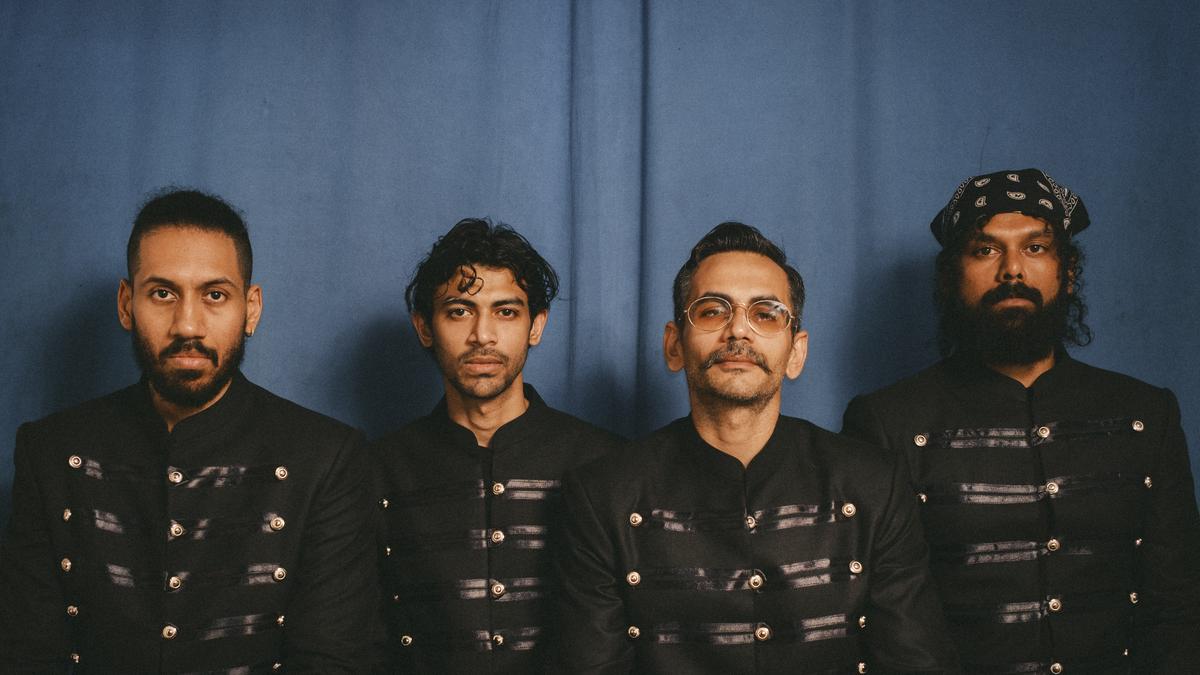

Three years ago, Chennai-based indie alternative rock band The F16s went to Ooty and stripped down. Literally. For almost a month in 2023, Harshan Radhakrishnan, Joshua “Josh” Fernandez, Sashank Manohar and Abhinav Krishnaswamy lived together in the hills, making music, playing together, and eventually taking their clothes off in Nature. The resulting photograph — four grown men, naked and unbothered — became the cover of the 10-track All Dogs Go To Heaven, their second full-length album, out October 21, ten years after their first album, Triggerpunkte. It is an apt image for a record that feels like the F16s have stripped away some of the machinery around making music and, in the process, found themselves sounding freer.
The nakedness was not a publicity stunt, I am told. Joshua, lead vocalist and guitarist, says the idea came from what dogs represented to them: instinct, purity and a lack of judgement. The photograph, like much of the album, was not heavily planned. “It sort of wrote itself, sort of shot itself, sort of named itself,” he says. Even the title came unusually easily. The four were sitting around a whiteboard throwing out ideas when All Dogs Go To Heaven came up. Everyone immediately agreed. For a band that apparently struggles to agree on album titles, this qualified as a small miracle.
Homecoming

The All Dogs Go To Heaven album cover
| Photo Credit:
Special arrangement
The F16s have spent nearly 13 years moving around their own sound. Triggerpunkte, released in 2016, was a young band’s energetic collision of influences; the EPs that followed — WKND FRNDS in 2019 and Is It Time To Eat The Rich Yet? in 2021 — pushed further into synths, psychedelia and danceable territory. There have been solo projects and stretches of working apart, too. By the time they came together for this album, they were not particularly interested in asking what the next F16s record was supposed to sound like.
“Age just sort of softens you naturally,” Joshua says. After years of playing together, the four musicians have developed what he describes as a kind of shared wavelength. The new record reflects that: it is mellower and more cohesive than Triggerpunkte, but not particularly interested in sanding off the band’s sense of humour. If anything, there is less constraint.
Harshan wanted to capture the particular chemistry of the four musicians playing together in a room. Previous recordings could be fragmented, with one person coming in to record guitar and another arriving later for bass. In Ooty, everyone played together.
“We’ve never gone forward with an album thinking it has to sound this way,” Abhinav says. Deciding in advance that it should be heavy, psychedelic or anything else, he argues, only puts the band in a box. So they took the equipment they had, borrowed or bought what they needed, and made it work.
The entire album was subsequently mixed by Harshan at his home studio in Chennai. That detail matters because this is the first F16s album they feel they have made almost completely themselves. Earlier releases involved outside engineers, mixers and other collaborators. This time, the recording, mixing, artwork and creative decisions remained largely within the four-person ecosystem.
The sound

The track list
| Photo Credit:
Special arrangement
You can hear the difference in the singles. ‘Mt. Whateverest’ is still unmistakably F16s but less interested in racing towards the next beat. ‘LMAO’ is, well, LMAO: proof that growing older has not compelled them to become solemn. And then there is ‘Little Mama’s Boy’, which initially sounds like a cheeky maternal refrain into something stranger — affection, expectation and a lifetime’s worth of parental approval compressed into two words.
The record’s looseness extends to its ideas. The band did not write with a predetermined genre in mind; they wrote songs and gradually worked out which ones belonged together. Some older fragments were repurposed while songs were joined.
That freedom is particularly striking in 2026, when musicians are increasingly encouraged to make songs that can survive outside the song: the 15-second Reel that inevitably is used to bolster engagement on Instagram. The F16s have little interest in writing backwards from the algorithm. Joshua describes the idea of judging a musician and a TikTok creator by the same metrics as fundamentally misguided. Their brief was simpler: make a good album, not an album engineered to become famous.
The F16s are not trying to sound younger or louder. They have removed a few layers between the four of them and the music, including outside voices, predetermined rules, less perfectionism, and instructions about what a rock band ought to be.
Even their relationship to the band has changed. Joshua describes coming back to the F16s after individual projects as “coming home to your person” — a relationship with its own affection and scrutiny.
It is perhaps why the naked album cover does not feel like a gimmick.
Published – October 01, 2026 07:50 am IST