




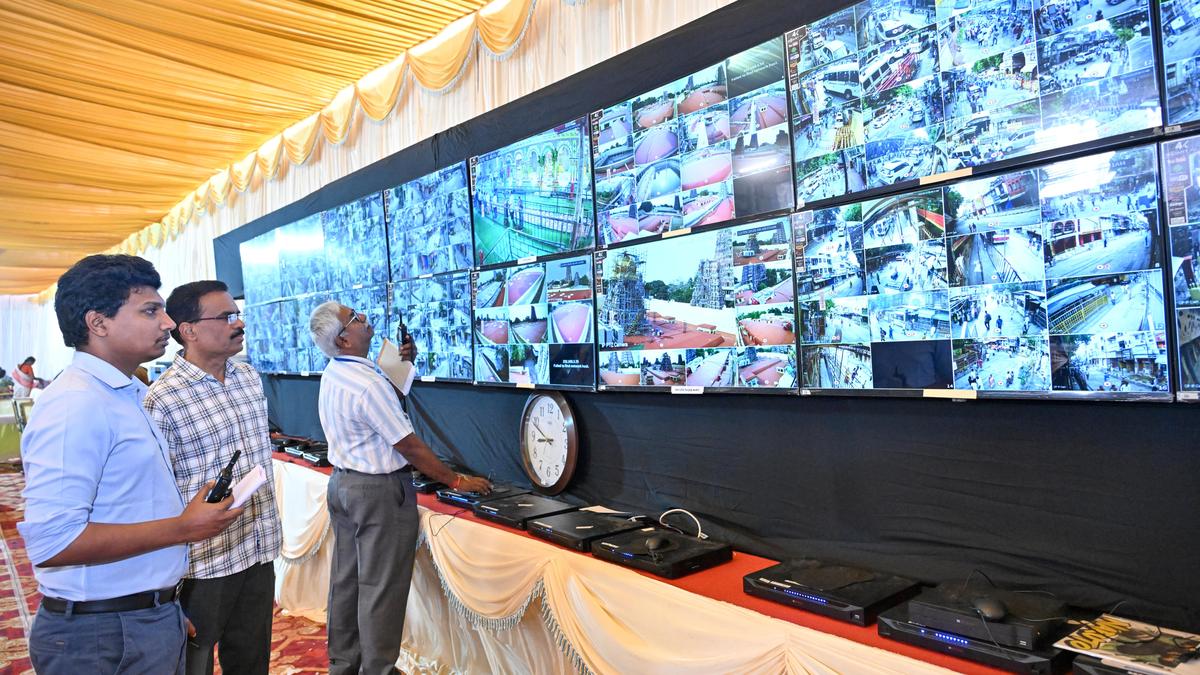


The control centre to monitor the footage from the CCTV cameras installed for the consecration around Sri Meenakshi Sundareswarar Temple in Madurai.
| Photo Credit: R. ASHOK
The installation of AI-enabled CCTV cameras around Sri Meenakshi Sundareswarar Temple for the consecration has successfully proven its worth by assisting authorities in locating a missing child and also identifying seven persons with criminal records.
Out of the 277 total surveillance cameras installed across the temple’s surroundings, 77 were equipped with advanced Artificial Intelligence capabilities, specifically featuring facial recognition systems.
These specialised cameras were installed via the Tiruvannamalai-based R.S. Power Agency and came powered with varifocal lenses—a camera lens type featuring an adjustable focal length that permits manual or motorised zooming in and out to dynamically modify the field of view.
The AI-driven camera software was specifically designed to recognise and match photographs uploaded directly by the system operators.
According to authorities, approximately 2,000 reference faces of individuals carrying criminal records were uploaded into the database beforehand.
By leveraging this technology, whenever any flagged individual appeared within the camera’s monitored zones, the system would immediately dispatch an alert to the user.
Officials noted that this capability allowed police forces to successfully identify and apprehend suspects well before any criminal acts could take place.
They explained that such proactive preventive action significantly contributed to controlling major offenses throughout the duration of the ceremony. Through this mechanism, seven suspected criminals were flagged, and police officers connected via dedicated WhatsApp groups were instantly notified, enabling them to quickly track down the suspects and keep them under strict surveillance.
A similar success occurred regarding a seven-year-old boy who had gone missing during the crowded event, after his parents provided a photograph that was promptly uploaded into the system.
Officials highlighted that the AI-enabled cameras quickly recognised the child and pinpointed his exact location. This swift notification enabled the authorities to execute an immediate rescue operation and safely return the boy to his family.
These high-tech cameras were positioned across four major junctions surrounding the temple’s five grand gopurams.
Explaining the technical advantages, officials pointed out that the varifocal lenses are specifically engineered to zoom closely onto a subject while retaining high clarity, ensuring the individual can be accurately identified.
In contrast, they added, standard conventional CCTVs typically yield heavily distorted and pixelated images whenever an operator attempts to zoom in on a person.
Nevertheless, the continuous deployment of mass surveillance and facial recognition technology has already raised concern and alarms among civic activists.
These have publicly expressed their opinions that such constant monitoring of citizens—even when targeted at individuals possessing criminal backgrounds—violates fundamental privacy rights.
Published – September 18, 2026 08:19 pm IST