








The ECI said bulk Form 7 applications by individual voters on unsubstantiated grounds inconvenience the elector objected upon and increases workload on field-level functionaries.
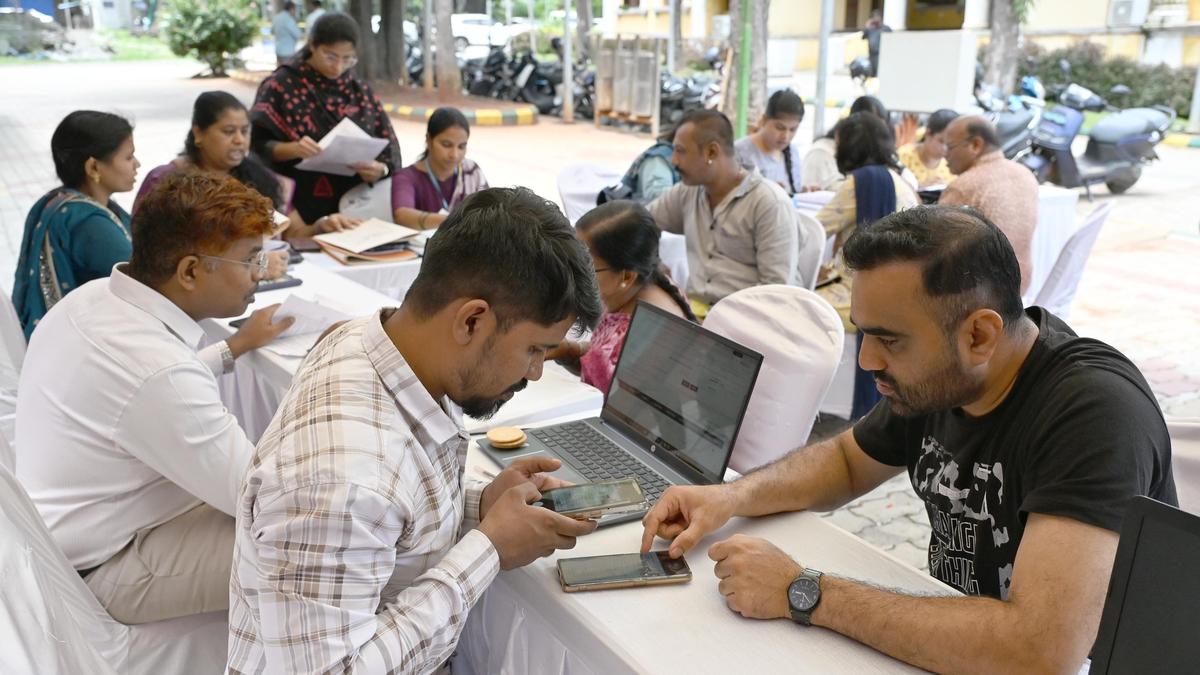
| Photo Credit: S.K. Dinesh
The Election Commission of India (ECI) on Friday (October 9, 2026) capped the number of Form 7s a voter can submit to contain bulk applications seeking deletion of voter names during the Special Intensive Revision (SIR) in many States.
The maximum number of applications during the period of claims and objections an individual elector can file has been capped at 10, while applications during the continuous updation of electoral rolls by a voter has been fixed at five per month. These will apply to both online and physical forms.

Till now, there was no limit prescribed on the number of physical Form 7s a voter can file.
The Hindu has reported from Rajasthan, Gujarat, West Bengal, and Karnataka on the submission of bulk Form 7s in the name of BJP leaders.
For the SIR period, the Commission has already allowed booth-level agents (BLAs) of the recognised political parties to file applications in bulk, subject to the condition that the BLA shall not submit more than 50 forms per day to the booth-level officer before the draft publication of electoral rolls, and 10 forms per day thereafter.
For an individual elector of a constituency, applications are filed as per para 11.3.2 (ii) of the Manual on Electoral Rolls, 2023, which provides that claims and objections presented in bulk, including those sent by post, by an individual should not be entertained. It also provides for personal cross-verification by the electoral registration officer (ERO) where the same person is the objector in more than five cases.

In a letter to the Chief Electoral Officers of all States and Union Territories, the ECI said: “Although, the number of applications to be filed online by an individual elector has been fixed as 6 at a time subject to disposal, the number of physical forms presented in bulk has not been defined and has been left to the judgement of the EROs, which is creating challenges for the field functionaries.”
“Accordingly, the Commission with the intent to discourage bulk filing of objections by an individual elector has decided to prescribe the following limits on filing of Form 7 applications in both online and offline mode: (i) Maximum number of Form 7 applications during the entire period of claims and objections by an individual elector: 10 (ii) Maximum number of Form 7 applications during the period of continuous updation of electoral rolls by an individual elector: 5 per month,” the letter said.
The ECI said bulk Form 7 applications by individual voters on unsubstantiated grounds inconvenience the elector objected upon and increases workload on field-level functionaries.
According to the Registration of Electors Rules, 1960 (RER, 1960), any claim or objection not lodged within the period or in the form and manner specified in the rules shall be rejected by the ERO.
“Accordingly, the ERO should ensure that full details are filled in the Form 7 and the form is signed by the objector at appropriate place. Seal of the signature of the objector can’t replace the original signature. The ERO should also check the genuineness of the applicant by verifying with the electors list details,” the directive said.
The directive further said if the complaint is false or fabricated, the ERO will take action against the applicant.
Published – October 09, 2026 10:54 pm IST