

A Kashmiri house stands at the entrance to Sakshi Gallery’s 40th anniversary exhibition, Of Being and Becoming, in Delhi’s Travancore Palace. The installation’s familiar architectural form is interrupted by shrapnel, skulls and fragments, while mirrors multiply the image of destruction around it. In Veer Munshi’s Echoes Without Borders, a memory of home becomes a meditation on displacement and the recurring violence of war.
It is an arresting way to enter an exhibition, and an indication of what follows. The show does not simply look back at the artists the gallery has represented, or assemble a selection of its most recognisable works. Instead, curator Manan Shah uses the occasion to ask how Indian contemporary art arrived at the visual language we see today, and what, along the way, changed it.
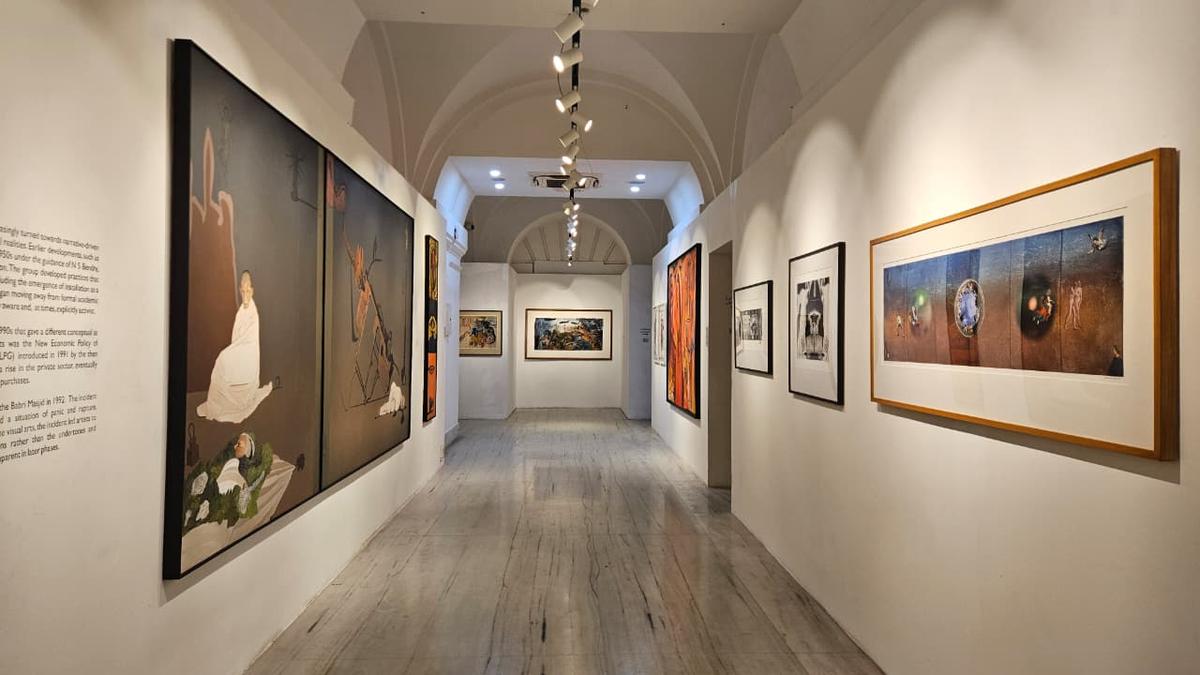
The exhibition brings together 46 artists across generations, including Vivan Sundaram, Gulam Mohammed Sheikh, Nalini Malani, Rekha Rodwittiya, KG Subramanyan, Navjot Altaf, Shilpa Gupta, Thukral and Tagra and others. Paintings, sculpture, video, installation and projection are brought into conversation across three sections spanning the late 1980s to the present.

“When I was looking at the archive of Sakshi, they had done over 600 exhibitions,” says Manan. “Some of them were exceptional names to include. But I excluded them either due to space constraints or simply because they did not align with the premise of the show.”
That premise is the changing visual grammar of the last four decades. Rather than simply declaring that art has become more political, conceptual or experimental, Manan wants the works themselves to demonstrate how and why those shifts occurred.
Three scenes, changing vocabularies
The exhibition unfolds like a theatre production, divided into three scenes: the late 1980s to 1999, the early 2000s to 2014, and 2014 to the present. The structure allows artists from different generations to sit alongside one another, with older and newer works sometimes placed almost in direct conversation.

The first section looks at a period when artists were moving away from formal conventions towards more narrative, conceptual and socially engaged practices. Manan points to two events in particular as significant: the economic reforms of 1991 and the demolition of the Babri Masjid in 1992. Both altered the social and political landscape, and, in turn, the concerns and visual strategies of artists.
Works by Vivan Sundaram, Gulam Mohammed Sheikh and others reflect this transition. Elsewhere, in Rekha Rodwittiya’s In Search of My Mother’s Garden, personal memory becomes a point of departure for a wider feminist vocabulary. The work, depicting a grown woman within another woman’s womb, draws on Rodwittiya’s childhood memories of listening to her mother recount stories at their ancestral home.

By the late 1990s and early 2000s, Manan identified another shift, towards what he calls “political minimalism”. Political concerns remain, but they increasingly arrive through fragments, satire and metaphor rather than direct representation.
When the familiar turns unsettling
That quality runs through much of the later work. A sculpture by Sunil Gawde that initially resembles a floral garland reveals itself to be made of blades. The viewer is repeatedly asked to look again.
Manan sees this movement towards indirectness as one of the significant changes in contemporary visual practice, particularly after 2014, when concerns around surveillance, censorship, protest and political identity began to surface in increasingly layered ways.

The political can also enter through reinterpretation. In Vivek Vilasini’s Last Supper – Gaza, Leonardo da Vinci’s familiar composition is recast through contemporary realities of faith, conflict and betrayal. The arrangement of figures echoes the original grouping of Christ and the apostles, but the historical image is made to speak to a present marked by war and political violence.
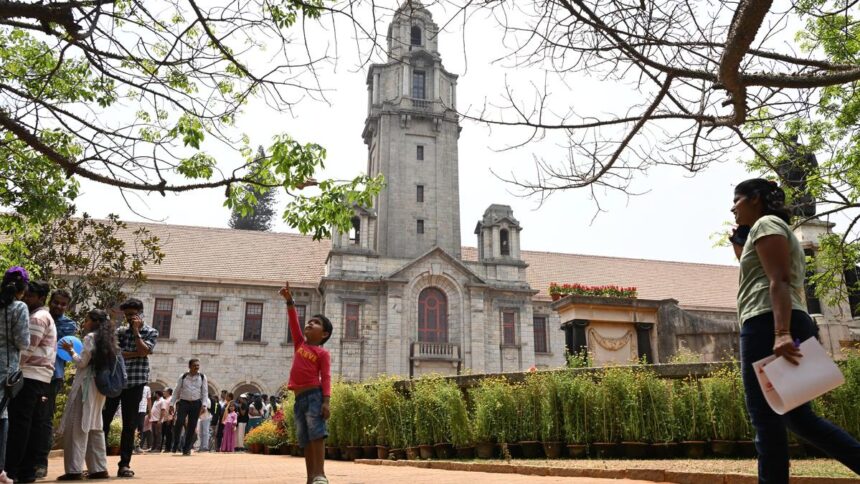
The architecture of Travancore Palace becomes part of this story too. Rather than treating the historic building as a neutral container, Manan has retained its arches and character, while several artists have responded directly to the space. Riyas Komu’s Walking Towards the National Museum II considers walking as both procession and retreat, while young artist Salik Ansari’s large-scale installation Altar of Celebrations looks at celebration and the violence that can lie beneath it. By the end, even the familiar feels worth questioning.
The exhibition is on till September 20, at Travancore Palace, Shrimant Madhav Rao Scindia Marg, Copernicus Marg, New Delhi. Open daily, 11am – 6pm
Published – September 26, 2026 07:13 pm IST