




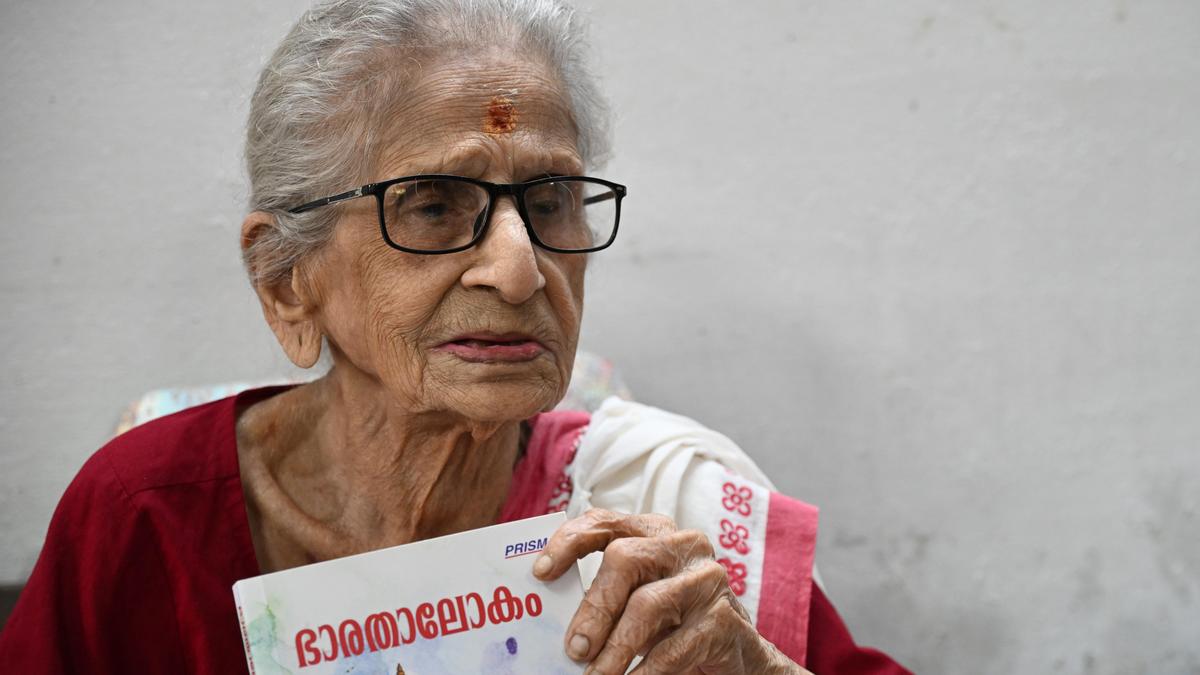


Malayalam literary critic M. Leelavathy with a copy of her book Bharathalokam at her residence in Kochi.
| Photo Credit: THULASI KAKKAT
The years have not dulled her clarity of thought or stolen her felicity with words. At 98, literary critic M. Leelavathy remains busier than ever, meticulously compiling her thoughts and scholarship into collector’s volumes.
She has just brought out Bharathalokam, her journey through the major episodes of the Mahabharata in search of its soul. She concludes that the epic intends to convey a strong message against war while stressing the need for unconditional love. “‘With arms raised, I cry out, but no one listens to me,’ was how Veda Vyasa lamented,” she says, reciting a shloka from the epic. “Starting from Vyasa, all great writers to date have spoken against war, but who pays attention to writers? The world is witnessing many wars even now. But would Trump or Netanyahu listen to writers? Those who begin wars do not understand the writers’ eternal anguish,” she says.
Many characters in the Mahabharata could have averted the battle of Kurukshetra. Sree Krishna, when he showed his Vishwaroopam (cosmic form), could have easily deployed his chakra to behead Duryodhana and prevented the war. Karna could have done that when he realised who his real parents were. If he had accepted Kunti’s request and switched sides, could this have happened? There were others, too, like Bhishma and Kunti, but all of them chose to remain silent, she explains, pointing to the inevitability of fate. The reign of niyathi (destiny) is a theme in the Ramayana as well.
When too many people burden the earth, some will have to go. That’s what fate decides. It makes us wonder if wars could be a means to that end, she says.
Tragic flaw in Bhishma
In the introduction to the book, Dr. Leelavathy points to the tragic flaw in Bhishma, arguing that being a ‘great person’, he should have remained impartial. “During our time, Jawaharlal Nehru’s policy of non-alignment was a brave model for the world, but he never shied away from condemning a side if it turned iniquitous,” she says. The puzzling question of why Bhishma chose to fight for Duryodhana after calling out his stance for being unethical is problematised in the book.

Kerala Leader of the Opposition Pinarayi Vijayan presents the ‘Sanoo Sammanam 2026’ award instituted by the Prof. M.K. Sanoo Cultural Centre to literary critic M. Leelavathy for her outstanding contributions to the cultural sphere, on August 2, 2026.
| Photo Credit:
THULASI KAKKAT
It took Dr. Leelavathy three months to write Bharathalokam, following a routine of getting up at 4 a.m. to read and write. This was easy since she was troubled by insomnia, she says with a smile. She is presently working on a book, the second part of which is about the evolution of caste in Kerala.
But a far more interesting one is titled Mary-Arundhateeyam, which is ready for publication. Dr. Leelavathy was enamoured of author Arundhati Roy’s extraordinary portrayal of her mother, Mary Roy, and found many parallels between her own mother and Mary Roy.
M. Leelavathy on her latest book ‘Bharathalokam’
At 98, renowned writer and literary critic Prof. M. Leelavathy has written Bharathalokam, a study of the Mahabharata. In this conversation, she reflects on the epic’s enduring messages of unconditional love and the need to avoid war at any cost, while also speaking about destiny, literature and what it means to continue writing at her age.
| Video Credit:
The Hindu
“My mother did not receive higher education, so she could not found a school and rise to Mary’s stature. But she fought my father and the matrilineal system for 15 years. They never met during this period and she even forbade us from meeting him. Her grit equalled that of Mary’s,” Dr. Leelavathy says. The concluding chapter of the book is titled Alamel Mary (Mary on the Waves), and Dr. Leelavathy recalls Ms. Roy’s exquisite portrayal of Mary walking on the waves like Jesus Christ. “It’s an unforgettable image,” she says.
Published – August 05, 2026 08:15 am IST