



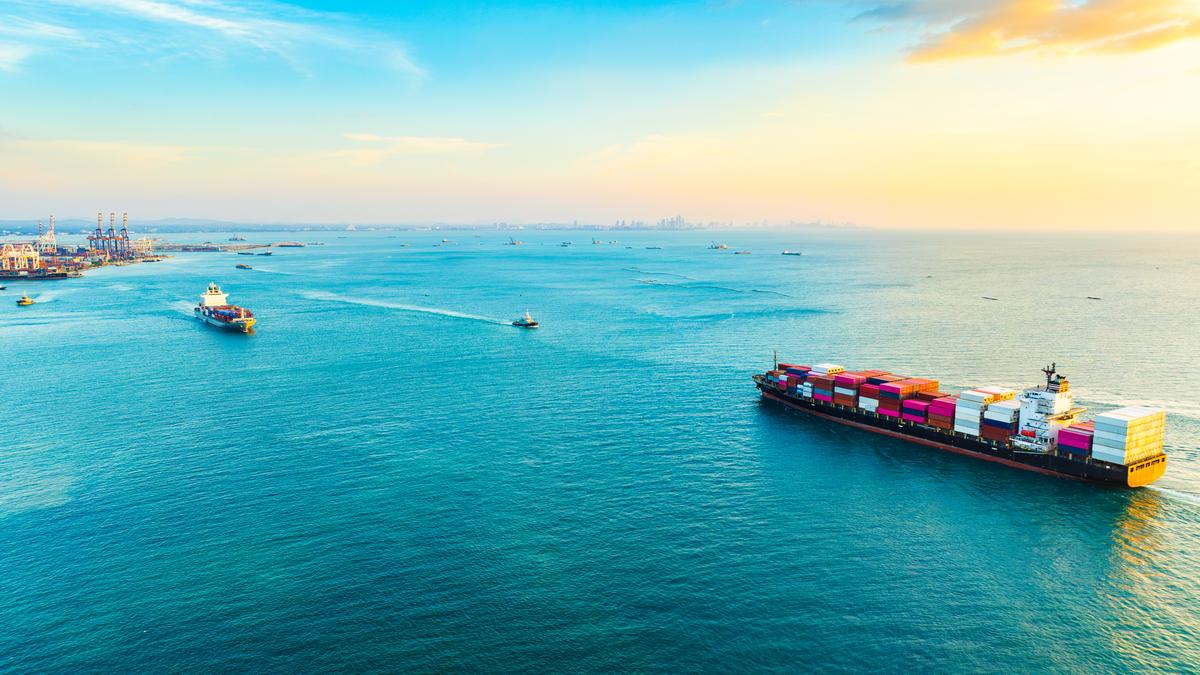

India’s maiden blue bond, under the Sagarmala programme, seeks to bring the ocean economy to the capital markets, even as doubts linger on its timing given the signs of hardening global interest rates.
As much as ₹1,000 crore is slated to be raised through a blue bond issuance by Sagarmala Finance Corporation Ltd. (SMFCL), the financing arm associated with the Sagarmala programme, one of the critical parts of India’s mammoth multimodal infrastructure programme called PM GatiShakti. The funds are intended to support maritime projects.

The proposed thematic bond issue by SMFCL is small in size compared with Sagarmala’s overall investment pipeline, as it represents only 0.17% of the total identified project cost of more than ₹6 lakh crore.
However, its importance is in the precedent it creates in the country because infrastructure financing — which has a long gestation period — has traditionally depended on bank loans, budgetary support and conventional bonds.
What is blue bond?
Like a conventional bond, an instrument through which an issuer raises money from investors and promises periodic interest payments and to repay principal at maturity, a blue bond follows the same structure but adds an environmental element: the proceeds must be for clearly identified water- and ocean-related projects.
There is also additional responsibility for greater disclosure. Issuers need frameworks explaining where the money will be invested, impact measurement mechanisms and periodic reporting to eschew bluewashing.

The market regulator, the Securities and Exchange Board of India, has already recognised blue bonds as part of sustainable finance instruments and highlighted their potential for the country’s blue economy.
Why Sagarmala blue bond?
The government aims to increase the maritime sector’s contribution to GDP significantly by expanding ports, inland waterways, shipbuilding and coastal infrastructure, requireling massive capital requirements.
For SMFCL, the bond has a strategic purpose of correcting asset-liability mismatch as its loans for infrastructure projects span around 12 years, while it has shorter existing borrowing tenure.
A longer-duration bond — which can provide a better match between the maturity of liabilities and assets — could diversify borrowing sources and attract investors as insurance companies, pension funds and global sustainability-focused funds.
Launched in 2015, the Sagarmala programme has about 845 projects with an estimated investment of ₹6.06 lakh crore. Around 315 projects valued at nearly ₹1.56 lakh crore have already been completed, while the remaining projects are either under implementation or development.
Not all projects under Sagarmala will qualify for blue bond financing; only those demonstrating measurable ocean or water-related sustainability outcomes are eligible.
Major beneficiaries
Sagarmala has identified more than 200 projects under coastal shipping and inland water transport. Segments that ought to benefit are Ro-Ro and Ro-Pax ferry services; inland water terminals; coastal cargo movement; and cruise infrastructure. Sagarmala-supported cruise and passenger infrastructure includes terminals at Mumbai, Kochi and Chennai, along with other coastal tourism facilities.
Port modernisation is the largest investment segment under Sagarmala, with projects worth nearly ₹2.9 lakh crore. Future investments could comprise energy-efficient cargo handling systems, electrification of port operations, shore power facilities for vessels and cleaner logistics systems.
Fishing harbour upgrades and coastal livelihood programmes would need modest capital, which blue bonds can support.
International experiences
According to the World Bank, cumulative blue bond issuance crossed $15 billion by mid-2025, up from about $222 million in 2018. Most issuances were from emerging markets, particularly countries with large marine ecosystems and climate vulnerability.
In October 2018, the Government of Seychelles, with support of the World Bank, issued the world’s first sovereign blue bond.
In 2021, Belize restructured around $553 million of external commercial debt, supported by The Nature Conservancy, creating financing space for marine conservation, billed as the largest ocean conservation-linked transaction.
Nordic Investment Bank issued one of the earliest institutional blue bonds after Seychelles in 2019.
Unlike small island nations, the U.S. has deep and well-developed municipal bond markets as well as strong institutional investors and climate finance channels; hence, it historically lagged Asia and Europe in blue-labelled issuance, but activity has risen.
Asia-Pacific accounted for the largest share of cumulative blue and water-labelled bonds in the recent years.
Why blue lags behind green?
Despite strong investor interest, blue bonds face challenges due to the lack of a standard definition (no universally accepted blue taxonomy equivalent to green bond standards).
It is difficult to attach a pecuniary value to coral restoration, biodiversity improvement and fish stock recovery and most blue bonds are bought by specialised impact investors rather than mainstream pension funds.
Many countries have ocean strategies but lack investment-ready projects.
India’s blue bond pipeline
India’s pipeline of potential blue bond issuers is still at an early stage. Unlike green bonds, where Indian issuers have already raised thousands of crores, blue bonds are still moving from concept to the first issuance.
The other publicly known issuance move is that of Vadodara Municipal Corporation for its water infrastructure, indicating that India’s blue bond market may evolve beyond oceans into broader water-related sustainability finance.
Andaman and Nicobar Island development may see blue bonds to support the country’s ocean economy ambitions, according to The Ministry of Earth Sciences.
There is no official market-size forecast yet for blue bonds because issuance has not begun at scale, but the potential base is significant, given that India has a coastline of about 7,500 km and around 95% of trade by volume moves through maritime routes. The financing requirement for maritime infrastructure alone runs into several lakh crore rupees, suggesting that blue bonds could become a specialised financing channel similar to green bonds.
Amid rate uncertainty
The Federal Reserve’s recent rate increase has possibly ended the era of cheap money because U.S. Treasury yields act as a global benchmark for borrowing costs.
High-quality infrastructure and sustainability-linked bonds can still find investors, but issuers will need robust fundamentals and realistic pricing, while ensuring transparent use of funds.
SFCL’s success in blue bond will gauge whether this new asset class becomes a mainstream infrastructure financing tool or remain a niche sustainability product.