






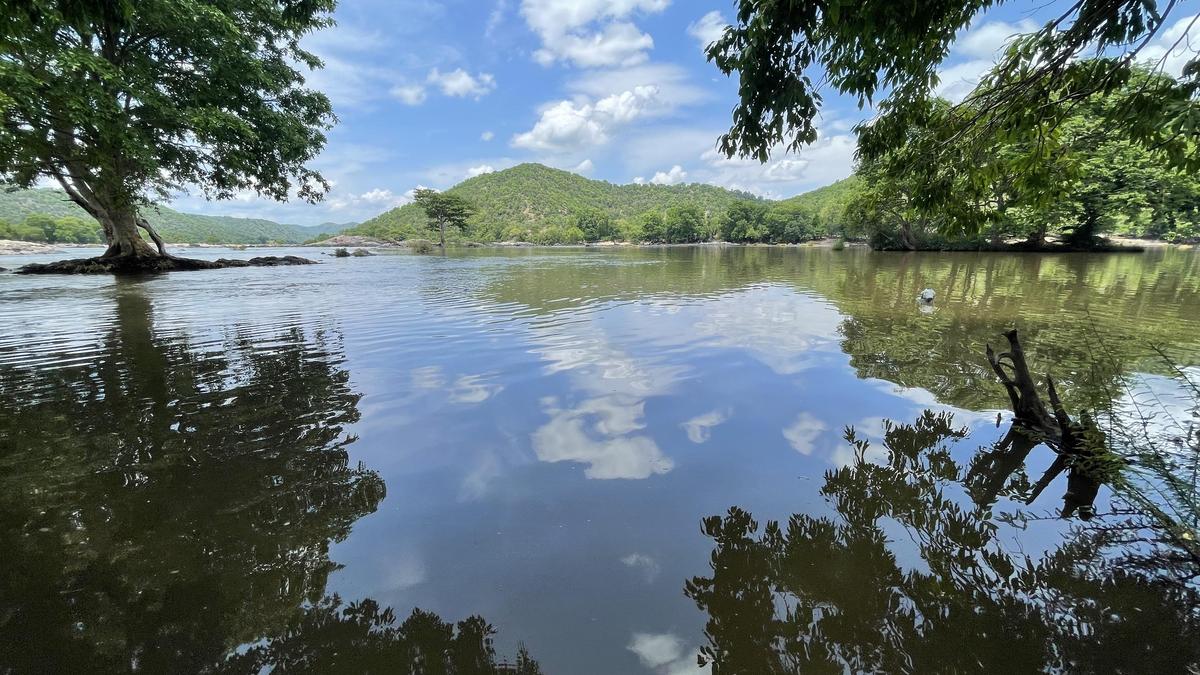


The Cauvery flowing through Bengaluru South district. Karnataka expressed its inability to ensure any further release on the grounds that it had to prioritise its limited water storage for drinking water requirements.
| Photo Credit: K. MURALI KUMAR
Karnataka, reeling under serious drought, has found itself in a tough situation again with the Cauvery Water Management Authority (CWMA) on Thursday upholding an earlier direction of the Cauvery Water Regulation Committee (CWRC) to the State to ensure release of Cauvery water at a rate of 3,000 cusecs a day for 15 days to Tamil Nadu. The total release for 15 days will add up to 3.88 tmcft.
As per the order, the release will have to commence from 8 a.m. of October 9 (Friday). The stipulated release has to be ensured at Biligundlu inter-State water gauge.
Earlier, Karnataka expressed its inability to ensure any further release on the grounds that it had to prioritise its limited water storage for drinking water requirements. The State pointed out that it was reeling under serious hydrological distress which was marked by 54% deficit in cumulative inflows to its four reservoirs in the Cauvery basin.
As against the 30-year average of 257.633 tmcft inflow, the four reservoirs had received only 257.633 tmcft this season, it said. The State submitted that its water situation was critical as there was no scope for any replenishment since the southwest monsoon, which is the mainstay of its weather system, had ended.
While its reservoirs had a total storage of 46.968 tmcft, the water availability from all sources was estimated to touch 57 tmcft. But the State would need 45 tmcft of water to ensure drinking water supply, environmental flows besides accounting for evaporation, it said, while pointing out that it would be left with a “grossly inadequate” quantum of 12 tmcft for taking care of irrigation needs.
On the contrary, Karnataka argued that Tamil Nadu’s situation was better as it had a storage of 37.997 tmcft in its reservoirs and this was projected to touch 244.997 tmcft considering the downstream contributions and groundwater availability as it was expected to have a normal northeast monsoon.
Karnataka argued that any inter-State water sharing decisions must reflect actual hydrological distress, reservoir storage, intermediate catchment contributions and seasonal rainfall patterns in both the States.
On its part, Tamil Nadu maintained that water release towards irrigating its samba crop had been delayed by 81 days leading to crop stress.
Tamil Nadu maintained that it had received only 46.047 tmcft of water as against the stipulated 127.706 tmcft, leaving a backlog of 15.022 tmcft. It appealed to the CWRC to direct Karnataka to clear this backlog.
After hearing both the States, the CWRC directed Karnataka to ensure the release of 3,000 cusecs a day for 15 days, aggregating to 3.88 tmcft.
Published – October 08, 2026 11:58 pm IST