



The Delhi Police on Friday (October 9, 2026) denied permission to the Cockroach Janta Party (CJP) to hold its proposed protest at Jantar Mantar on Saturday (October 10), citing alleged violations of conditions agreed upon for an earlier demonstration, even as authorities rolled out an extensive security plan across the national capital.
Despite the denial of permission, the CJP released a poster that says “Final Call To Save Democracy”, asking its supporters to reach Jantar Mantar at 10 a.m. on Saturday (October 10) as they look to go ahead with the protest demanding the resignation of Chief Election Commissioner Gyanesh Kumar and the rollback of the Special Intensive Revision of electoral rolls.
Authorities have taken several measures ahead of the protest, including internet curbs in parts of Delhi, the shutting down of markets and Metro stations, and the cancelling dozens of trains bound for the capital.
The Union Ministry of Home Affairs (MHA) directed all States and Union Territories (U.T.s) to coordinate with the Delhi Police and take preventive measures to stop the movement of protesters towards Delhi. In a communication sent to Chief Secretaries and Directors General of Police (DGP), Union Home Secretary Govind Mohan drew attention to the “grave law-and-order and public-order implications” arising from the proposed protest.

‘History of non-compliance’
The letter noted that the Delhi Police had categorically rejected the CJP’s request to hold the gathering. The communication further said that the CJP and supporting organisations had a “documented history of non-compliance with lawful directions” during previous mobilisations, adding that earlier protests involving participants travelling from different States had resulted in significant disruption to public order and damage to public property, the letter, seen by The Hindu, said.
The letter cited intelligence inputs as indicating that the CJP and its supporters intended to defy statutory restrictions and attempt entry into Delhi from various States and U.T.s.
“To pre-empt any breach of public tranquillity and to safeguard critical infrastructure,” the Home Ministry directed States to “immediately operationalise preventive measures in coordination with the Delhi Police and within the framework of law”.
The Ministry emphasised continuous, real-time intelligence-sharing among State intelligence agencies, transit authorities and the Delhi Police to ensure coordinated action. Describing the maintenance of law and order as a “non-negotiable constitutional imperative”, the Ministry called for the strict implementation of the directions to uphold the rule of law.
Around 6,000 additional security personnel — 40 companies of the Indo Tibetan Border Police (ITBP) and 20 companies of Sashastra Seema Bal (SSB), the primary border guarding forces along the border with China and Nepal, respectively — were deployed in Delhi for “law-and-order duty” on the instructions of the Union Home Ministry. This deployment is in addition to the 7,000 Central Reserve Police Force (CRPF) personnel pulled from Chhattisgarh and West Bengal, as well as personnel of the Delhi Police.

Joint Commissioner of Police (New Delhi Range) Nupur Prasad said the organisers had failed to comply with undertakings given during a previous protest. “Because of not following the conditions as part of undertaking during the past protest, this time, the permission has been denied,” she said.
Police officials also noted that the request for permission had been submitted at short notice. According to them, CJP leaders informed the Delhi Police about the proposed demonstration through a letter on October 7, seeking arrangements for law and order and traffic management. However, applications for such events are ordinarily expected to be made at least 10 days in advance, the officials said.
Police strategy
Several members of civil society and political workers in Delhi, Madhya Pradesh, Goa, Andhra Pradesh and Uttar Pradesh claimed they were visited by the police and asked not to participate in the protest. A Delhi resident was allegedly physically stopped from leaving his residence. In Uttar Pradesh’s Bijnor, police camped at the residence of Students Federation of India (SFI) leader Abhishek.

According to police officials, a district-wise security strategy has been drawn up to prevent protesters from reaching central Delhi. Dedicated detention centres have been established in all 15 police districts, while more than 30 blocking points have been identified across the New Delhi district.
The strategy marks a departure from previous deployments, where personnel from multiple districts were concentrated at a few locations. This time, authorities plan to intercept protesters within their respective jurisdictions before they converge on central Delhi.
The Delhi Police have also requested the Delhi Metro Rail Corporation (DMRC) to shut 57 Metro stations from 9 p.m. on Friday (October 9) until Saturday (October 10), citing the possibility of large-scale movement of protesters towards sensitive locations.

Major curbs
Internet curbs were announced in the heart of the capital — an extraordinary step that was first taken in July this year during the Gen-Z protests demanding the resignation of Dharmendra Pradhan as Union Education Minister. The shutdown has been notified from 10 p.m. on Friday for a period of 24 hours and is applicable within a four-km radius of the Janpath-Kartavya Path crossing, according to a notification by Delhi Police.
Wide-ranging social media censorship may also be put into motion, following an advisory by the IT Ministry urging social media platforms to take quick action on content affecting “public order”, and further telling them to take quick action against posts referred to them by Ministries and departments.

The Delhi Police conducted meetings with market associations and requested them to keep their shops closed on Saturday (October 10). Shops will remain closed in Connaught Place, Chandni Chowk, Karol Bagh and other areas, respective trader associations said.
In a parallel move, the Railway Ministry ordered the cancellation of Mail and Express trains scheduled to arrive at New Delhi and Hazrat Nizamuddin railway stations between 4 a.m. and 2 p.m. on October 10.
A circular issued by the Railway Board stated that trains departing from originating stations after 2 p.m. on October 9 and scheduled to arrive at either station during the specified period would be cancelled. Railway officials said the decision was taken in anticipation of severe traffic congestion and large crowds around the two stations.
Trains cancelled
The Railways claimed that more than 5,000 passengers had missed trains on October 8 due to traffic disruptions and road blockades linked to political protests in the national capital.
Around 45 Mail and Express services have been affected, including major trains such as the Sealdah-New Delhi Rajdhani Express, CSMT-Hazrat Nizamuddin Rajdhani Express, Ranchi-New Delhi Garib Rath Express, and the Howrah-New Delhi Rajdhani Express. Passengers holding reserved tickets will receive full refunds, officials said.

Two Mumbai-Delhi Rajdhani services, including the Mumbai Central-New Delhi Tejas Rajdhani Express and the August Kranti Tejas Rajdhani Express to Hazrat Nizamuddin, have had their departures delayed by five hours.
Moreover, the Madhya Pradesh Government Railway Police (GRP) detained 14 students after taking them off a train at Itarsi Junction Railway Station as they were travelling from Pune to attend the protest in Delhi. Various senior police officers, who spoke on the condition of anonymity, said the students were detained during searches of trains going towards Delhi following “orders from high above”. They, however, claimed the students were released on Friday but refused to leave the private hotel they were kept in.
‘Choking the capital’
Reacting to the restrictions, CJP leaders accused the government of attempting to suppress a peaceful demonstration.
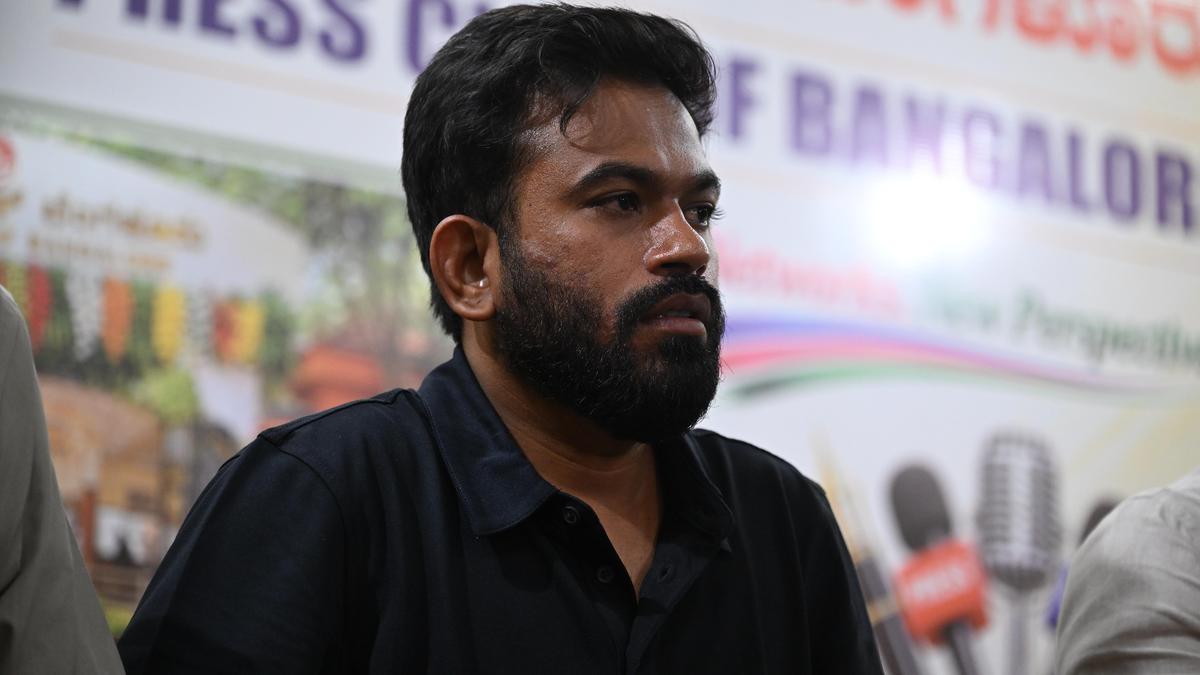
CJP leader Abhijeet Dipke expressed confidence that protesters would still reach Jantar Mantar. “Prime Minister Narendra Modi is so scared of peaceful protest that they are taking measures that were not taken even in the time of Emergency. Instead of acting against CEC Gyanesh Kumar, they are choking the National Capital,” he said.
All India Students’ Association president Neha Bora, in a video message to supporters, compared the mobilisation to the Quit India Movement and urged protesters to continue their agitation even if prevented from reaching the venue.
“Wherever you are stopped, whether it is a Metro or train station, sit down right there with your demands of ‘roll back SIR, Gyanesh Kumar must go’,” she said.
Meanwhile, the Samyukt Kisan Morcha (SKM) extended support to the October 10 protest and criticised the security measures imposed by authorities. In a statement, the farmers’ organisation alleged that activists had been placed under house arrest in several States and described the cancellation of trains and proposed closure of Metro stations as an excessive response.
The SKM accused the Centre of curbing citizens’ constitutional right to peaceful protest and urged authorities to facilitate demonstrations rather than impose blanket restrictions. It also reiterated its demand for the withdrawal of the SIR exercise and action against the Chief Election Commissioner.