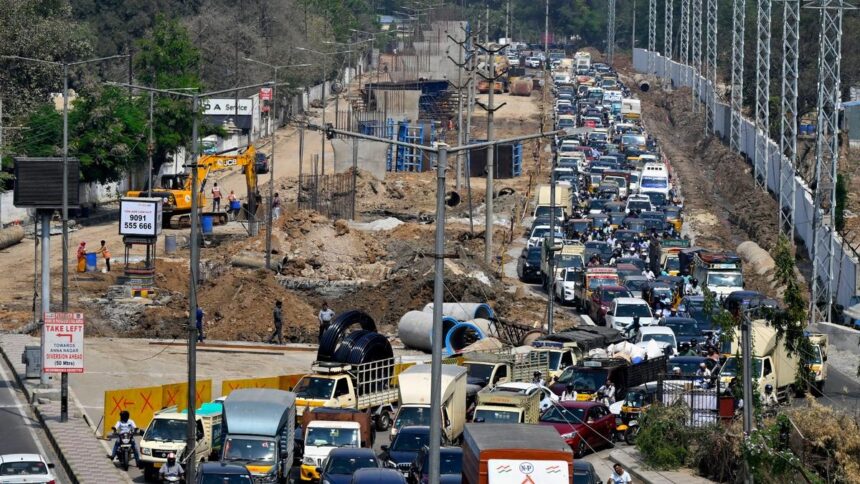






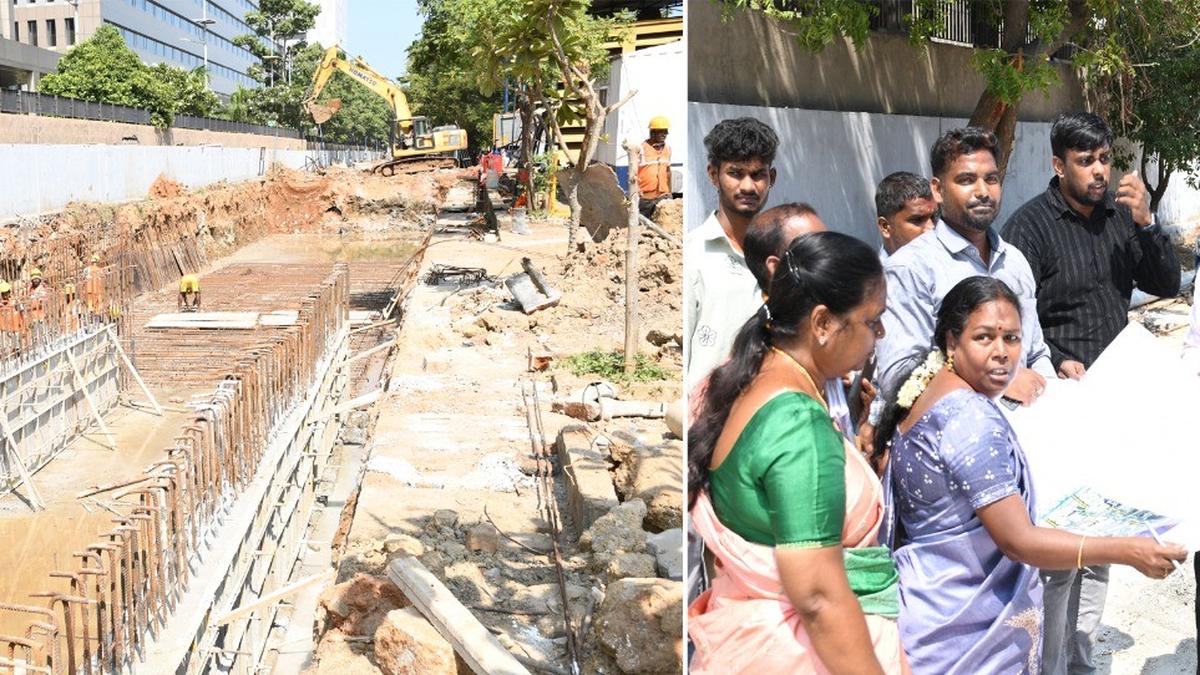

The Thiruppugazh Committee report on Chennai’s flood risks largely remains unavailable in the public domain, despite the the Greater Chennai Corporation (GCC) completing 57 of the 63 flood-mitigation works recommended by the panel in the last five years.
Formed after the 2021 floods, the committee headed by retired IAS officer V. Thiruppugazh had produced a 600-page report with basin-wise recommendations and numerous measures.
As per these recommendations, the GCC had completed works worth ₹307.51 crore, including 198 metres of stormwater drains, 200 Internet of Things (IoT) street sensors, and 7,072 silt catchpits with rainwater harvesting structures within the Adyar and Cooum basin, as per a recent Action Taken Report (ATR) accessed by The Hindu.
Further, four works were in progress for an estimated ₹118.75 crore, and five more, worth ₹51.86 crore, were yet to be taken up, as on September 18.
Work completed
Stormwater drains (SWDs) were constructed at Seethammal Colony, Bharathidasan Salai, T.T.K. Road, C.V. Raman Road, C.P. Ramasamy Road, Canal Bank Road and Dr. Ranga Road, with disposal into the Buckingham Canal
.Integrated stormwater drains were completed at Bazullah Road, Thirumalai Pillai Road, Vijayaraghava Road and G.N. Chetty Road, with disposal into the Mambalam Canal. Similar works were completed at Vembuliamman Koil Street, P.V. Rajamannar Street, R.K. Shanmugam Salai, Ramasamy Salai, Lakhmanasamy Salai, Munusamy Salai and Anna Main Road, with disposal into the MGR Canal
.Similar stormwater drainage works were completed at Ashok Nagar 18th Avenue, Dr. Natesan Salai, Kamarajar Salai and Ashok Pillar Road, with disposal into the Inner Ring Road
.In Tondiarpet Zone, at the Ganesapuram subway near Vysarpadi Railway Station,*push through culvert for 40 m* has been installed and sump and pump work is in progress. The estimated cost is ₹2.5 crore, the report revealed.
.In Anna Nagar Zone, at Millers Road and T.P. Chatram Road, pumps have been installed, and 435 metres of stormwater drain has been completed at a cost of ₹1.44 crore. Construction of another 198 metres of stormwater drain at Convent Street, connected to Poonamallee High Road, is in progress at an estimated cost of ₹4.5 crore.
An official said some bridge works, including four on the Mambalam Canal and nine on the Virugambakkam Canal, had to be taken up in phases. In Adyar Zone, the construction of a cut-and-cover drain is under way at Tidel Park at an estimated cost of ₹7.75 crore.
In Valasaravakkam Zone, Chennai Metro Rail Limited is reconstructing a stormwater drain at a cost of ₹104 crore along Arcot Road after completing the Metro Rail work on the stretch.
Works proposed
The GCC is planning to begin certain works after the monsoon, as building new infrastructure during the rains would lead to complications, an official said.
The works proposed include the construction of bridges across Mambalam Canal in Teynampet Zone at an estimated cost of ₹40 crore, and across MGR Canal on Anna Main Road in Kodambakkam Zone at ₹8 crore; infrastructure and stormwater drain works in Gajalakshmi Nagar in Alandur Zone at ₹1.40 crore; and a box culvert drain on OMR near the Software Technology Park of India in Sholinganallur Zone at an estimated ₹2.46 crore.
Following the committee’s recommendations, the GCC established sponge parks in 57 locations and eco-block rainwater harvesting structures in 778 locations.
It also completed 7,072 silt catchpits within the Adyar and Cooum basin, and built 43,500 additional structures in the Kovalam and Kosasthalaiyar basin.
To improve groundwater recharge and storage, 208 wells were sunk in the Adyar and Cooum basins, Miyawaki forests were planted in 38 locations, and 197 out of the 210 planned ponds and lakes restored, the ATR said.
Additionally, based on recommendations regarding protection of waterways and removal of encroachment, 4,979 families along the banks of the Adyar and 13,484 families along the Cooum have been resettled into Tamil Nadu Urban Habitat Development Board tenements.
Pre-monsoon desilting is being regularly carried out across 44 canals using amphibian vehicles and robotic excavators, and at least 200 IoT street sensors have been installed near key waterways and strategic areas to track flood levels, the report added.
White paper
In 2024, the then DMK-led State government promised to release a white paper on the Thiruppugazh committee report’s recommendations to explain the expenditure, progress of projects, and areas requiring drain repair works, besides the works already undertaken.
The State government had cited this report to justify design changes and drain upgrades, the creation of artificial waterbodies, and its request for Central funds for an ‘Integrated Urban Flood Management’ project, yet the report remains unavailable in the public domain.
The TVK-led government has said it would publish the entire report soon.
Published – October 06, 2026 12:54 am IST