



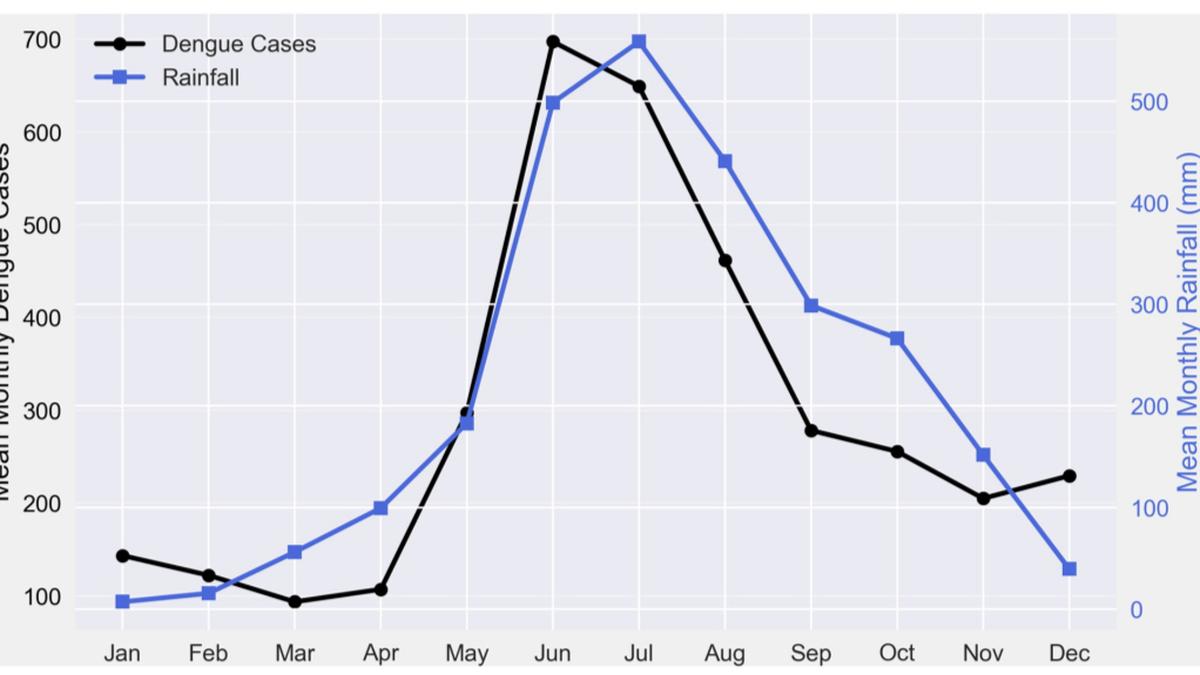


Monthly cumulative rainfall (blue line) and dengue cases (black line) in Keralam from 2006 to 2019. Dengue cases show a clear seasonal pattern that corresponds with the rainfall cycle.
Even as climate change is emerging as a significant driver of vector-borne diseases as it alters ecological and climatic conditions that influence mosquito proliferation and virus transmission, a study by the Centre for Climate Change Research at the Indian Institute of Tropical Meteorology (IITM), Pune, has confirmed strong seasonality in dengue transmission in Keralam. Nearly 60% of dengue cases in the State occur during the southwest monsoon (June-September) season, closely mirroring the State’s rainfall cycle.
The study, titled ‘Climate-informed dengue prediction and future risks under a changing monsoon climate in Keralam,’ identified rainfall, humidity and the El Niño-Southern Oscillation (ENSO) as the key drivers of dengue transmission. It also pointed out that climate change and shifting monsoon patterns can increase dengue incidence in the State.
The study, conducted in collaboration with experts from the Department of Atmospheric and Space Sciences, Savitribai Phule Pune University; ICMR-National Institute of Translational Virology and AIDS Research, Pune; School of Public Health, Kerala University of Health Sciences (KUHS); Government Medical College, Thrissur; and KUHS, found that dengue cases begin rising in May and peak during the southwest monsoon, particularly in June and July.
Long-term risk planning
Future simulations using different machine-learning models suggest that dengue risk in Keralam could increase by 16-20% during 2021-2040 and by up to 113% by 2081-2100 under low- to high-emission pathways, underlining the need for climate-informed dengue early warning systems and long-term risk planning.
A key contribution of the study, published in GeoHealth, a peer-reviewed, open-access scientific journal, is the inclusion of El Niño-Southern Oscillation as a predictor of dengue risk. Both El Niño and La Niña were found to influence dengue risk depending on regional climate responses, although La Niña events, generally associated with cooler and wetter conditions, were found to be of relatively lower risk than El Niño.
Locally, warmer temperatures of 30.5°C-32.5°C and moderate humidity of 66%-79% during the pre-monsoon season, along with moderately high monsoon rainfall of 180-450 mm a month, were found to favour higher dengue incidence.
Peak and weaker phases
According to climate scientist Roxy Mathew Koll of IITM, Pune, who led the study, the model can predict the peak and weaker phases of dengue transmission more accurately when high-resolution climate and epidemiological data are available. Such data are particularly important at the block level in Keralam because of variations in maritime and orographic influences, monsoon rainfall and its active and break phases.
For instance, the southwest monsoon is generally more vigorous in northern districts, while southern districts experience more intense spells during the northeast monsoon. Changes in atmospheric pressure, temperature and relative humidity during the active and break phases can influence localised mosquito breeding and dengue risk, Mr. Koll said. The same modelling approach could potentially be extended to other vector-borne diseases by incorporating detailed temperature, rainfall and epidemiological data, he said.
Post-monsoon dengue
Post-monsoon dengue also showed considerable year-to-year variability, possibly reflecting differences in the spatial distribution of monsoon rainfall. The Keralam dengue model could be further strengthened through enhanced disease surveillance, better representation of vector biology and socio-demographic factors, and continuous validation.
The researchers also cautioned that changes in circulating dengue virus strains could trigger sudden surges in cases, while the future deployment of vaccines currently in development could substantially reduce dengue risk. Despite these limitations, the model demonstrated reasonable forecasting accuracy and provided region-specific insights that could support early warning systems and public health planning. Given the marked spatial variation in monsoon characteristics and dengue distribution across Keralam, more localised studies using high-resolution climate and epidemiological data could further improve dengue forecasting and risk assessment, said the researchers.
Published – September 16, 2026 07:19 pm IST