






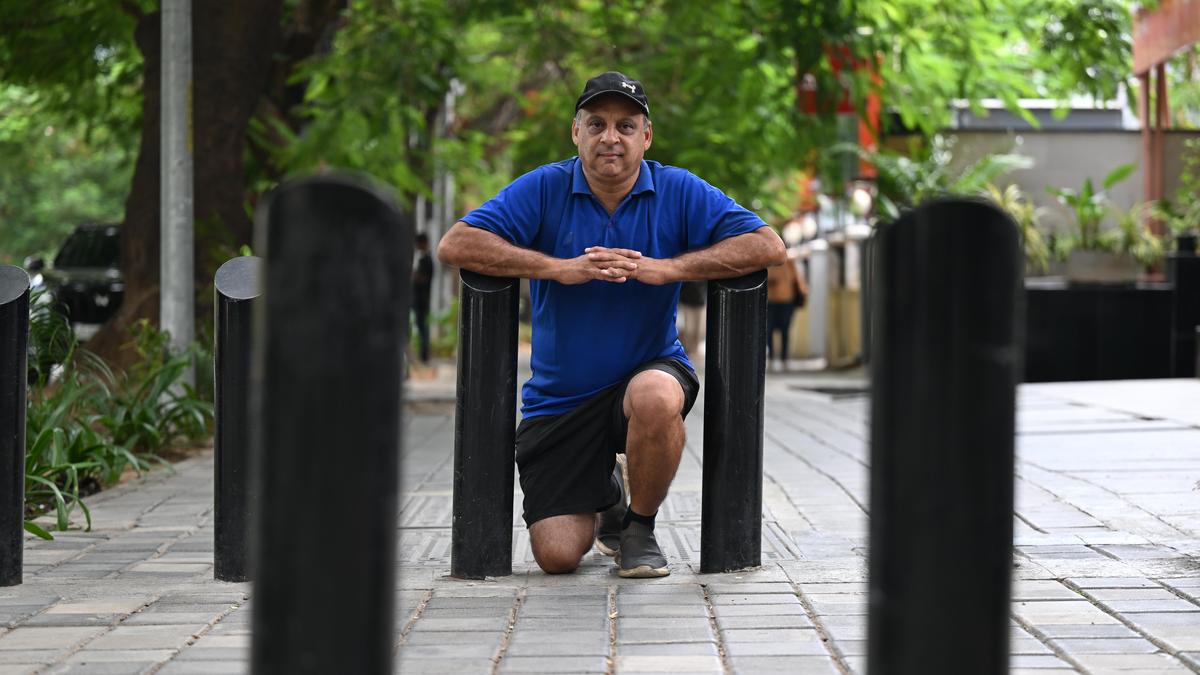

Bengaluru’s pavements are a CrossFit course of broken tiles, construction debris and garbage — and Arun Pai, 57, won’t stop walking until he has cleared these obstructions. His video tutorial on dismantling sofas abandoned on the street got him a mention on Prime Minister Narendra Modi’s Mann Ki Baat podcast. Recently, Pai, founder of the popular Bangalore Walks and the city’s self-appointed ‘footpath mayor’, felt like the universe was finally listening.
Last month, after the Supreme Court declared that walking on footpaths is a fundamental right, Karnataka appointed a Bengaluru Development Minister, Krishna Byre Gowda, who promptly unlocked ₹70 crore to fix 2,000 km of footpaths. Pai, an until recently low-key man who has partnered with the government to improve walkability for two years, felt a burst of optimism, though it must be said that ousted street vendors are staging citywide protests in response to the ‘Safe Footpath’ campaign.
It was in 2005 that Pai decided to quit his corporate job and dive full-time into conducting walking tours of Bengaluru, just as the city was morphing from a sleepy paradise into a startup magnet. He has spent the last two decades following the mantra of kaam chaalu, mooh bandh (keep working, keep quiet). The more Pai walked, the more he saw how Bengaluru could potentially be like any clean, walkable European city. He decided to combine civic action with storytelling.

The urban middle class has a very curious attitude towards maintenance and cleaning of streets and other civic amenities, says Arun Pai.
| Photo Credit:
Allen Egenuse J.

Filling the gaps
While receiving an award from his alma mater IIM Bangalore recently, Pai revealed that he was one of the early volunteers of the viral civic movement, The Ugly Indian, which began in 2009 as an attempt to clean the city. “Cornell University theorised that it is successful because it does not define itself in opposition to anything else. It is about solving a problem,” Pai says, adding that the success was also attributed to its central philosophy of “I will own it, I will solve it, I will not blame anyone”.
For Pai and other volunteers, The Ugly Indian was an idea by an anonymous group that believed, as he says, that “the doer is not important”. Four years later, he formalised it with the India Rising Trust that now employs around 25 people, most of them blue collar workers. “We are like a contractor,” he says. “We fill the gaps in government capacity.” North Bengaluru recently partnered with them to clean up 100 chronic garbage ‘black spots’.
At some point, Pai realised that while Indians applaud the social work that happens in schools and hospitals, they don’t think the same way about clean ups. “If I’m cleaning your street, you suddenly say, ‘no, that’s the government’s job’. The urban middle class has a very curious attitude towards maintenance and cleaning, and it comes from our feudal caste background,” he says. “But what people really care about is that when I walk or drive, everything should be perfect.” That’s when he pivoted from talking about cleanliness to discussing walkability. (When he spoke masked at The Ugly Indian’s TED Talk 11 years ago, the title was ‘Why Is India So Filthy?’) Good footpaths, it turned out, was a more universal civic problem.

It was at a mobility seminar in 2024 that Pai spoke as a representative of walkers and declared himself the footpath mayor of Bengaluru. “As is my style, I didn’t want to talk unless I’ve done something,” he says. So beforehand, Pai ran 100 km on the city’s footpaths, rating all of them from 1 to 5. A top official in the audience instantly asked for and acted on his blueprint.
Catalysing urban change
In Pai’s world, ward officers and engineers come on walks, Bengaluru’s civic body chief is incredibly responsive, and officials join enthusiastically in creative endeavours, such as the recent IPL (Indian Pedestrian League) in which RCB (Raste Clean-up Bengaluru) emerged a winner. “It’s a middle-class thing to say everything is bad,” says Pai, whose interactions with local officials are invariably friendly, rather than confrontational.
“Solving walkability is a silver bullet for many civic challenges,” he says. Fixing footpaths, he believes, can impact everything from a company’s carbon footprint to the safety of women and pedestrians. “I’m getting a place at every mobility discussion because nobody else is standing up for walkers,” he adds.
One of the consistent donors to Pai’s Trust is Rohini Nilekani, whom he refers to as “India’s most generous woman”. They met only in the third year after she began donating and their relationship was cemented over a clean-up. “I don’t like to do meetings,” he told her. “Shall we clean up the area outside your office?”
Pai has his own blueprint on how you can catalyse urban change. Focus only on solving the problem; work within your means and don’t ask anyone for money; don’t take credit for it, in fact barter credit for access; be anonymous; attack a problem that everyone wants solved; involve all stakeholders whether you like them or not; do government work at no cost; give it time; let the action do the talking.
“If you want to solve a problem at scale in India, use the compounding effect of media to inspire people and make them copy you,” he says. “We are very good at emulating.”
The writer is a Bengaluru-based journalist and the co-founder of India Love Project on Instagram.
Published – July 09, 2026 05:04 pm IST