




(This review might contain mild spoilers about the sub-genre, as Dorothy makes it necessary to tackle the online bigotry that has spoiled the film’s cleverly concealed sub-genre)
A man contemplates killing a part of himself because another woman embraced a part of herself that she had been suppressing all her life. This is a thread from the film we are discussing, but also an allegory for how queerphobic individuals on social media have been killing their own humanity these last few days, after the TIFF premiere of Karthik Subbaraj’s Dorothyrevealed that this could be the first major queer entrant in mainstream Tamil cinema.
In a way, Dorothy, starring Sananth, Rishikanth and Keerthy Suresh, has exposed queerphobia in modern Tamil society even before its release.
There is a cost to making a film like Dorothy, and sometimes what you give up could actually work in your favour. In this case, the film’s conceit is to make you believe it’s a story about two men, Karthi and Subbu, who fight over a woman, the titular Dorothy. The promo materials seem designed with this in mind, but the brilliance of Karthik’s screenplay is that, at the end of the day, even when you know there’s a queer theme, the film still tells that story in a breathtaking way — perhaps the bigots didn’t win after all.
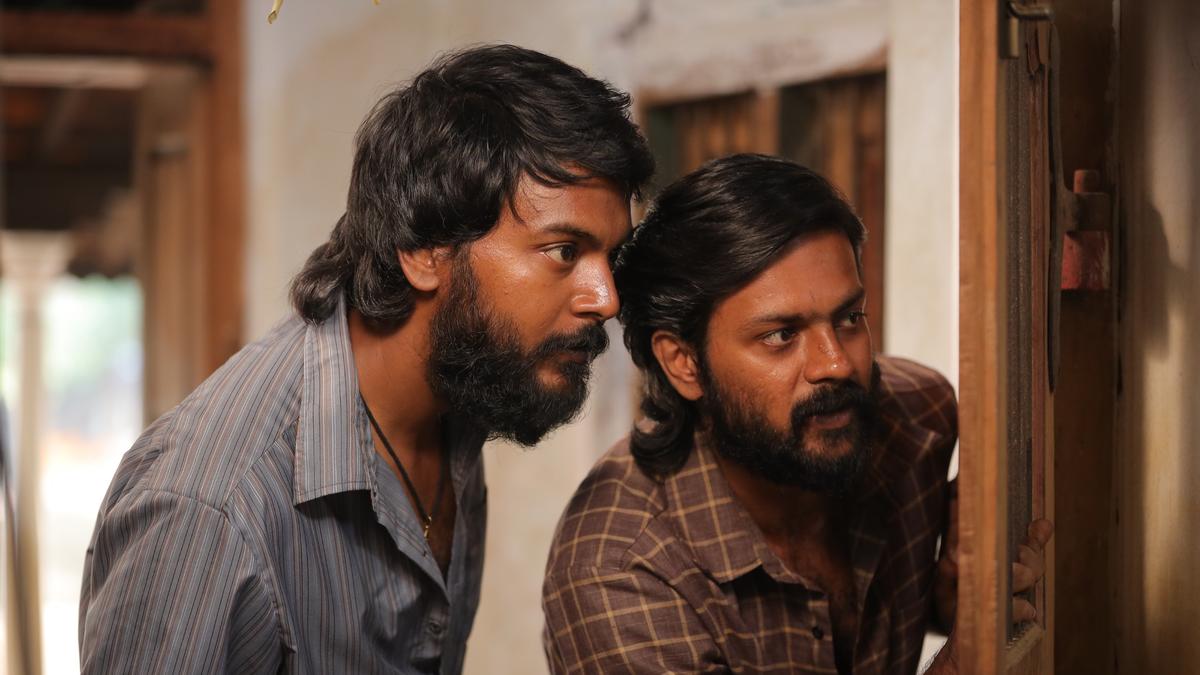
We have Subbu (a perfectly cast Sananth), a young man who looks up to Bruce Lee and spends much of his time with his best friend, Karthi (Rishikanth of Modha Rathri fame steals the show). Raised as a ‘kadaikutty’ by ruffians in a womanless household, Subbu yearns for motherly love, which he first sees in Karthi’s mother and later, in his sister-in-law, Dorothy (Keerthy Suresh makes you want to see more of her).
Karthi, on the other hand, starts as a young, scared boy who did not have a father to protect him and his mother from a cruel, patriarchal world. However, as life has it, Karthi grows up as someone who seems more suited to Subbu’s world, and vice versa. Even when they attempt to murder a local gangster, Karthi tries to salvage the botched attempt, while Subbu, despite being a skilled fighter, cowers.


Sananth and Rishikanth in a still from ‘Dorothy’
| Photo Credit:
Special Arrangement
The first half of the film shows how Subbu and Karthi find each other, how they complete each other, and how they, in a way, become each other. At the beginning, Subbu tells Karthi, “Aambala azha koodadhu da (Men shouldn’t cry)” — and this thought ends up causing the first layer of rust in Karthi. Even after the former learns the truth of the matter — as Karthi’s mother says, there’s no gender to emotions — a tender part of Karthi begins to corrode.
At a time when incel culture is suffocating Indian social media, it’s a crucial work of writing that underlines how a heartbreak caused by patriarchy fuels this toxicity in Karthi.
In fact, every crucial moment in this story is inadvertently caused by women — through her wedding, her affection, her death, or simply her existence. Whenever a character finds a woman’s shoulder to lean on or confide in, whether it’s a friend or a mother, destruction snatches the moment away. At one point, the toxicity around Karthi and Subbu begins to affect them, which we realise when they end up attacking a woman.
But there’s a well somewhere in our world where femininity is stored and repressed. Eventually, it flows as a river. And when femininity decides to break out, it can obliterate anything in its path, and this fierce nature of femininity in the face of oppression is what Dorothy celebrates.

Dorothy (Tamil)
Director: Karthik Subbaraj
Cast: Sananth, Rishikanth, Keerthy Suresh, Muthukumar
Runtime: 146 minutes
Storyline: Two men bound by friendship and violence find their lives transformed when a woman enters their world and awakens parts of themselves they have long suppressed
In a film that could be seen as a follow-up to his 2016 film Iraivi, Karthik Subbaraj looks far more mature. He lets his characters be themselves and show who they are. Through a steady buildup of character, Karthik’s script lets you experience being a feminine presence in a hypermasculine, cis-heteronormative world. He shows that women too can fight like Bruce Lee, but there is also bravery and intellect in walking away from a fight.
Karthik’s most cohesively written script, Dorothy is also his most progressive take on how caste, class and gender intersect. From a dialogue a child utters when asked his caste to how the cops go easy on their caste members, casteism exists comfortably with patriarchy in this world; in fact, caste also explains why Subbu gets to be closer to Dorothy and not Karthi.
The filmmaker conveys both large and small ideas efficiently; even the way a character eats parotta becomes a sentiment, with a shot likening the salna flowing over parotta to blood draining out. Or take, for instance, how a reference to the famous comic ‘Irumbu Kai Maayavi’ accrues new meaning when Karthi injures his hand. Speaking of the comic, Karthik Subbaraj has never missed an opportunity to celebrate cinephilia — from a perfectly placed cinema bandi-style advert of Nayakan to a shot of a man looking at Grace Jones’ thighs in the poster of A View to Kill.
The Rajinikanth fan in Karthik also doesn’t miss paying tribute to the superstar of the 80s through Rishikanth, who resembles Rajini; there’s a reason why Rishi’s hairstyle looks like Rajini’s in Thalapathy and why he opts for a different look in some portions. Interestingly, the Tarantino fan in Karthik makes up for some of the damage Once Upon a Time… in Hollywood inflicted upon Bruce Lee fans.


Keerthy Suresh in a still from ‘Dorothy’
| Photo Credit:
Special Arrangement
And no call to nostalgia seems complete without maestro Ilaiyaraaja, whose music becomes a character itself in Dorothy. Fans of the composer have been eagerly waiting for the film ever since Karthik announced that he is using ‘Do Anything’ from the composer’s album How to Name It?, but nothing prepares you for the weight of the moment the track is used in. In his 1551st movie, Ilaiyaraaja once again displays an understanding of when to vanish into the background and let the material speak for itself, and when the song must come to add new meaning or emotional heft to the text.
For many years, Tamil queer audiences who took a liking to World Cinema titles such as All About My Mother and A Fantastic Woman have yearned for a queer film that reflects their lives with accurate representation. Dorothy might be the start of a queer revolution in mainstream Tamil cinema, and Karthik has shown real effort to understand some of what queer life in India means. The film allows you to understand the importance of pronouns, while a scene featuring a scorpion illustrates that even Nature is fluid.
To speak in the language of hate that Dorothy seems to be attracting online, if this queerphobia and immorality are a zombie herd of ignorance and apathy, more mainstream representation of queer themes will be the flash flood of sense and scientific temper. All it took was one audacious filmmaker, a daring producer, and a passionate cast to pull off what might just become the most important Indian film of the year. And so, the wells will fill, the rivers will swell, and nobody cannot stop them.
Dorothy is currently running in theatres
Published – September 25, 2026 05:42 pm IST