



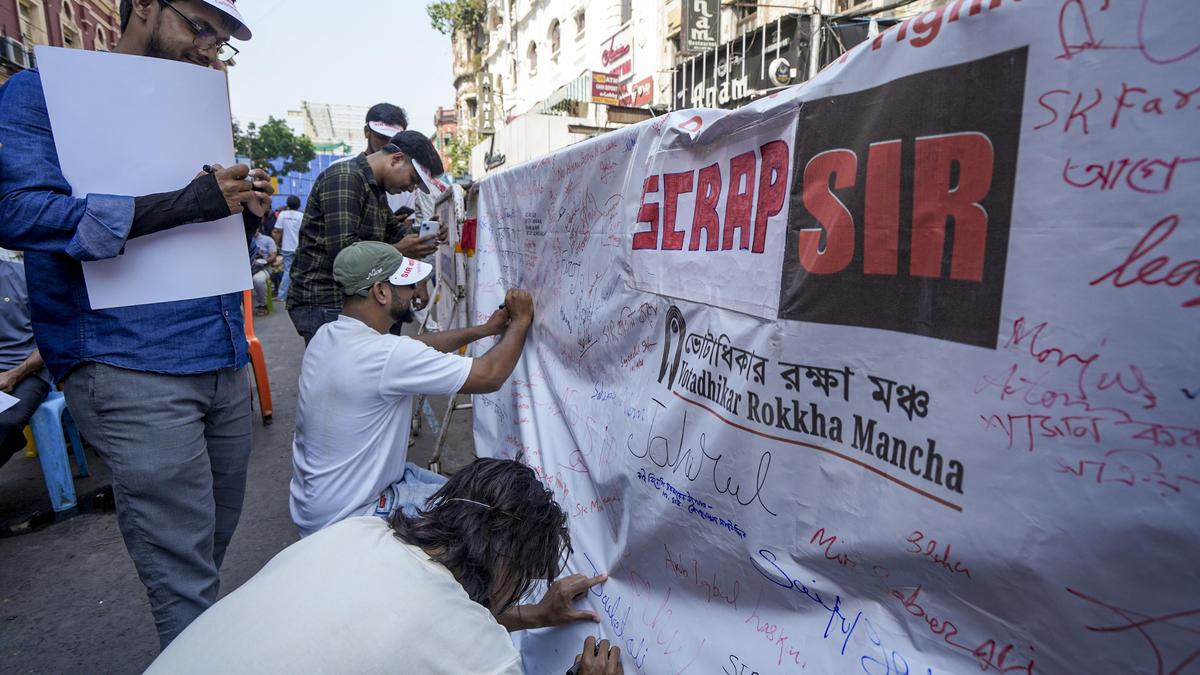


According to an affidavit submitted by the EC in the Supreme Court, 22.21 lakh appeals are pending before the tribunals in West Bengal. File
| Photo Credit: PTI
The Election Commission’s (EC) special “door-to-door” drive to re-enrol any voter left behind during the SIR process through Form 6 will not be applicable to the more than 20 lakh voters in West Bengal whose cases are pending before the appellate tribunals. This could create two parallel re-enrolment routes, one through the tribunals and one through Form 6 applications to Electoral Registration Officers (EROs) and as the EC has directed Form 6 applicants to be cleared within one or two months, the tribunal appellants could wait several years.
A senior EC official told The Hindu that while Booth Level Officers (BLOs) would re-check if any voters are left out among the ASDD (Absent/Shifted/Dead/Duplicate) list which was issued after the Enumeration Phase, those whose cases are in the tribunals “is different as it is already under adjudication”.

According to an affidavit submitted by the EC in the Supreme Court, 22.21 lakh appeals are pending before the tribunals in West Bengal.
The appellate tribunals came out of Supreme Court’s supervision of the SIR. Judicial officers, drawn from a list the Calcutta High Court sent at the Supreme Court’s direction, were adjudicating the roughly 60 lakh “doubtful and pending” cases. On March 10, the apex court had directed that a separate appellate body be set up so that people could challenge those officers’ decisions. On March 21, the EC constituted 19 Appellate Tribunals for West Bengal. The tribunals began functioning around April 13, and on April 16, the Supreme Court ordered that voters whose appeals succeed be added through a supplementary list. This came only days before Assembly elections began on April 23, and reportedly only 136 names had been cleared by then.

Before this, during enumeration phase, about 31.7 lakh voters (31,68,424) were identified as “unmapped”, meaning they could not be linked to the 2002 electoral roll. A further approximately 1.36 crore were flagged under “logical discrepancy”. Both groups were called for hearings after the draft roll was published on December 16 last year.
Around 60 lakh cases were still unresolved when the final roll was published on February 28 after the hearings had cleared the rest. The Chief Electoral Officer described them as names under adjudication for logical discrepancies.

The ASDD list was prepared by BLOs during the enumeration phase and made public before the draft roll. Its 58,20,898 names were excluded from the draft roll of December 16, 2025. Of these, 24.16 lakh were marked dead, 32.65 lakh shifted or absent, and 1.38 lakh duplicates.
In an October 1 letter to the CEOs of all States and Union Territories, the EC has said that BLOs shall compare the current electoral roll with the pre-SIR electoral roll and identify such electors whose names were there in the pre-SIR roll but who are not included in the current electoral roll and prepare a list of such electors. Then they have to make a door-to-door visit to ascertain their present status and ensure their enrolment through Form 6 if the concerned person is found eligible.
The West Bengal Congress has said that since the enrolment drive was announced just before the October 6 byelections in Nandigram and Rejinagar, where over 6,000 and 12,000 appeals respectively remain pending, these voters would be deprived of their vote for a second consecutive time.
WBPCC President Shubhankar Sarkar and the party’s SIR Committee Chairperson Prasenjit Bose, in a letter to the EC, asked for all 22.21 lakh appellants to the electoral roll to be restored provisionally until their appeals are finally decided, or to convert all pending tribunal appeals into Form 6 applications addressed to the EROs concerned.
Published – October 02, 2026 09:40 pm IST