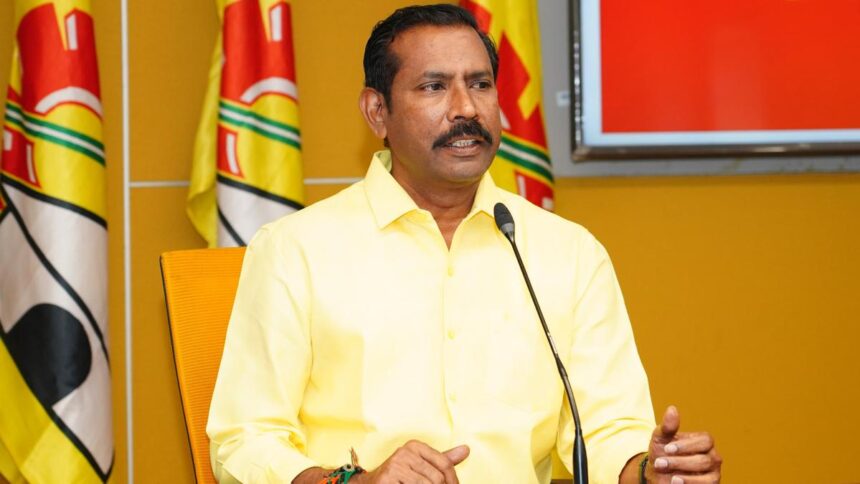










Tamil Nadu Chief Minister Vijay. File.
| Photo Credit: PTI
The hearing on Chief Minister C. Joseph Vijay’s plea to reject an election petition filed against his victory from the Perambur constituency took an interesting turn on Wednesday (October 7, 2026), with Justice V. Lakshminarayanan of the Madras High Court remarking that the entire texture of the case had changed in view of the Supreme Court judgments cited by counsel for the election petitioner.

After hearing the arguments made on behalf of the Chief Minister on Monday and Tuesday, the judge began firing a volley of questions at the election petitioner’s counsel on Wednesday (October 7, 2026), asking how some alleged discrepancies in assets worth over ₹600 crore declared by Mr. Vijay would amount to undue influence over voters or could be termed as a corrupt electoral practice.
The judge wanted to know whether the voters in the Perambur constituency would have been swayed in one direction or the other simply because there was a difference of a few crores or a few lakhs in the assets declared by the Chief Minister, especially in light of the fact that he was a “superstar” in the cinema industry and had voluntarily declared both movable and immovable properties worth more than ₹600 crore.
The judge said he had relied on a chartered accountant to declare his assets while being elevated to the position of a judge of the High Court. Therefore, if Mr. Vijay had also declared his assets through a chartered accountant, how could his election itself be declared null and void for any mistakes made by the auditor in such a declaration, the judge wondered.
He also questioned the challenge made by a voter, S. Dinesh, through his counsel on record, V.R. Shanmuganathan, to the election of the Chief Minister from Perambur on the ground of improper acceptance of the nomination form by the Returning Officer concerned. The judge wanted to know how the Returning Officer could be expected to verify the correctness of the declared assets.
In answering the questions, the election petitioner’s counsel said that the Returning Officer was expected to conduct only a summary inquiry, whereas the charge of false declaration, and whether such declaration was made wilfully and deliberately, could be inquired into only by means of leading evidence during the course of trial in an election petition. Hence, the election petition should not be rejected at the threshold, he argued.
He said, Justice V. Ramasubramanian (during his stint in the Madras High Court before his retirement as a Supreme Court judge) had in Krishnamoorthy versus Sivakumar (2009) held that “any incorrect information, wrong information, incomplete information, false information, one-sided information, disinformation, misinformation and non-information would certainly interfere with the free exercise of the electoral right of the voter, inasmuch as his choice of candidate will be influenced greatly by the information so furnished or withheld.”
“The view taken by Justice Ramasubramanian was affirmed by the Supreme Court in 2015. Therefore, I have made out a cause of action for the trial of the election petition and it should not be rejected in limine,” the counsel said. He also relied upon the Supreme Court’s judgment in Resurgence India versus Election Commission of India (2013), wherein it was held that a voter’s right to know about a candidate was a natural right flowing from the concept of democracy and was an integral part of Article 19(1)(a) of the Constitution.
After hearing him at length, Justice Lakshminarayanan turned towards senior counsel Gopal Sankaranarayanan for the Chief Minister and said: “Mr. Gopal, the texture of the case has changed in entirety. Please see the judgements he has circulated. See Justice Ramasubramanian’s judgement.” When Mr. Sankaranarayanan said, “there is a square answer to it,” the judge asked him to answer it in his reply on Thursday (October 8, 2026).
Published – October 07, 2026 10:48 pm IST