




The story so far:
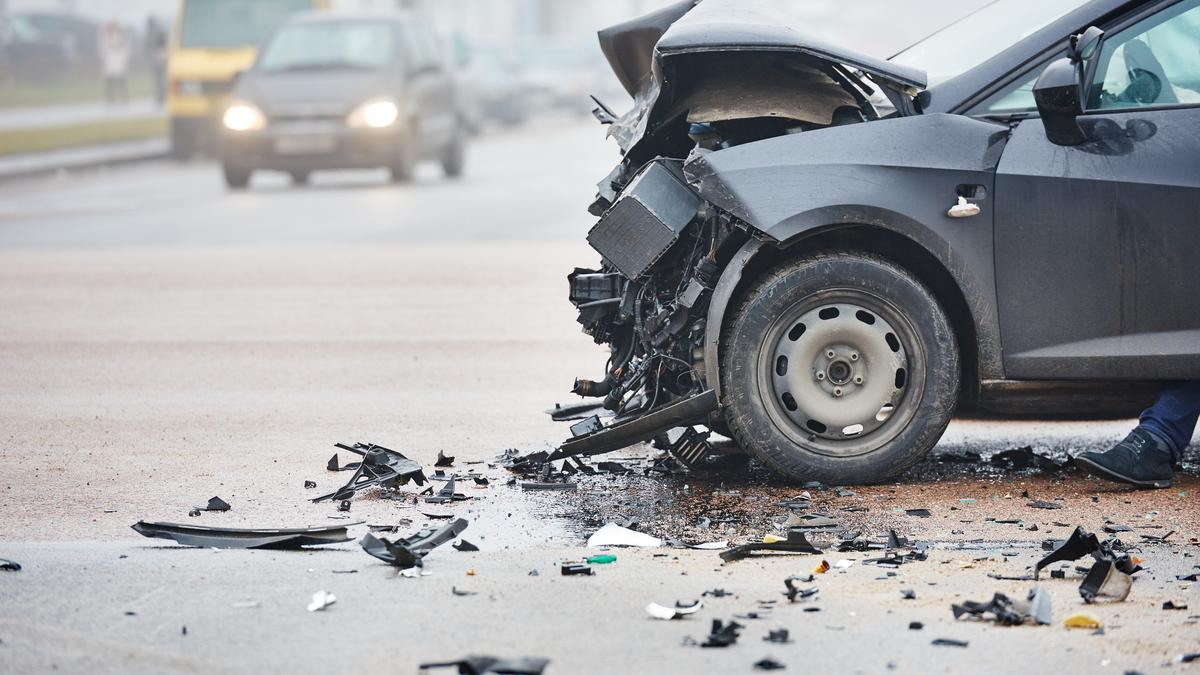
India has the world’s largest road network, spanning about 6.7 million kilometres, larger than the U.S.’s 6.59 million km and China’s 5.49 million km, but it also records the world’s highest road fatalities. Over-speeding and reckless driving, poor road upkeep, inadequate driver training, and weak emergency and trauma care continue to make road crashes a severe public-safety crisis.
According to the Ministry of Road Transport and Highways’ Road Accidents in India 2024 report, 4,87,707 road accidents in 2024 claimed 1,77,175 lives (about 485 deaths a day or 20 an hour) and injured 4,71,441 people. With road crashes estimated to cost around 3.14% of India’s GDP, their impact extends beyond lost economic productivity, falling most heavily on dependants of those killed or permanently disabled. Yet, for many claimants, courts’ quantification and compensation awards remain difficult to navigate.
What is the legal framework?
The Motor Vehicles Act, 1988 (MV Act) is the principal law governing motor-accident compensation. The MV Act creates a statutory scheme covering the entire accident chain, from regulation and driver and owner duties to insurance, liability, investigation, and compensation. For adjudicating claims, Section 165 empowers State governments to constitute Motor Accidents Claims Tribunals (MACTs) for specified areas to determine claims arising from motor-vehicle accidents.
Under Section 166, a claim may be filed by the injured person, the owner of damaged property, or, in case of death, by all or any of the deceased’s legal representatives (LRs). The insurer, owner, and driver are ordinarily parties to the proceedings, as the Tribunal must determine both the amount of compensation and the party liable to pay it. The claim is ordinarily first heard by the MACT, which is the primary fact-finding and compensation-awarding forum. An appeal under Section 173 may be filed before the High Court within 90 days, subject to the depositing of ₹25,000 or 50% of the awarded amount, whichever is less. In determining liability, the Tribunal typically examines the FIR and chargesheet, site plan, Mechanical Inspection Report, post-mortem report or medical/disability records, insurance policy, and the depositions of eyewitnesses and the investigating officer, etc.
Importantly, the same accident may generate two distinct proceedings: a criminal case for offences such as rash or negligent driving, and a separate MACT claim for compensation. As held by the apex court in Reena v. Managing Director, KSRTC (2026), an acquittal in the criminal case does not affect the MACT proceedings, since the two operate in distinct legal spheres and apply different “standards of proof”.
Who is liable to pay the compensation?
Liability initially attaches to the negligent driver and, vicariously, to the owner of the offending vehicle. Where the vehicle is insured, the insurer generally satisfies the award. Section 146 mandates compulsory third-party insurance, while Section 150 requires insurers to satisfy awards arising from third-party risks, subject to limited defences under Section 150(2), including specified policy breaches, unauthorised use, driving without a valid licence, and non-disclosure or misrepresentation in obtaining the policy. Even where a defence is established, courts may apply the “pay and recover” principle, directing the insurer to pay the victim/LRs first and recover the amount from the owner or driver thereafter.
A separate “no-fault liability” route dispenses with proof of negligence and provides compensation of ₹5 lakh for death and ₹2.5 lakh for grievous hurt (post the 2019 amendment), payable by the owner or authorised insurer, without proof of negligence.
How to calculate compensation in accidental deaths?
Money cannot substitute for a life lost, but motor-accident compensation seeks to ease the financial burden on the deceased’s dependants. Section 168 of the MV Act requires an award of “just” compensation. Through landmark decisions such as Sarla Verma (2009) and Pranay Sethi (2017), the top court has evolved standardised formulas and foundational principles for giving effect to this requirement. Once “rash and negligent” driving is established, the quantum can broadly be understood as a three-stage exercise: first, establishing the foundational facts; second, applying them to the prescribed heads and formulae; and third, aggregating the amounts to arrive at the final award.
The first stage is to establish three facts: (1) the deceased’s age at the time of the accident, (2) annual income and (3) number of dependants. “Age” can be established, among others, from the date of birth recorded in the school-leaving certificate and not from the Aadhaar card, as was ruled in Saroj (2024) by the Supreme Court. “Income” means actual income less income tax paid (as per Pranay Sethi). The Supreme Court in Rashmirekha Tripathy (2026) held that, for salaried persons, the ITR of the immediately preceding assessment year should ordinarily be considered, while for self-employed persons or business owners, the Tribunal should take the average income reflected in the preceding three years’ ITRs, subject to the circumstances. Where income cannot be proved, the applicable State-notified minimum wage for the relevant time for unskilled, semi-skilled or skilled category is used. The LRs, including married and earning sons and daughters, are entitled to claim compensation, regardless of financial dependency on the deceased, as settled by the Supreme Court in Jitender Kumar (2025).

The second stage is to translate these three facts into the four heads under which compensation in a death case is computed: (A) loss of income/dependency, (B) loss of estate, (C) funeral expenses, and (D) loss of consortium. The major component is “loss of income”, which represents the financial loss suffered by the dependants on account of the victim’s death. For the first head, the calculation begins with the deceased’s “annual income” to which the prescribed percentage towards “future prospects”, having regard to the deceased’s age and nature of employment, is added. From the resulting figure, the prescribed “deduction” towards the deceased’s personal expenses is made, and the balance is multiplied by the appropriate “multiplier” to arrive at the “loss of income”. The aforesaid three components perform different functions: “future prospects” account for the career growth the deceased would reasonably have received had they survived. As delineated in para 61 of Pranay Sethi (2017), for a person in a permanent government or salaried job with assured career progression, 50% is added where the deceased was below 40 years, 30% where aged 40–50 years, and 15% where aged 50–60 years; no addition is made above 60 years. For a self-employed person or one on a fixed salary, the corresponding additions are 40%, 25% and 10% for these three age groups, respectively, with no addition above 60 years.
Further, the “deduction” recognises that a portion of the deceased’s earnings would have been spent on their own personal living expenses. As per Sarla Verma (2009), for a married deceased with two to three dependent family members, the standard deduction is one-third (33%); where there are four to six, it is one-fourth (25%); and where there are seven or more, it is one-fifth (20%). In the case of a bachelor or unmarried deceased, the usual deduction is one-half (50%) where the parents or other dependants are the claimants, although courts may reduce the deduction where the number of dependants is particularly large. Lastly, the “multiplier” represents the deceased’s remaining active working life and is determined solely with reference to age. According to Sarla Verma, the multiplier is 18 for ages 15-20 and 21-25; 17 for 26-30; 16 for 31-35; 15 for 36-40; 14 for 41-45; 13 for 46-50; 11 for 51-55; 9 for 56-60; 7 for 61-65; and 5 for 66-70 years.
The remaining three are conventional heads and, unlike “loss of income”, do not depend on the deceased’s profession or actual earnings. Under Pranay Sethi (2017), (i) “loss of estate” was fixed at ₹15,000, representing the loss of savings, investments and accumulated assets that the deceased could reasonably have built up and left for the heirs; (ii) “funeral expenses” at ₹15,000; and (iii) “loss of consortium” at ₹40,000 for each eligible family member, recognising the emotional trauma and loss of companionship, love, care and guidance. Consortium includes spousal consortium for the surviving spouse, parental consortium for surviving children, and filial consortium for parents who lose a child. Each eligible family member is independently entitled to the standard base amount, and therefore the applicable consortium amount is multiplied by the number of eligible dependants.
These three conventional amounts are to be enhanced by 10% every three years, as directed by the Supreme Court in Pranay Sethi (para 61).
The third stage is simply to aggregate the four heads to arrive at the compensation payable. Additionally, the court may also grant interest under Section 171, typically ranging between 6% and 9%, depending on the facts of the case.
In a significant judgment recently, in Shishu Pal (2026), a case involving the accidental death of a homemaker, recognising that household work, including cooking, cleaning and caregiving, supports the paid workforce, the Supreme Court fixed a minimum notional income of ₹30,000 per month under a new head of “loss of domestic care”, with a 10% cumulative enhancement every three years.
(Kartikey Singh and Barkha Dwivedi, lawyers based in New Delhi)